Best Solar Charge Controller for LiFePO4 Batteries: Efficient, Safe Off-Grid Power Management
If you rely on LiFePO4 batteries for off-grid living, RVing, boating, or solar DIY projects, choosing the right solar charge controller is essential. LiFePO4 chemistries benefit from precise charging profiles, protection against overcharge, and compatibility with multi-stage charging. The following five controllers are selected for broad compatibility, robust safety features, and clear, user-friendly operation. Each product supports LiFePO4 in addition to common lead-acid variants, making them versatile for varied solar setups.
| Product | Battery Types | Key Benefit |
|---|---|---|
| Renogy Wanderer Li 30A 12V PWM | LiFePO4, GEL, Flooded, AGM | Compact, budget-friendly PWM with LiFePO4 optimization |
| LNEX Solar Charge Controller | LiFePO4, AGM, Gel, Flooded | Ultra-thin design, IP65 waterproof, 5-stage PWM |
| ECO-WORTHY 30A Bluetooth PWM | FLD/LiFePO4/SLD/GEL | Bluetooth app monitoring and versatile presets |
| OXSUN MPPT Solar Charge Controller | LiFePO4, Gel, AGM | MPPT with USB/Type-C outputs for mobile charging |
| SOLPERK 8A 12V PWM Controller | Gel, AGM, Lead-Acid, Lithium LiFePO4 | Compact, IP67-rated waterproof with LED status |
Renogy Wanderer Li 30A 12V PWM Controller

The Renogy Wanderer Li 30A 12V PWM is designed to optimize charging for LiFePO4, GEL, Flooded, and AGM batteries. Its PWM regulation supports a full 4-stage charging approach with protection against reverse polarity, overcharging, overload, and short circuits. The unit is compact and suitable for tight RV or marine spaces, with a waterproof IP32-rated case and corrosion-resistant materials. It provides intuitive LED indicators to monitor charging stages and battery health, making real-time management straightforward in mobile setups.
Key advantages for LiFePO4 users include an auto-select charging curve that adapts to battery type and a robust protection suite that helps extend battery lifespan in variable climates. The Wanderer Li 30A integrates easily with Renogy solar panels and can be mounted on walls or DIN rails, offering flexible installation options. While PWM technology may charge slightly slower than MPPT under certain conditions, the controller remains a reliable, economical choice for mid-range LiFePO4 systems and smaller solar arrays.
Use scenarios: small to medium 12V LiFePO4 systems in RVs, boats, or cabins where space is at a premium and a straightforward, proven charging path is preferred. Always confirm battery type in the controller’s configuration to ensure the appropriate charging profile and protection features are active.
LNEX Solar Charge Controller
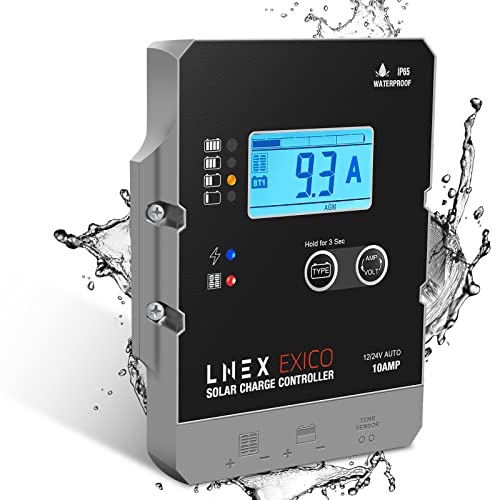
The LNEX Solar Charge Controller emphasizes a slim, waterproof design and 5-stage PWM charging. It is compatible with LiFePO4, GEL, AGM, and Flooded batteries, making it a versatile option for various solar installations. The IP65 waterproof rating supports outdoor use, and the backlit LCD display plus LED indicators provide clear, at-a-glance system information. The controller includes auto memory and mode recall, which helps simplify startup after maintenance or seasonal storage.
With LiFePO4 support, LNEX’s controller benefits users who require reliable daytime charging in variable weather. The compact form factor helps fit into tight spaces behind panels or in hidden compartments, and the rugged build supports outdoor exposure. Because it uses PWM, it may not extract every last watt under high-irradiance conditions compared to MPPT, but it delivers stable charging suitable for many residential or recreational LiFePO4 systems.
Consider this model when you need a durable, space-efficient controller that remains straightforward for installers who value a simple visual readout and dependable performance in environments with rain, sun, and temperature swings.
ECO-WORTHY 30A Bluetooth PWM

The ECO-WORTHY 30A PWM controller features Bluetooth connectivity for remote monitoring and configuration. It supports 12V and 24V systems and is widely compatible with LiFePO4, GEL, Flooded, and SLD/GEL battery types. The Bluetooth functionality enables users to review charging data, set presets, and monitor performance via a mobile device, which is particularly helpful for distant installations or multi-battery setups. The controller offers a range of preset modes and a customizable CUS mode for tailored charging profiles.
From a LiFePO4 perspective, the controller provides a stable charging regime with smart protection against overcharging and short circuits. The Bluetooth app reduces the need for direct access to the unit during adjustments, simplifying maintenance for remote solar rigs. While MPPT typically yields higher efficiency, PWM with solid protections and LiFePO4 compatibility makes this a practical choice for mid-sized systems where budget and simplicity are priorities.
Ideal use cases include cabins, RVs, and boats where a user-friendly interface and app-based monitoring improve day-to-day operation and troubleshooting of LiFePO4-powered solar solutions.
OXSUN MPPT Solar Charge Controller

The OXSUN MPPT controller targets higher efficiency with maximum power point tracking, delivering improved charging performance for LiFePO4, GEL, and AGM batteries. It includes USB and Type-C output ports for charging mobile devices directly from the solar array, which can be convenient for remote cabins or off-grid setups. The unit is designed for 12V battery systems, and it requires the battery to be connected before the solar panel to ensure proper sequencing and polarity safety.
For LiFePO4 users, the MPPT approach can achieve greater energy harvest in fluctuating light conditions, translating into shorter charging times and more reliable energy storage. The compact size and USB outputs add versatility, enabling direct device charging while maintaining proper battery care. Installation notes emphasize correct polarity and adherence to system voltage limits to maximize safety and performance.
Use this controller when your LiFePO4 installation benefits from higher efficiency, longer battery life, and convenient USB/Type-C charging alongside traditional battery management tasks.
Buying Guide: LiFePO4 Controller Considerations
- Technology: PWM vs MPPT. MPPT controllers extract more energy, especially in colder or lower-irradiance conditions, but tend to cost more. PWM controllers are often sufficient for smaller solar arrays or when budget is a priority.
- Voltage and current rating. Ensure the controller’s input and output voltage/current match your battery bank (commonly 12V, 24V; amp ratings from 8A to 30A or more).
- Battery compatibility. Confirm LiFePO4 support and confirm compatibility with other chemistries you may use (Gel, Flooded, AGM) to keep a single controller across multiple systems.
- Safety features. Look for protection against reverse polarity, overcharge, overcurrent, short circuit, and battery temperature (where applicable). A robust protection suite extends LiFePO4 battery life and improves reliability.
- Protection and durability. IP ratings (waterproofing), enclosure material, and mounting compatibility matter for outdoor installations on boats, RVs, or sheds.
- Monitoring and control. LED indicators, LCD displays, Bluetooth apps, and USB/Type-C outputs can simplify operation and device charging in remote locations.
- Ease of installation. Check size, mounting options, and whether the unit ships with mounting hardware, temperature sensors, or DIN-rail compatibility for tighter spaces.
- Future scalability. If you anticipate expanding your solar array or battery capacity, select a controller with a higher amperage rating or clear upgrade paths.
In selecting a LiFePO4-compatible solar charge controller, consider how often you access the system, the environment it operates in, and whether you prioritize monitoring, compactness, or energy harvest optimization. The five controllers above provide a range of PWM and MPPT capabilities, enabling reliable LiFePO4 charging across different off-grid scenarios.