Best Deep Cycle Battery for Solar Storage: Top 5 Picks for Off-Grid Power
Choosing the right deep cycle battery is essential for reliable solar power, RV setups, cabins, and off-grid projects. This guide highlights five top options across AGM and LiFePO4 chemistries, focusing on capacity, safety, longevity, and maintenance needs. Each pick balances performance with practicality for American homes, cabins, and mobile setups.
| Product | Chemistry | Capacity | Why It Shines |
|---|---|---|---|
| Weize Deep Cycle AGM 12V 100Ah | AGM | 100 Ah | Maintenance-free with low self-discharge; solid for RVs and solar banks. |
| Renogy Deep Cycle AGM 12V 100Ah | AGM | 100 Ah | Trusted safety and compatibility; widely used in off-grid systems. |
| Interstate Batteries 12V 110Ah SLA/AGM | AGM/SLA | 110 Ah | Long, dependable cycle life with universal fit options. |
| GRNOE 2-Pack 12V 100Ah LiFePO4 | LiFePO4 | 100 Ah per battery | Low weight, long lifespan, built-in 100A BMS; scalable in packs. |
| Rvpozwer 12V 100Ah LiFePO4 | LiFePO4 | 100 Ah | High cycle life and robust BMS protection; expandable in series/parallel. |
Weize Deep Cycle AGM 12V 100Ah Battery
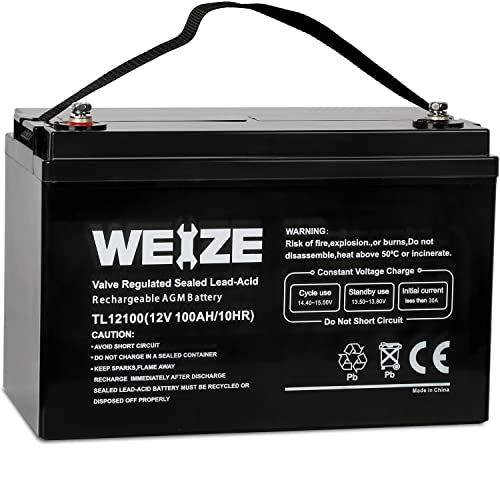
The Weize AGM 12V 100Ah battery is a sealed lead-acid option designed for maintenance-free operation. Its AGM separator technology minimizes acid leakage and supports durable performance in RVs, solar systems, trolling motors, and camping gear. Operating temperature ranges from -10°C to 50°C, with a recommended 25°C, and it features a strong 5-second max discharge current up to 1100A. Lower self-discharge (1–3% per month) helps with long storage between charging cycles, provided temperatures stay within the suitable range.
Renogy Deep Cycle AGM 12V 100Ah Battery

Renogy’s 12V 100Ah AGM battery is a safety-focused, maintenance-free option with strong discharge capabilities. Renogy emphasizes broad compatibility for series and parallel connections—useful for larger solar banks. The sealed design minimizes leaks and reduces maintenance needs, making it a practical choice for RVs, cabins, and off-grid systems where safety and reliability matter most.
GRNOE 2-Pack 12V 100Ah LiFePO4

This GRNOE LiFePO4 kit includes two 12V 100Ah batteries with a built-in 100A BMS and low-temperature protection. LiFePO4 chemistry offers higher energy density, lighter weight, and a longer life than AGM lead-acid, with cycles well into the thousands. The BMS guards against overcharge, over-discharge, overcurrent, and short circuits, and the batteries are suitable for RVs, camps, and solar storage. Note the heavier weight-per-pack when ordering two units and verify charging voltages for optimal performance.
Rvpozwer 12V 100Ah LiFePO4 Battery

Rvpozwer’s LiFePO4 battery emphasizes longevity with a stated 15-year lifespan and up to 15,000 cycles at 60% depth of discharge. A 120A smart BMS provides comprehensive protection, including overcharge, over-discharge, and short-circuit safeguards. The pack is designed for expanding power systems, including RVs, trolling motors, marine applications, solar setups, and off-grid homes. It supports series and parallel configurations to tailor capacity for specific needs.
Interstate Batteries 12V 110Ah SLA/AGM

Interstate Batteries’ DCM0100 lineup targets professional-grade deep cycle performance with AGM/SLA technology. The 110Ah capacity offers substantial energy storage for solar banks, camping setups, and RVs. Its popularity stems from a blend of durability, availability, and a familiar automotive-grade reliability, making it a dependable choice for long-term off-grid use and replacing older AGM units.
100Ah LiFePO4 Battery With Built-In 100A BMS

This 100Ah LiFePO4 option features a built-in 100A BMS, low-temperature protection, and the typical LiFePO4 advantages: lighter weight, longer cycle life, and higher energy density. It’s suitable for RVs, solar storage, boats, and home energy systems where a compact, maintenance-light lithium solution is preferred. The recommended charging parameters emphasize a 14.6V charge voltage and careful monitoring in cold environments.
Buying Guide: Deep Cycle Battery For Solar
- Chemistry choice: AGM batteries offer lower upfront cost and maintenance-free operation, while LiFePO4 provides longer life, lighter weight, and higher safety margins. For larger solar banks or mobile setups, LiFePO4 often provides better long-term value.
- Capacity needs: Calculate daily energy use and essential loads. 100Ah at 12V yields roughly 1,200Wh; however, real-world usable capacity varies with discharge depth and temperature. For off-grid homes, consider bigger packs or parallel configurations.
- Cycle life and longevity: LiFePO4 typically offers thousands to tens of thousands of cycles, while AGM can provide several hundred to a few thousand depending on usage. In cold climates, LiFePO4 plus a robust BMS is advantageous.
- Protection and safety: A built-in BMS in LiFePO4 batteries guards against overcharge, over-discharge, over-current, and short circuits. AGM/VRLA designs emphasize sealed construction and spill resistance, but require proper charging to maximize lifespan.
- Temperature considerations: Charging and discharging temperatures impact performance. Look for batteries with rated operating ranges suitable for your region. Consider indoor storage or insulated enclosures for extreme climates.
- Charging compatibility: Ensure your solar charge controller and inverter can handle the chosen chemistry. LiFePO4 systems often require precise charging voltages, while AGM systems are generally more flexible.
- Maintenance needs: AGM batteries are largely maintenance-free beyond periodic checks, whereas LiFePO4 requires monitoring of BMS status and occasional balancing in multi-battery setups.
- Weight and space: LiFePO4 cells are significantly lighter for the same capacity, enabling easier installation in tight spaces. AGM units tend to be heavier but often come in cost-effective packages.
When selecting a deep cycle battery for solar, consider the balance between upfront cost, long-term lifespan, system size, and the environmental conditions where the system will operate. The five options above span common solar use cases—from portable RV setups to fixed off-grid cabins—providing reliable energy storage across different chemistries and installation needs.