Best 24 Amp EV Charger for Home Use: Top Picks for 2026
The search for a 24 amp Level 2 EV charger that fits a typical American home often comes down to compatibility, ease of use, and flexibility. This guide highlights five dependable options designed to deliver up to 24A at 240V, with varying plug types and connector standards to fit most non-Tesla and Tesla-compatible vehicles. Each charger emphasizes plug‑and‑play setup, adjustable current, and the ability to use common dryer outlets in many homes. Read on to compare features, installation considerations, and performance assumptions to choose the right charger for your driveway or garage.
| Product | Brand | Plug Type | Connector | Key Benefit |
|---|---|---|---|---|
| SEGUMA NEMA 14-30 Level 2 Charger | SEGUMA | NEMA 14-30 | J1772 | Wide compatibility with standard dryer outlet and multiple EVs |
| EVDANCE Level 2 EV Charger | EVDANCE | NEMA 14-30P | J1772 | Long cable reach and smart current adjustments |
| EVDANCE Level 2 EV Charger (NEMA 10-30) | EVDANCE | NEMA 10-30P | J1772 | Alternative outlet type for older homes |
| SEGUMA NEMA 10-30 Level 2 | SEGUMA | NEMA 10-30 | J1772 | Flexible current settings for older circuits |
| GODIAG Level 2 EV Charger | GODIAG | Various (multi-amp) | J1772 | Smart app with real‑time monitoring |
SEGUMA NEMA 14-30 Level 2 Charger – 24A

The SEGUMA 24A Level 2 charger uses a NEMA 14-30 dryer outlet for 240V charging with a J1772 connector. It offers adjustable current settings (10A, 16A, 20A, 24A) to match household circuit capacity and minimize overload risk. The unit supports 5.76kW charging and provides roughly 15-20 miles of range per hour of charging under ideal conditions. It is designed for garages or laundry areas, with compatibility across a broad range of J1772-equipped EVs. Tesla owners may require a J1772-to-Tesla adapter (sold separately).
Key features include plug-and-charge simplicity via a standard dryer outlet and a familiar J1772 interface, enabling broad vehicle compatibility without specialized wiring. Consider whether your home’s dryer outlet is comfortably accessible and if 24A fits your electrical panel capacity to ensure safe operation.
EVDANCE Level 2 EV Charger 24A – 25FT
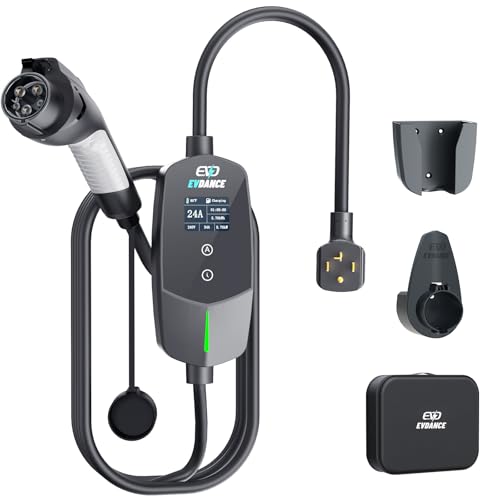
The EVDANCE Level 2 charger provides 24A at 240V with a 25-foot cable, enabling charging progress around 15-20 mph for many EVs when connected to a dryer outlet. Its plug-and-charge setup uses a NEMA 14-30P plug (240V/24A). The unit keeps you within a practical range of outlets and typically avoids need for electrical upgrades. It supports J1772 compatibility for most non-Tesla EVs, while Tesla owners would need a J1772-to-Tesla adapter. The display shows real-time charging metrics and adjustable current to fit your home circuit.
Consider the reach of the 25-foot cable and whether your parking spot aligns with a dryer outlet. The charger’s smart features help you monitor and manage charging times to save energy costs.
EVDANCE Level 2 EV Charger (NEMA 10-30) – 24A

This variant uses a NEMA 10-30 plug, making it compatible with older 240V dryer outlets common in many homes. It delivers up to 24A at 240V and provides a similar 15-20 mph charging rate under optimal conditions as other Level 2 units. It uses a J1772 connector and supports the same broad non-Tesla EV compatibility, with Tesla charging requiring the standard adapter. The cable length and the 25-foot reach are designed to accommodate flexible parking locations inside the garage or driveway.
Users should evaluate their outlet type and circuit capacity to set a safe current level (10A–24A) that avoids overloading shared circuits while delivering meaningful charging improvements over Level 1.
SEGUMA NEMA 10-30 Level 2 Charger – 24A

This SEGUMA charger uses a NEMA 10-30 dryer outlet with adjustable current (10A, 12A, 16A, 20A, 24A) for Level 2 charging at 240V. The J1772 connector ensures broad EV compatibility, including popular non-Tesla models. It emphasizes plug‑and‑play installation in garages or laundry rooms. The 24A setting delivers faster charging than Level 1 while accommodating older wiring by lowering the amperage when needed. Tesla drivers will require a J1772 adapter unless a direct Tesla-compatible port is included.
When selecting this unit, examine your home’s outlet type, the distance to the parking area, and whether an on-site upgrade is needed for longer-term reliability and safety in 240V circuits.
Buying Guide: Key Considerations For 24A Level 2 Chargers
- Outlet compatibility: Choose between NEMA 14-30 and NEMA 10-30 based on your dryer outlet type. NEMA 14-30 commonly supports four-prong outlets, while NEMA 10-30 is a three-prong option found in some homes.
- Current adjustability: Look for units with 10A–24A selectable ranges. This helps tailor charging to your circuit capacity and minimizes risk of tripping breakers or overheating.
- Connector compatibility: Most non-Tesla EVs use SAE J1772. Tesla vehicles may require a J1772-to-Tesla adapter unless the charger supports NACS/Tesla-specific interfaces directly.
- Cable length and reach: A longer cable (e.g., 25 ft) provides flexibility for parking farther from outlets, but ensure the weight and handling are manageable for daily use.
- Smart features: Some models include LCD/LED displays and mobile app control for real-time status, voltage, current, timing, and safety alerts. These can help optimize charging times and energy costs.
- Installation considerations: Most of these units are plug-and-play but verify that your home’s electrical panel can safely handle the 24A load. If in doubt, consult a licensed electrician before wiring changes or upgrades.
- Future readiness: Some chargers advertise compatibility with upcoming EV standards (like North American adapters or NACS integration). Consider long-term needs if you expect vehicle changes in the household.
- Portability: If you plan to move or need temporary charging in different locations, portable Level 2 units with standard dryer outlets can be advantageous.
In summary, a 24A Level 2 charger with a flexible outlet and adaptive current settings offers meaningful gains over Level 1 charging for many American EV owners. Ensure outlet compatibility, circuit capacity, and vehicle support align with your daily driving patterns for optimal results.