Best 4 Car Speakers: Top 5 Picks for Clear, Balanced Car Audio
Elevate your car’s sound with four-inch and six-and-a-half-inch speaker options that deliver clear highs, robust mids, and punchy bass. Below are five highly-rated 4-inch and near-4-inch (or compatible) car speaker pairs that pair well with a variety of factory audio setups. Each entry highlights power handling, design, and frequency response to help you compare for OEM power and aftermarket upgrades.
Summary table of selected products:
| Product | Brand | Impedance | Max Power | |
|---|---|---|---|---|
| Pioneer F-Series TS-F1035R | PIONEER | 4Ω | 150W | 2-Way Coaxial |
| Pioneer G-Series TS-G4620S | PIONEER | 4Ω | 210W | 2-Way |
| Pyle PL42BL | Pyle | 4Ω | 180W | 2-Way |
| Kenwood KFC-1066S | Kenwood | 4Ω | 210W | 2-Way |
| PIONEER TS-A1681F | PIONEER | 4Ω | 350W | 4-Way |
Pioneer F-Series TS-F1035R 4” 2-Way Speakers (Pair)

Pioneer’s F-Series TS-F1035R delivers a compact 4-inch coaxial solution designed for OEM power and ease of installation. With a 4-ohm impedance and 150W maximum power (20W nominal), these speakers balance style with reliable, distortion-free sound at higher volumes. The 2-way coaxial design integrates a woofer and a tweeter for a coherent audio image, ensuring that core frequencies remain clear across a broad listening range. A sensitivity rating around 86dB helps preserve clarity even when the vehicle’s head unit isn’t pushing massive watts.
Pioneer G-Series TS-G4620S 4” x 6” 2-Way Speakers

This 4” x 6” pair from Pioneer uses a 2-way design with separate drivers to reproduce different frequency bands more accurately. It handles up to 210W peak and 30W continuous, delivering clear highs and solid bass through a responsive system. The wide frequency response (35 Hz to 22 kHz) supports genres from bass-heavy tracks to shimmering cymbals, making it a versatile upgrade for factory setups lacking in detail or dynamism.
Pyle 4″ Car Sound Speaker PL42BL (Pair)

Pyle’s PL42BL pair features a blue poly injection cone and 4-ohm impedance, optimized for contemporary car electrical systems. The 110 Hz to 20 kHz frequency response supports a bright, detailed high end with midrange emphasis. The 1/2″ neodymium film dome tweeter adds crisp top-end extension, while the 3/4″ ASV voice coil improves high-temperature handling and efficiency for longer listening sessions.
Kenwood KFC-1066S 4″ 2-Way Speakers
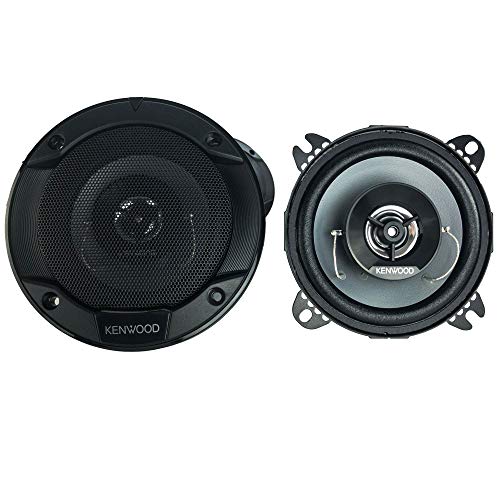
Kenwood’s KFC-1066S is a compact 4-inch pair with a 4-ohm impedance and 210W peak power. The 1-inch balanced dome tweeter supports clear highs, while the overall design aims to deliver a balanced, articulate sound suitable for OEM power environments. It’s a practical upgrade when aiming to preserve cabin space while adding audible detail across listening levels.
PIONEER A-Series Plus TS-A1681F 6.5” 4-Way Speakers

The TS-A1681F belongs to Pioneer’s A-Series Plus with a 6.5” footprint, expanding the scope beyond 4 inches while still fitting many factory openings. This 4-way design uses independent drivers to reproduce a broad frequency spectrum, enhancing clarity across instruments and vocals. With a peak of 350W and continuous power of 80W, these speakers deliver consistent performance and a broad frequency response from 35 Hz to 29 kHz, making them a compelling upgrade for users seeking a step up from stock audio without major wiring changes.
Buying Guide: Key Purchase Considerations
When selecting car speakers for a best-in-class upgrade, consider these factors to align performance with vehicle electronics and listening preferences.
- Speaker Size and Fit: Measure mounting depth and diameter to ensure compatibility with factory locations. Coaxial 2-way designs save space and simplify installation, while 4-way systems offer wider frequency coverage.
- Impedance and Power Handling: Most aftermarket car speakers use 4-ohm impedance, which matches common head units. Check peak and continuous (RMS) power ratings to avoid distortion or component stress when paired with an amplifier or high-output head unit.
- Frequency Response: A wider range supports more musical detail. Look for models with strong bass extension in the lower end and clear highs in the upper ranges to avoid harsh treble or muddy midrange.
- Design and Materials: Polypropylene cones and PEI tweeters balance durability and sound quality. Neodymium components contribute to lighter, more efficient drivers, improving transient response.
- Installation Accessories: Some packages include installation adapters and mounting hardware, which can reduce install time and ensure a cleaner integration with OEM dashboards.
- Vehicle Use and Music Style: If you primarily listen to rock or electronic music, prioritize speakers with stronger high-end response and dynamic range. For acoustic or jazz, emphasis on midrange clarity and soundstage width is beneficial.
- System Integration: If you plan to add an amplifier, ensure the speakers can handle the extra power without distortion. If you’re sticking with the factory head unit, prioritize efficiency and sensitivity to maximize loudness with limited wattage.
Additional Considerations And Perspectives
Sound quality is subjective and influenced by cabin acoustics, door configurations, and vehicle noise levels. Coaxial designs generally offer easier installation and broader compatibility with factory wiring. For enthusiasts seeking deeper bass without a separate subwoofer, consider 4-way or 6.5” configurations with increased cone area and dedicated midrange drivers. If space is constrained, prioritize models with a smaller mounting depth and robust magnet structures to sustain performance under varied driving conditions. Always match speaker quality with your head unit or amplifier to preserve linearity and minimize distortion at higher volumes.