Best Accurate Tire Pressure Gauge: Shop-Grade Readouts for Every Vehicle
Choosing an accurate tire pressure gauge helps optimize safety, fuel efficiency, and tire life. This article highlights five top options that deliver professional-grade readings, reliable performance, and durable construction. Each model is evaluated on accuracy, range, usability, and build quality to help American drivers pick the right tool for cars, trucks, motorcycles, and more.
| Product | Brand | Max Range | Key Benefit |
|---|---|---|---|
| JACO ElitePro Digital Tire Pressure Gauge – 100 PSI | JACO Superior Products | 0-100 PSI | Shop-grade accuracy with dual sensors |
| ETENWOLF T300 Digital Tire Pressure Gauge | ETENWOLF | 3-200 PSI | Wide range with thermal compensation |
| AstroAI Tire Pressure Gauge Digital | AstroAI | 0-150 PSI | Illuminated nozzle and backlit display |
| JACO ElitePro Digital Tire Pressure Gauge – 200 PSI | JACO Superior Products | 0-200 PSI | High-capacity, durable, with quick bleed |
| Rhino USA Heavy Duty Tire Pressure Gauge | Rhino USA | 0-60 PSI | Large glow dial and robust brass build |
JACO ElitePro Digital Tire Pressure Gauge – 100 PSI
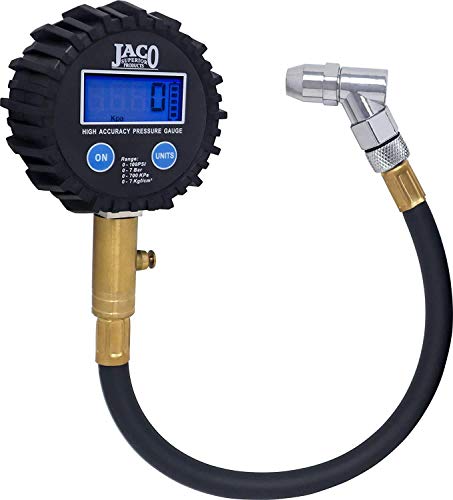
The JACO ElitePro 100 PSI model emphasizes pro-grade accuracy with dual pressure sensors certified to ANSI 2A standards, delivering readings with a ±0.50% full-scale precision and 0.10 PSI resolution. Built from solid brass and steel, it includes a 10″ HybridFlex hose and a 360-degree swivel air chuck for easy access from any angle. A built-in air bleeder valve allows real-time pressure relief, making it ideal for cars, trucks, motorcycles, bikes, RVs, and trailers. Readings lock onto the display until you reset, ensuring stable measurements during inflation or deflation tasks.
ETENWOLF T300 Digital Tire Pressure Gauge

The ETENWOLF T300 offers a broad 3-200 PSI range with ANSI B40.7 Grade 2APlus-Minus 0.5% accuracy. Its manual calibration reinforces reliability, and the device features a temperature-compensating AI chip to maintain accuracy in extreme climates (-4°F to 130°F). A replaceable battery keeps service simple, while the device is engineered for use across cars, trucks, motorcycles, and bikes. Note that the Presta valve adapter is not included and if used for bicycles, it must be purchased separately.
AstroAI Tire Pressure Gauge Digital 0-150 PSI

AstroAI’s digital gauge provides rapid measurements with ±1 PSI precision and a backlit LCD display for visibility in low light. It features a 0-150 PSI range and four units (PSI, Bar, Kgf/cm2, and kPa), with a 360-degree swivel chuck and an illuminated nozzle to simplify valve alignment. The device is calibrated with professional-grade tools for accuracy and compact enough to carry in a glovebox. Its robust electronics ensure consistent performance across typical driving conditions and emergencies on the road.
JACO ElitePro Digital Tire Pressure Gauge – 200 PSI

This ElitePro model expands the range to 200 PSI while maintaining professional ANSI 2A accuracy with dual sensors and a 0.10 PSI resolution. The same rugged construction carries through: solid brass and steel internals, a shock-resistant guard, and a 10″ HybridFlex hose with a 360-degree swivel chuck. It adds a built-in air bleeder valve for precise deflation and quick pressure adjustments. The display locks readings until reset, ensuring stable measurements during tire inflation and maintenance workflows, suitable for higher-pressure tires and off-road needs.
Rhino USA Heavy Duty Tire Pressure Gauge (0-60 PSI)

The Rhino USA gauge emphasizes simplicity and durability with a large 2-inch glow dial for easy readability, a solid brass construction, and a robust braided hose. It includes an integrated deflator valve to help fine-tune tire pressure for off-road traction or precise inflation. Although it operates within a lower 0-60 PSI range, its dependable ANSI B40.1 certification and 360-degree swivel head make it a reliable choice for everyday driving, especially on vehicles with lower tire pressures or compact cars where quick checks are common.
Buying Guide: Key Purchase Considerations
When selecting an accurate tire pressure gauge, several factors influence long-term value and reliability:
- Accuracy standards: Look for gauges calibrated to ANSI/B40.1 standards and a published accuracy figure (for example, ±0.5% FS or ±1.5%). Dual sensors can improve reliability by cross-checking readings.
- Pressure range: Choose a range that matches your typical tires. Vehicles with higher-performance tires may benefit from gauges that reach 150-200 PSI, while everyday cars can suffice with 0-60 or 0-100 PSI.
- Display and readability: A backlit LCD or large dial improves visibility in dim conditions or at night. Consider a glow dial for quick reads without lighting.
- Deflation controls: Built-in bleeder or deflator valves enable precise adjustment without repeatedly inflating and deflating the tire.
- Hose and chuck design: A flexible, leak-proof hose and a 360-degree swivel chuck simplify accessing the valve from any angle and reduce user fatigue during repeated checks.
- Durability: Solid materials (brass, steel) and protective guards help withstand drops and rough handling in garages or trunks.
- Power and maintenance: Battery-powered digital gauges offer advanced features, but ensure they’re easy to replace or service. Analog pencil gauges eliminate battery concerns but may lack certain conveniences.
- Unit versatility: Gauges with multiple units (PSI, Bar, kPa) enable easy compatibility with different regions and user preferences.
- Portability: Compact designs fit in a glovebox or tool kit, which is useful for frequent travelers and roadside emergencies.
- Included accessories: Look for extra nozzles, Presta adapters, or caps that extend compatibility across bikes and various tire valves.
Across these selections, the common thread is reliability and ease of use: gauges with durable construction, precise readings, and practical deflation options help keep tires properly inflated, improving safety and fuel economy. For motorists who value speed, a digital model with backlit display and a quick-read feature can significantly cut check time on busy days. For DIY enthusiasts, a robust mechanical gauge with a large dial may be preferred for tactile feedback and straightforward operation.