Best Garage Chargers for Electric Cars in 2026
Choosing the right home charging solution is essential for convenient, efficient, and safe EV ownership. The following selections focus on Level 2 home chargers and compatible portable options that fit a typical residential garage setup in the United States. Each charger supports common SAE J1772 connectors, multiple charging speeds, and practical features like smart apps, weatherproof enclosures, and longer cords for flexibility. Read on to compare five top options and find the best garage charger for your electric car.
| Product | Brand | Key Feature | Cable Length |
|---|---|---|---|
| Raylix 16A Level 2 EV Charger | Raylix | Adjustable current with delay charging; built-in display | 21 ft |
| ChargePoint HomeFlex Level 2 EV Charger | ChargePoint | Smart app control; broad network access | — |
| Autel Home Smart EV Charger | Autel | Up to 12 kW, weatherproof; indoor/outdoor use | 25 ft |
| ELEGRP Level 1/2 EV Charger | ELEGRP | Dual 16A/120V-240V operation; IP67 weatherproof | 25 ft |
| Lectron Level 2 EV Charger | Lectron | High amperage up to 40A; NEMA 14-50 plug | 16 ft |
Raylix 16A Level 2 EV Charger
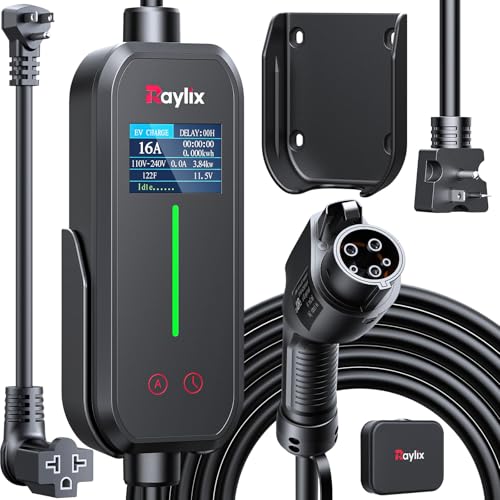
The Raylix charger emphasizes user-friendly operation with a built-in display to monitor charging status and current settings at a glance. It is compatible with all SAE J1772-equipped EVs and plug-in hybrids, making it a versatile option for households with multiple vehicles or visiting guests. Its adjustable current (16A or 12A in some conditions) and a delayed charging feature allow off-peak scheduling and safer operation on different outlets. The 21-foot cable offers flexible placement in most garages, reducing the need to move vehicles for access to the outlet.
ChargePoint HomeFlex Level 2 EV Charger

ChargePoint delivers a robust home charging solution with a focus on connectivity and network access. The HomeFlex supports Level 2 charging and is paired with the ChargePoint mobile app, enabling reminders, smart home integration, and charging data tracking. Its expansive network reach—thousands of charging locations across North America and Europe—adds value for homeowners who travel often or require confidence that charging options are widely available. WiFi or cellular connectivity is used for features, with some functionalities requiring a network connection for troubleshooting.
Autel Home Smart EV Charger

Autel’s MaxiCharger AC Home emphasizes safety and weather resilience, offering up to 50A charging for rapid energy transfer. The unit is designed for both indoor and outdoor operation with a NEMA 4 rating, providing protection in adverse weather conditions. It includes features such as over-current, over-voltage, and over-temperature protection, plus a durable 25-foot cable suited to garages with space to maneuver and park vehicles. The charger is positioned as a premium option for homeowners who want dependable performance in a variety of climates.
ELEGRP Level 1/2 EV Charger

ELEGRP combines Level 1 and Level 2 charging in one portable unit with a 25-foot cable and adapters for NEMA 6-20 and 5-15 outlets. The charger adopts PBE (protective balanced electronics) and LCR technologies to deliver reliable performance, cooler operation, and stable charging speed. Its IP67 rating makes it suitable for both indoor garages and protected outdoor spaces. The flexibility to switch between 120V and 240V use makes this charger a practical choice for renters or homeowners who value portability and broad compatibility.
Lectron Level 2 EV Charger

Lectron offers a Level 2 charger with up to 40A input and a NEMA 14-50 plug, making it compatible with high-power 240V outlets commonly found in American garages. The charger emphasizes portability and rapid charging, supporting a 16-foot extension cord and J1772 compatibility for broad EV support. With ETL certification and IP65 dust and water resistance, it is designed for reliability in both indoor garages and more exposed outdoor environments. Its straightforward design appeals to users who want strong performance without complex setup.
Buying Guide: Key Purchase Considerations For Home EV Charging
- Charging Speed and Power: Level 2 chargers typically offer 16–40A, translating to roughly 3–9 kW of power. Choose a unit that matches your vehicle’s onboard charging rate and your electrical panel capacity. If future-proofing, consider chargers with higher amperage options or adjustable current.
- Compatibility and Connectors: Ensure the charger uses the SAE J1772 connector, which covers most American EVs and plug-in hybrids. If you drive a Tesla, confirm whether an adapter is compatible or included.
- Smart Features and Apps: Many modern chargers offer mobile apps with charging reminders, scheduling, and energy usage insights. Check WiFi or cellular requirements and data access policies. Consider whether you want networked charging for home energy management.
- Installation and Wiring: Some units are hardwired, while others use a NEMA 14-50 or 6-20 plug. Hardwired installations may require an electrical upgrade; portable models offer easier installation but may limit peak charging rate.
- Weather Resistance and Durability: For outdoor garages or carports, look for IP ratings (IP65, IP67) and NEMA 4 enclosure ratings. Robust build quality helps with long-term reliability in varying climates.
- Cable Length and Handling: A longer cable provides flexibility in arranging charging spots but adds weight and potential wear. A swivel or wall-hold option can reduce clutter and trip hazards in tight garages.
- Security and Safety Certifications: Look for ETL, UL, or equivalent safety certifications. Features like overcurrent protection, leakage protection, and temperature monitoring improve long-term safety.
- Network Access and Roaming: If you travel or share charging with guests, a charger connected to a broader network may be beneficial. Consider data privacy, roaming rates, and customer support.
- Cost of Ownership: Balance upfront price with features, warranty length, and potential rebates or incentives. Federal or local rebates could affect total ownership cost.
Overall, the ideal garage charger balances charging speed with safety, ease of use, and compatibility with your home electrical system. Homeowners may prioritize a unit with robust app features for scheduled charging, while others may favor a high-amperage, weatherproof model for frequent outdoor use. When evaluating options, consider your typical daily driving distance, the time you can dedicate to charging, and potential future vehicle purchases.