Best Car Audio Crossovers for Clear, Balanced Sound
Choosing the right car audio crossover helps your speakers perform at their best, delivering crisp highs, warm mids, and solid bass without distortion. This guide highlights top crossovers available on Amazon, covering compact units, multi‑channel processors, and pro‑level options. Each pick balances ease of installation with adjustable filters to fine‑tune your system. Read on to compare features, connectivity, and performance across five standout models.
| Product | Brand | Type | Key Benefit |
|---|---|---|---|
| Taramps Crx4 Electronic 4 Way Crossover | Taramp’s | 4‑channel electronic crossover | Compact, customizable sound adjustments |
| PRV Audio EX3.5 | PRV AUDIO | 2/3/4 RCA input, 6 outputs | Flexible 2–4 channel routing, precise filters |
| Pyle 2‑Way Electronic Crossover | Pyle | 2‑way electronic crossover | Simple, compact, LED indicator |
| Skar Audio SKEC23 | Skar Audio | 3‑way electronic crossover | Six channels, front/rear/sub integration |
| Recoil CRX‑PRO 5‑Way | RECOIL | 5‑way electronic crossover | Pro‑level signal processing, subsonic control |
These products span budget to pro grade, offering different channel counts, input/output configurations, and tuning capabilities. Consider the size of your vehicle, the number of speakers, and whether you need subwoofer control or pass‑through options when making a choice. The following sections summarize each model’s strengths and what to expect in real‑world use.
Taramp’s Crx4 4‑Way Crossover

The Taramp’s Crx4 is a compact 4‑channel electronic crossover designed for car audio processors and stereo equalizers. It offers customizable sound adjustments across channels, allowing tailored high‑pass and low‑pass filtering. This unit suits riders seeking a balance between space‑saving design and flexible tone shaping, with straightforward wiring and a focus on preserving signal integrity in compact installations.
PRV Audio EX3.5 Crossover
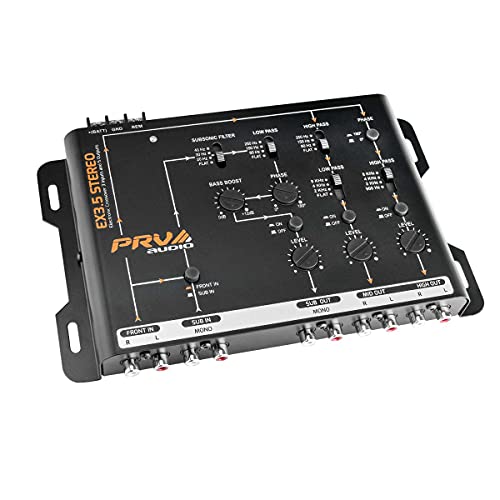
The PRV EX3.5 provides flexible 2/4 input configurations with multiple outputs, making it adaptable for 2‑ or 3‑way systems. It features 3‑way high/low pass filters, per‑channel output level control, and a bass boost option on the sub output. This model is ideal for enthusiasts who want precise tonal control and the ability to adapt the crossover layout as their system evolves.
Pyle 2‑Way Electronic Crossover

The Pyle crossover focuses on two‑way separation with clear high‑pass and low‑pass filtering. It includes four RCA outputs and two inputs, along with a remote subwoofer control option. Its compact footprint and built‑in LED indicator help installers verify operation quickly, making it a practical choice for aftermarket upgrades without excessive complexity.
Skar Audio SKEC23 3‑Way Crossover

The Skar Audio SKEC23 delivers a robust 3‑way electronic crossover with six channels, simplifying front, rear, and subwoofer signal routing. It outputs up to 5V max per channel, supporting clean, dynamic sound across a multi‑speaker setup. The unit is well‑suited for users building a more involved system without sacrificing signal clarity.
Recoil CRX‑PRO 5‑Way Crossover

The Recoil CRX‑PRO is a pro‑level 5‑way electronic crossover featuring precise frequency splitting across five bands, a subsonic filter, bass boost, and a phase control option. With ultra‑low THD and high crosstalk rejection, this unit is designed for audiophile‑leaning installations in vehicles where signal integrity and deep bass response are priorities.
Buying Guide: Key Purchase Considerations
- Channel count and routing: Determine how many speakers you have (two‑way, three‑way, or more) and choose a crossover that supports the needed inputs/outputs and a logical signal path (front, rear, sub).
- Filter types and ranges: Look for adjustable high‑pass and low‑pass filters, slope options (12dB, 24dB per octave), and a sub boost or bass control if you have a subwoofer in the system.
- Power handling and headroom: Ensure the crossover’s output range matches your amp’s capabilities to avoid clipping while preserving dynamic range.
- Ease of installation: Compact form factors, clear wiring diagrams, and remote control options can simplify installation in tight dashboard spaces.
- Sound signature and use case: Pro or studio‑grade crossovers emphasize signal purity, while budget models prioritize straightforward control; decide based on your listening goals and system complexity.
- Compatibility: Check input/output configurations with your existing head unit, amps, and processors to ensure seamless integration.
- Durability and build quality: ABS or metal housings with solid connectors reduce the risk of noise pickup and wear in a vehicle environment.
When selecting a crossover, balance your current setup with potential future upgrades. A flexible 2/3/4‑way unit may save money if you plan to expand your speakers and subs, while a dedicated 5‑way processor helps achieve high‑fidelity performance in more complex systems. For most mid‑sized vehicles, a 3‑to‑4‑channel crossover paired with a capable amp offers a strong baseline for clear, well‑rounded sound across the audible spectrum.