Best Kayak Lift for Car: Top Roof Loading Solutions to Consider
Finding the right kayak lift for your vehicle can reduce strain and protect your gear. This guide reviews five strong options that help you load, lift, and secure a kayak onto a car roof with minimal effort and maximum stability. Each product is evaluated on lifting capacity, ease of use, compatibility, and safety features to help you compare at a glance.
| Product | Brand | Approx. Capacity | Notes |
|---|---|---|---|
| Tri-Grip Kayak Load Roller | HLOGREE | Up to 260 lbs | Tri-suction, vacuum pump with safety indicator |
| TOOENJOY Heavy-Duty Lift Assist | TOOENJOY | Up to 100 lbs | Smart-Lift mechanism, crossbar compatibility |
| Kayak Hoist by RAD Sportz | RAD Sportz | Up to 125 lbs | Overhead garage pulley system |
| Codinter Kayak Roller | Codinter | Up to 220 lbs | Rubber roller, flexible installation |
| Thule Hullavator Pro | Thule | 40 lbs assist | Waist-high loading, lift-assist |
The selections above address a range of vehicle setups—from compact sedans to larger SUVs—and a variety of roof rack configurations. Consider how often you transport a kayak, the height of your garage, and whether you prefer manual or assisted lifting features when choosing the best option for your needs.
Tri-Grip Kayak Load Roller By HLOGREE

The HLOGREE Tri-Grip model features a three-suction cup arrangement forming a stable triangular base, designed to support up to 260 lbs. A vacuum pump system removes air to maximize hold, and a red line safety indicator helps verify suction strength during installation. A slight movement in the foam support accommodates installation tolerance for better fit on varied glass angles, while the third suction cup adds stabilizing support for better balance during loading. The system emphasizes secure attachment and reliable lift assistance for roof loading on SUVs and many cars.
TOOENJOY Heavy-Duty Lift Assist Roof Rack

This lift rack offers a 100 lbs maximum load capacity and an advanced Smart-Lift mechanism for easy loading of kayaks, canoes, bikes, SUPs, and more. It requires extended, adjustable crossbars (approximately 29.76 inches) for compatibility and provides an option to purchase an accessory adapter for fixed-crossbar setups. Engineered for safety, the rack employs a sturdy locking mechanism to secure cargo during transport, with the potential to pair multiple units if needed for larger payloads.
RAD Sportz Kayak Hoist

Designed for garage ceilings up to 12 feet, this overhead pulley system supports up to 125 lbs and includes a rope brake that automatically locks to help one person raise a kayak safely. Installation can be configured parallel or perpendicular to joists, and a wall cleat is provided to manage excess rope. The unit is well-suited for storing kayaks overhead, freeing up garage floor space while protecting the craft from ground-level hazards.
Codinter Kayak Roller Loader

Codinter delivers a heavy-duty aluminum bar system with two strong suction cups and a rubber roller, supporting up to 220 lbs. The design includes a gentle angle-shaking feature to adapt to various rear-window curvatures and a 360-degree rubber roller for smooth hull loading. It is compatible with most sedans and SUVs with rear windows that accommodate a semi-horizontal loading path, providing a versatile option for many common vehicle configurations.
Thule Hullavator Pro
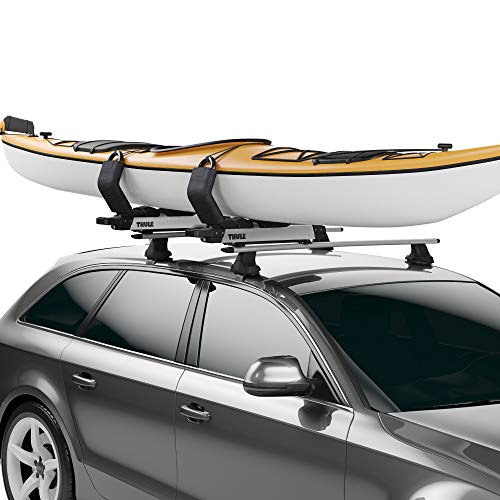
The Thule Hullavator Pro is a lift-assisted rack designed to bring kayak loading to waist height. It features gas-assisted struts and a dual-extend arm system to load or unload a kayak with reduced effort. The unit emphasizes corrosion resistance and comes with integrated tie-downs. While offering a notable convenience, the Hullavator Pro is best suited for drivers seeking premium, waist-high access with robust durability for frequent use.
Buying Guide: Key Considerations For Selecting A Kayak Lift For Your Car
- Capacity: Match the weight of your kayak (including accessories) with the lift’s maximum load. Heavy-duty options handle large kayaks, while lighter models suit recreational boats.
- Vehicle Compatibility: Check crossbar types and spacing. Some systems require adjustable crossbars or adapters for fixed setups. Roof rail width and door clearance also matter.
- Mounting Method: Suction-based rollers work best on certain glass surfaces with smooth, flush windows, while rigid rack-based lifts rely on crossbars and clamps. Consider your car’s roof and weather exposure.
- Ease Of Use: Lift-assisted models reduce manual lifting. Look for features like vacuum indicators, auto-locking ropes, or gas-assisted struts to simplify handling.
- Safety Features: Suction indicators, locking mechanisms, and redundancy in support (multiple cups or braces) reduce risk during loading and transit.
- Garage And Storage Considerations: Ceiling-mounted hoists save floor space but require ceiling height and sturdy anchoring. If garage height is limited, waist-high options can be preferable.
- Durability and Materials: Aluminum components resist corrosion; consider plastic or rubber contact surfaces to protect the hull.
- Maintenance: Regularly inspect suction cups and ropes for wear. Clean to remove debris that could reduce grip or smooth operation.
- Cost vs. Benefit: Premium lift assists offer easier loading and greater durability but at higher upfront cost. Review how often you transport kayaks to weigh value.
- Installation Complexity: Some units are ready to attach to existing racks; others require professional mounting or additional accessories. Assess your DIY comfort level.
In choosing the best kayak lift for your car, evaluate how you load your kayak most often, your garage height, and whether you prefer a manual approach or an automated assist. The right system should improve loading efficiency, protect your kayak from damage, and fit your vehicle’s roof configuration for safe, reliable transport.