Best Oscilloscopes for Car Audio: Accurate, Portable Options for Automotive Signals
Car audio enthusiasts and professional installers rely on precise signal interpretation to optimize bass, clarity, and overall system integration. The following five handheld and desktop oscilloscopes are among the top picks for car audio work, combining compact form factors with essential features like auto and manual triggers, adequate bandwidth, and user-friendly interfaces. This guide highlights their strengths and helps you choose the right tool for diagnosing and tuning audio signals on the road or in the shop.
Summary of Selected Products:
| Product | Brand | Type | Key Benefit |
|---|---|---|---|
| AUKUYEE Oscilloscope Kit | AUKUYEE | Handheld Mini Scope | Extended sensitivity and handheld convenience |
| BSIDE Handheld Digital Oscilloscope | BSIDE | Portable Scope | 3.2″ display with broad viewing angles |
| SoundQubed HDS2.2 Subwoofers | SOUND Q QUBED | Car Subwoofer | High-power bass performance for car rigs |
| 120W DC-DC Power Converter | MZHOU | Power Regulator | Stable 12V supply with automotive range |
| Additional Car Audio Scope Utility | Various | Monitoring Tools | Supports signal measurement across sources |
AUKUYEE Oscilloscope Kit: Mini Handheld Scope
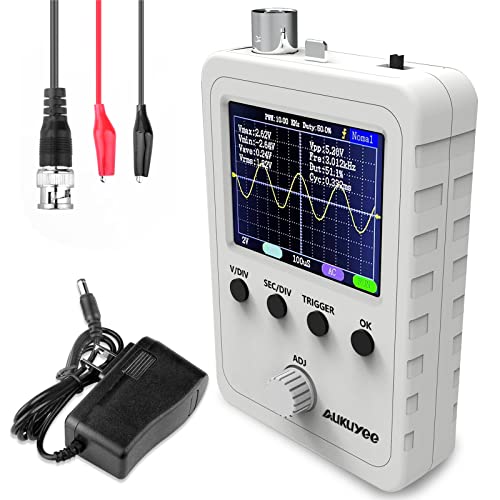
The AUKUYEE oscilloscope kit is designed for compact diagnostics and on-the-go testing. Its upgraded version features a wider sensitivity range from 5 mV/div to 20 V/div, enabling precise measurement of weak audio signals as well as larger automotive electrical outputs. The handheld design places the display and MCU on the same mainboard, reducing inter-board complexity and improving signal integrity. An integrated rotary encoder makes parameter adjustments quicker, which is especially helpful when chasing subtle waveform details in car audio systems. This tool is well-suited for checking preamp outputs, speaker outputs, and power rails during installation or troubleshooting.
BSIDE Handheld Digital Oscilloscope: 3.2” TFT Display

The BSIDE handheld oscilloscope offers a practical 3.2-inch color display with a robust 48 MSa/s sampling rate and a 10 MHz bandwidth. Its 3.2″ LCD and wide viewing angle are designed to deliver clear readings even in bright showroom lights or a sunlit workshop. The device’s trigger options—auto, normal, and single—provide flexibility for capturing transient car audio signals, such as amplifier turn-on thumps, short bursts, or speaker impedance changes. This makes it a strong option for hobbyists and technicians diagnosing car audio channels, crossovers, and signal paths.
SoundQubed HDS2.2 Series Car Subwoofer

The SoundQubed HDS2.2 is a heavy-duty car audio subwoofer line designed for high-power bass delivery. It features a 10″ driver option with a dual voice coil and impedance options that support both 2 ohm and 4 ohm configurations. This subwoofer is engineered to handle 600 watts RMS (1200 watts peak) while maintaining thermal stability under demanding listening sessions. For car audio tuners focusing on deep, musical lows, pairing an amplifier under test with this subwoofer can reveal real-world performance and stage depth in installed rigs.
120W DC-DC Power Converter: 12V Output

The 120W DC-DC power converter from MZHOU provides a reliable automotive-grade 12V output from higher input voltages in the 20-72V range, suitable for cars, trucks, and boats. It includes protection features such as over-current, short-circuit, and over-temperature safeguards, helping to safeguard sensitive audio electronics during diagnostic work. The unit’s lever-nut terminal connections simplify wiring and reduce installation time, which is helpful when setting up test benches or temporary audio installations in a vehicle. For car audio signal testing, a stable 12V reference power supply reduces measurement noise and improves oscilloscope accuracy.
Buying Guide: Key Purchase Considerations
- Bandwidth and sampling rate: For car audio work, targets typically range from 5 MHz to 50 MHz. Higher bandwidth captures fast waveform edges and transients, such as amplifier rails and clipping signals.
- Input channels and connectivity: At least one channel is essential, but dual channels can help compare reference and test signals simultaneously. Look for BNC inputs or accessible probe connections, plus compatibility with common automotive probes and clamps.
- Triggering features: Auto, normal, and single-trigger modes enable capturing specific events like turn-on transients or crossover switching. A stable trigger helps to consistently reproduce waveform captures.
- Display size and readability: Larger color screens improve readability in a workshop or car interior. Consider anti-glare or wide viewing angle displays for bright environments.
- Portability and power: Handheld models with battery power are convenient for in-vehicle diagnostics, while desktop units offer more advanced analysis. Check battery life or the ability to run from a vehicle’s power system.
- Durability and safety: Automotive environments expose equipment to vibration and variable voltages. Look for robust construction, input protection, and overload safeguards.
- Accessories and probes: Ensure probes are suitable for automotive signals, including BNC-clip cables, ground leads, and isolation capabilities. A bundled kit can save time for field work.
- Software and data management: Some models include data logging, waveform maths, and export options. This supports documentation of installations and troubleshooting steps for customers or records.
In practice, the best choice depends on your typical workflow. For portable field diagnostics in a car, a handheld oscilloscope with a wide sensitivity range and easy triggering provides immediate value. For a shop environment or more complex signal analysis, a model with dual channels, a larger display, and richer data logging capabilities offers deeper insights. Pairing any oscilloscope with automotive-grade probes and a reliable 12V power supply can improve measurement stability and ensure repeatable results during tuning or fault finding.