Best Flexible Solar Panels for Car Roofs: Durable on-the-Go Power
For campers, van life enthusiasts, and boaters, flexible solar panels offer a clean, lightweight way to power devices on curved or irregular surfaces. This guide highlights top 5 options that balance portability, efficiency, and ease of installation for car roofs, RVs, boats, and cabin spaces. Each listing includes practical benefits, key features, and installation considerations to help you compare options at a glance.
| Product | Brand | Notable Benefit | Approx. Ideal Use |
|---|---|---|---|
| Renogy 100W Flexible Solar Panel 12V | Renogy | High efficiency with 240° bendability | Curved surfaces on vehicles and boats |
| Renogy Flexible Solar Panel 100W 12V | Renogy | Ultra-lightweight, ultra-thin profile | Stealth installs and tight spaces |
| ECO-WORTHY 2x130W Flexible Panels | ECO-WORTHY | Combined 260W with good flexibility | RV roofs, boats, curved surfaces |
| ECO-WORTHY 130W Flexible Panel | ECO-WORTHY | 30% more power vs 100W panels | RV, boats, uneven surfaces |
| ECO-WORTHY 260W Flexible Panel Kit | ECO-WORTHY | Two 130W panels with MPPT boost controller | Off-grid setups and larger surface areas |
The selections below cover five flexible panels that are well-suited for car roofs and other curved or irregular surfaces. Each product section includes a clickable link to the Amazon listing, an image block, and a concise feature-focused overview to help you compare performance and installation considerations at a glance.
Renogy 100W Flexible Panel — High Efficiency on Curved Surfaces
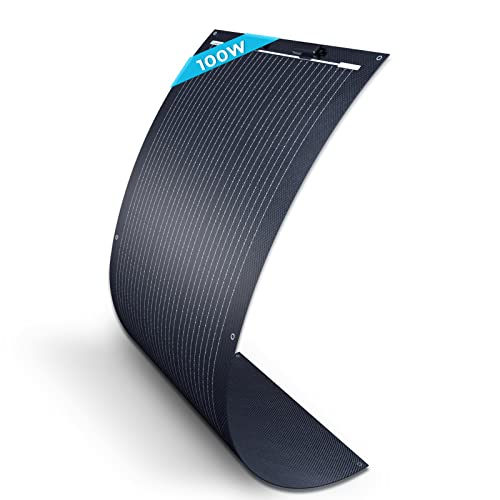
The Renogy 100W Flexible Panel features 240-degree bendability, enabling mounting on curved car roofs, RV cabins, boats, or other uneven surfaces. It weighs about one-third of a rigid panel, minimizing roof load while delivering solid daily output when sun is available. The panel employs half-cut PERC cell technology to improve light capture and overall efficiency, with a low-profile, glare-free appearance that blends with most vehicle exteriors. This combination of flexibility, light weight, and efficient cells makes it a practical choice for mobile power needs.
Ideal on curved surfaces close to the sun, this panel is suited for stealth installations where a barely-there look is preferred. Installation options typically include adhesives or mounting hardware designed for curved roofs, with weather resistance suitable for marine or off-grid environments. Users should plan for adequate venting and wiring conduit protection to maintain performance in varying weather.
Renogy 100W Semi-Flexible Panel — Ultra-Light and Thin

This 100-watt Renogy panel emphasizes ultralight and ultra-thin construction, designed for surfaces where rigid panels won’t fit. The flexible laminate allows mounting with minimal height while maintaining a slim silhouette. The manufacturer highlights 95% thinner than rigid options, making it less noticeable on rooflines. The panel’s flexible build is complemented by polymer-based materials that reduce overall weight, supporting easier transport and faster, simpler installations on curved or irregular surfaces.
Suitable for vehicles with tight roof lines, vans, and RVs with curved surfaces, the panel supports a range of mounting methods, including adhesive or mechanical fasteners. Pros include easier handling and stealth installation; considerations include ensuring a reliable weather seal around edges and connections to prevent water intrusion in exposed environments.
ECO-WORTHY 2x130W Flexible Panels (260W)

This ECO-WORTHY kit groups two 130W panels for a total of 260W, optimized for curved roofs and irregular surfaces common on RVs and boats. The kit emphasizes flexibility and a substantial power boost over single-panel setups. With four pre-drilled edge holes and multiple mounting options—adhesive, silicone, tape, cable ties, or Velcro—the kit supports fast, non-permanent installs or more permanent fixtures. The configuration is well-suited for drivers seeking a higher daily output when sun is favorable.
Performance notes indicate the potential to generate around 520Wh per day under four hours of optimal sun, with an overall daily average highly dependent on weather. The product line is designed for easy transport and simple installation while maintaining a robust, weather-resistant build suitable for marine and RV conditions. Consider wire routing and junction box protection to ensure long-term reliability on moving platforms.
ECO-WORTHY 130W Flexible Panel — 30% More Power

This 130W ECO-WORTHY panel delivers a 30% power bump over a standard 100W option, optimized for RVs, boats, and cabins with contoured surfaces. It remains ultra-thin and lightweight thanks to advanced polymer materials, enabling easier transport and installation on irregular roofs. Expected daily output climbs when paired with sunny conditions, up to roughly 520Wh per day under four hours of peak sun. The panel’s high flexibility supports curved mounting on many mobile platforms without sacrificing structural integrity.
Considerations include ensuring a compatible mounting method that preserves edge integrity and air flow under the panel. The product’s lighter weight helps with temporary setups and reduces the strain on roof structures, but you’ll want to verify surrounding hardware compatibility and weather sealing for long-term use in marine or off-grid environments.
ECO-WORTHY 260W Kit With MPPT Boost Controller

This two-panel 260W kit pairs 130W solar modules with an MPPT boost controller, designed to maximize charging efficiency across a range of battery types and voltages. The kit supports higher daily energy generation, delivering up to an estimated 1040Wh per day under favorable sun exposure. It is well-suited for larger surface areas on RVs, boats, or off-grid setups where more power is needed for extended trips or multi-device charging.
Key installation considerations include proper mounting on curved or uneven surfaces and ensuring the MPPT controller is correctly wired to the battery system. The kit’s weight and flexibility make it easier to handle during setup, but it still requires secure connections and weatherproof housings to sustain performance in outdoor environments.
Buying Guide: Key Considerations For Flexible Car Roof Panels
- Flexibility vs. Weight: Higher bend radii enable installation on more curved surfaces, but may come with trade-offs in durability. Ultra-thin panels reduce weight and profile but require careful edge sealing to protect against water ingress.
- Power Output and Daily Generation: Compare wattage ratings and expected daily watt-hours under typical sun conditions. Multi-panel kits can offer higher totals but require more mounting surface and wiring.
- Surface Compatibility: Assess roof curvature, material, and space. Vehicles, boats, and cabins vary in contour; ensure mounting hardware and adhesives suit your surface and environment.
- Durability and Weather Resistance: Look for waterproof junction boxes, robust connectors, and materials rated for wind, snow, and salt exposure if used near the coast or in boats.
- Installation Methods: Some panels are designed for permanent install with hardware; others are better for temporary setups with adhesives or Velcro. Plan for wiring routes, ventilation, and future panel removal if needed.
- Electrical Integration: Ensure compatibility with battery banks, charge controllers (MPPT preferred), and existing electrical systems. Correct sizing helps optimize charging efficiency and battery longevity.
- Maintenance: Flexible panels can accumulate dirt and moisture. Choose designs with easy access for cleaning and inspection, and consider protective coatings to extend lifespan on moving platforms.