Best Electric Motor Kits for Cars: Top Do‑It‑Yourself Options
Explore top-rated electric motor kits that empower car enthusiasts to build, modify, or repair DIY propulsion projects. This guide highlights five versatile, beginner-friendly kits suitable for educational STEM work, hobby projects, and practical vehicle upgrades. Each entry covers key specs, compatibility, and practical use cases to help you compare options quickly.
| Product | Brand | Key Features | Voltage |
|---|---|---|---|
| EUDAX 6 Set DC Motors Kit | EUDAX | Multi‑voltage kit, shaft propeller, DIY science projects | 3V–12V |
| Sntieecr 6 Set 131 PCS DC Motors Kit | Sntieecr | Large gear set, bulbs, buzzer, STEM learning | 1.5V–3V |
| VEVOR 1800W Brushless DC Motor Kit | VEVOR | High power, soft-start, dual-direction control | 48V |
| California JOS 6 Pack 130 Motor Kit | California JOS | Six motors with mounts, broad DIY applications | 0.5V–3V |
| Andgiv 6 Set 131 PCS Motor & Gear Kit | Andgiv | Complete circuit and gear set, extensive mechanical parts | 3V–6V (typical) |
EUDAX 6 Set DC Motors Kit

The EUDAX kit provides a compact set of DC motors calibrated for low to mid-range voltages (3V–12V). It includes a variety of colored shaft propellers and wheel components suitable for hands-on projects, making it a practical starter option for students and hobbyists. Key considerations include the need to follow circuit diagrams to prevent overheating and short circuits. The included motor dimensions and shaft sizes support simple integration into small DIY machines and demonstrations, with no-load speeds ranging up to 25,000 RPM for fast experiments.
Sntieecr 6 Set 131 PCS DC Motors Kit
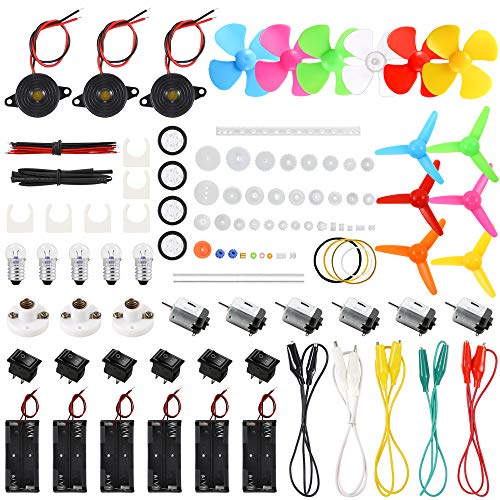
The Sntieecr kit emphasizes a comprehensive learning experience with a broad accessory set, including gears, gears, bulbs, and a buzzer. It is designed to foster curiosity in kids and beginners by providing varied components to explore electrical circuits, mechanical transmissions, and STEM concepts. The kit supports hands-on practice that enhances critical thinking and problem-solving while offering a complete platform for group or classroom activities.
California JOS 6 Pack DC Motors Kit

This kit bundles six small 130 RPM motors with metal mounts, suitable for Arduino projects, robotics experiments, and quick prototypes. With a rated speed around 15,000 RPM at 3V and a practical 0.5–3V operating range, it supports compact builds and repeatable experiments. The multiple motors and mounts ease scalability for classroom demonstrations and student-led projects, though it requires careful power management to avoid overheating in high-load tests.
Andgiv Electric DC Motor Kit
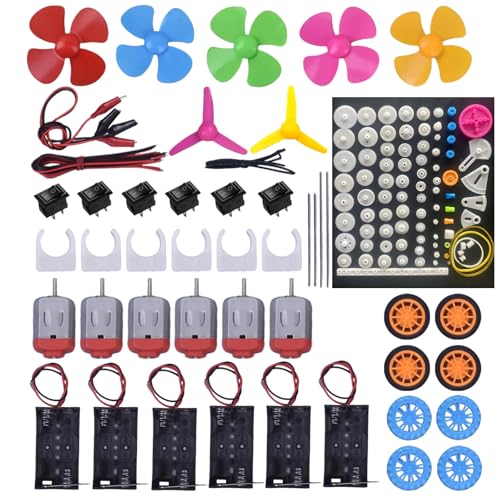
The Andgiv kit offers a complete circuit and gear system with 85 plastic gears and multiple propellers, enabling learners to explore gear ratios, motor control, and basic robotics. It emphasizes hands-on STEM learning with a rich assortment of parts designed to spark creativity in DIY inventions and school projects. The included wiring, switches, and mounts support a wide range of experiments from simple motion projects to more complex mechanisms.
VEVOR 1800W Brushless DC Motor Kit

The VEVOR brushless motor kit delivers high power and efficiency, featuring a 1800W motor suitable for electric bikes, scooters, and other DIY vehicles. It provides an intelligent soft-start for smooth power delivery, a high no-load speed, and a 100% copper core for reliable performance in varied weather. Dual-direction control (CW/CCW) adds versatility for compact, space-constrained installations where forward or reverse motion is needed.
4 in 1 Solar Power & Electric Motor STEM Kit

This 4‑in‑1 kit combines solar power with electric motor components, enabling solar car and wind car experiments alongside a wooden plane. It is designed for family STEM activities and classroom demonstrations, with magnetized tools and clear assembly instructions to simplify setup. The kit is suitable for children ages 8–12 and supports collaborative projects, making it a practical choice for early engineering exploration.
Buying Guide: Key Purchase Considerations
- Voltage and compatibility: Check the voltage range of motors to ensure compatibility with your power sources and control electronics. Lower voltage kits (1.5V–3V) are well-suited for small, educational projects, while higher voltage kits support more demanding tasks or vehicle-scale experiments.
- Gear and propeller options: A broad gear set or propeller assortment enables a wider range of projects, from simple transmissions to more complex robotics mechanisms. Consider kits that include different vane counts and gear teeth configurations for versatility.
- Motor type and efficiency: Brushless DC motors (BLDC) offer higher efficiency and smoother operation compared to brushed motors, but may require more complex controllers. Evaluate your desired balance of performance, complexity, and cost.
- Safety and learning support: Look for kits with clear wiring diagrams, beginner-friendly instructions, and safety notes to prevent overheating and short circuits during experimentation.
- Educational value and maturity: For learners and classrooms, prioritize kits that include a variety of components (switches, mounts, gears, LEDs, buzzers) to support hands-on exploration of circuits, mechanics, and systems thinking.
- Project scope and ambition: Choose a kit aligned with your goals—short demonstration projects, intermediate robotics builds, or long-term vehicle-related experiments—to maximize engagement and outcomes.