Best 12S ESCs for RC Car Performance and Reliability
Choosing the right 12S electronic speed controller (ESC) is crucial for high-performance RC cars that run on 12S LiPo packs. The right ESC handles high current, efficient cooling, and precise control, helping you maximize speed, torque, and reliability. Below, you’ll find five high-quality 12S ESC options with features designed for serious RC enthusiasts. The table summarizes key specs to compare at a glance.
| Product | Brand | Continuous Current | Battery Range | Notable Features |
|---|---|---|---|---|
| Spektrum Avian 120A | Spektrum | 120A | 6S-12S | Smart ESC, telemetry-ready |
| XC C8 Sensorless | XC | 160A | 3S-6S | Bluetooth app, high power |
| XC C10 Sensorless | XC | 120A | 2S-4S | Bluetooth app, compact |
| XC E10 Sensored | XC | 140A | 2S-4S | Turbo timing, app control |
| Spektrum Marine 200A | Spektrum | 200A | 12S | All-in-one telemetry, water-cooled |
Each option offers distinct strengths, from smart telemetry and Bluetooth connectivity to robust high-current performance and protective features. The following sections detail five carefully chosen ESCs that align with 12S RC car builds, balancing power, control, and ease of use for American hobbyists.
Spektrum Avian 120 Amp ESC For 6S-12S RC Cars

The Spektrum Avian 120A ESC is designed for 6S to 12S LiPo packs, delivering solid continuous current with modern telemetry support. It’s a smart ESC that can work with Spektrum’s ecosystem for data logging and performance tuning. Built for high-power applications, it aims to provide stable acceleration and reliable runtime in demanding off-road and on-road setups. The compact form factor makes it suitable for a range of 1/8 and 1/10 scale platforms, especially when paired with compatible motors and firmware.
XC C8 Sensorless 160A ESC

The XC C8 Sensorless ESC is a high-power option supporting 3S-6S LiPo packs with 160A continuous current. It features an adjustable BEC (6V/7.4V) and a built-in Bluetooth module for direct app programming, enabling quick parameter tuning without extra programming hardware. A self-developed current control algorithm minimizes the impact of pulse currents on the motor, which can improve throttle feel and motor wear over time while providing convenient on-the-go adjustments via a mobile device.
XC C10 Sensorless 120A ESC for 1/10 RC Trucks
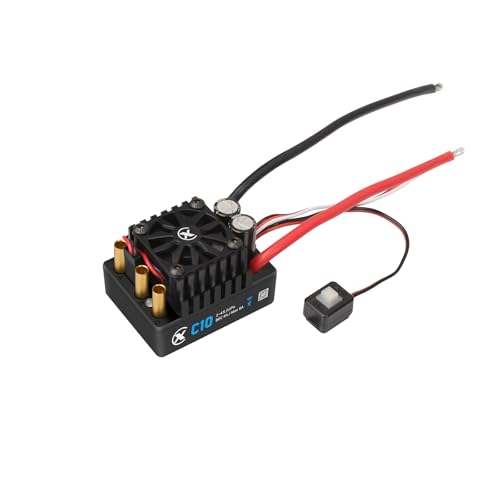
Designed for 2S-4S operation, the XC C10 offers 120A continuous current and an adjustable BEC (6V/7.4V). It emphasizes a streamlined feature set with Bluetooth connectivity for straightforward parameter changes. The compact size benefits tighter chassis configurations, including certain 1/10 scale trucks and short course builds. The device pairs well with brushless motors that require robust, dependable control without excessive bulk.
XC E10 Sensored 140A ESC With Turbo Timing

The XC E10 Sensored ESC targets 2S-4S LiPo batteries and delivers 140A continuous current with protection and cooling features. Its turbo timing adjustability (0° to 26°) allows precise throttle response tuning for peak acceleration. A built-in Bluetooth module supports app-based parameter programming, simplifying firmware updates and adjustments without extra equipment. This ESC is appropriate for intermediate builds seeking enhanced power delivery and timing control on 1/10 scale cars and similar platforms.
Spektrum 200A Smart Marine ESC

Though marketed for marine applications, the Spektrum 200A Smart Marine ESC demonstrates the robustness needed for high-current 12S setups in RC cars as well. It provides smart telemetry, a fast 32-bit ARM M4 processor, and water cooling for sustained performance under demanding conditions. The all-in-one telemetry workflow helps racers monitor motor temperature, current, and voltage in real time, supporting competitive tuning in hot-weather or high-load sessions. It’s a solid choice for large, powerful 12S configurations and endurance runs.
SEQURE 5-12S Dual-Way ESC

The SEQURE AM32 is a dual-way brushless ESC designed for 5-12S LiPo packs, offering 100A continuous current and 180A peak. It supports multiple protocols such as Dshot, PWM, Oneshot, and Multishot for flexible control. The broad voltage range and versatile protocol support make it suitable for a variety of RC car and even multi-vehicle setups. It’s a practical option for users who value protocol compatibility and reliable peak performance in high-demand environments.
Buying Guide
- Current rating and voltage range: Choose an ESC that can comfortably handle your motor’s stall current and your battery’s peak voltage (12S). Oversizing can improve reliability in long pulls, while undersizing risks overheating.
- Control interface: Bluetooth-enabled or app-configurable ESCs simplify setup and tuning. Consider whether you need on-board telemetry and compatibility with your radio system.
- Protection and cooling: Look for over-heat protection, low-voltage cut-off, and cooling strategies (fans or heat sinks). Water or splash resistance is beneficial for off-road or wet conditions.
- Programming complexity: Some ESCs require programming boxes, while others support direct app control. If you prefer quick tuning, favor models with built-in Bluetooth and intuitive apps.
- Motor compatibility: Ensure the ESC is compatible with sensored or sensorless motors as your build requires. Sensored options can provide smoother low-speed control, while sensorless designs may be simpler and lighter.
- Physical fit: For tight chassis spaces, compact form factors are advantageous. Verify mounting points, connectors, and wire lengths to avoid clearance issues.
- Reliability and support: Reputable brands with robust documentation, firmware updates, and customer support help sustain performance over time and during upgrades.
When evaluating 12S ESCs for RC cars, balance high current capability with practical features like Bluetooth programming, telemetry, and protective functions. The options highlighted here cover a spectrum from telemetry-enabled models to compact, high-power units suitable for aggressive 1/8 and 1/10 scale builds. Consider your vehicle weight, motor, gearing, and typical usage (racing, bashing, or endurance runs) to determine which ESC best aligns with your goals.