Best Car Heat Shield Options for Thermal Protection in 2026
Protecting vital vehicle components from radiant heat is essential for performance and longevity. This article highlights five top heat shield products designed to deflect and withstand high temperatures, offering options for mufflers, exhaust systems, underbody protection, and engine bays. Each choice balances heat resistance, durability, and ease of installation, helping you select a shield that matches your project and vehicle type.
A quick summary of the chosen products:
| Product | Brand | Key Strength | Max Temperature | Size (approx.) |
|---|---|---|---|---|
| Aluminized Heat Shield Thermal Barrier (12” x 40”) | FLASLD | Reflects heat, adhesive-backed | Up to 2000°F | 12″ x 40″ |
| Embossed Aluminum Heat Shield 12” x 20” | BSTFLEX | Durable insulation, easy to cut | Up to 1100°F | 12″ x 20″ |
| Second Skin Thermal Block 2 sq ft | Second Skin | Reflective aluminum with PET backing | Up to 800°F | 2 sq ft sheet |
| Aluminized Heat Shield Mat (12” x 24”) | FLASLD | High temp, reflective, easy trim | Up to 2000°F | 12″ x 24″ |
| Exhaust Heat Shield Kit 16″ x 39″ | SINNSIDELIN | Heavy-duty embossed aluminum, flexible | Up to 1022°F | 16″ x 39″ |
Aluminized Heat Shield Thermal Barrier Up To 2000°F
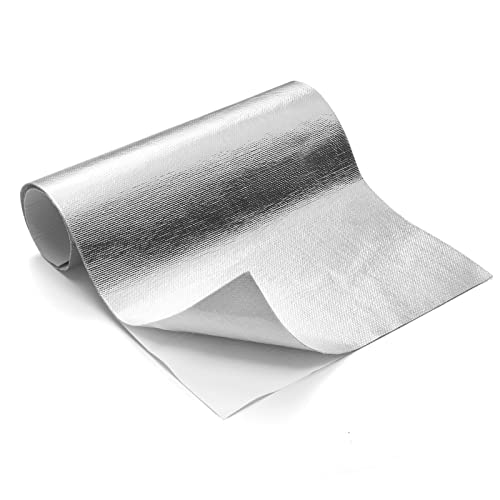
This aluminized heat barrier employs a flexible woven silica core with an adhesive backing. It can withstand temperatures above 2000°F and offers reflective surfaces to reduce radiant heat by up to 95%. The product is offered in multiple sizes, including 12″ x 40″ for larger contours, and it can be trimmed as needed to fit various projects.
Embossed Aluminum Heat Shield 12” x 20”

Made of insulated aluminum, this shield handles continuous loads up to 1100°F. It emphasizes durable thermal insulation suitable for mufflers, chassis, fuel tanks, and catalytic converters. The shield is easy to cut with tin snips and can be folded and formed along edges for neat, secure installations on car components demanding reliable heat protection.
Exhaust Heat Shield Automotive 16” x 78.7”
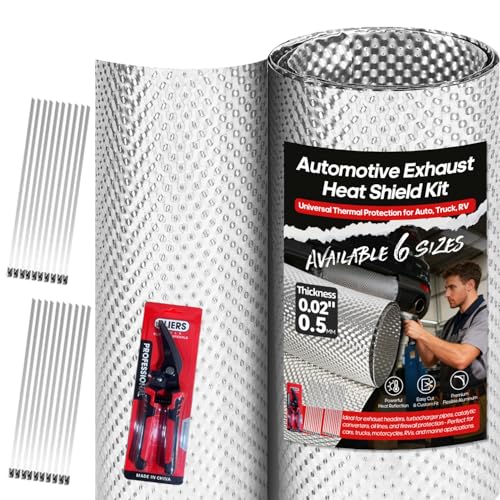
Designed for underbody, muffler, and pipe protection, this 0.5mm heavy-duty embossed aluminum shield resists up to 1022°F. Its robust material offers durability, easy bending, and cutting to fit complex contours, delivering reliable protection for critical automotive components against radiant heat and heat soak.
Second Skin Thermal Block – 2 Sq Ft

Thermal Block combines a 1/8″ thick reflective aluminum shield with PET fiber backing and a peel-and-stick adhesive. Each sheet covers 2 square feet and is FMVSS 302 fire-rated. It’s rated for up to 800°F and is flexible enough to conform to curved surfaces while offering 100–200°F reduction on the hot side depending on application.
Aluminized Heat Shield Mat 12” x 24”
This heat blanket uses a flexible aluminized finish over a woven silica core, offering more than 2000°F resistance. It reflects up to 95% of radiant heat and comes in a 12″ x 24″ size, with a thickness around 0.032″ (0.8 mm). It can be trimmed to fit diverse project shapes while maintaining high temperature protection.
Exhaust Heat Shield Kit 16″ x 39″

This kit provides a 16″ x 39″ embossed aluminum shield along with cable ties for installation. It withstands up to 1022°F and is designed for easy mounting on mufflers, exhaust ducts, and chassis areas needing thermal protection. The embossed pattern enhances heat reflection and shields critical components from radiant heat exposure.
Buying Guide
- Temperature rating: Choose shields rated for the highest expected heat exposure. For engine bays and exhaust routes, look for shields rated above 1000°F, with some options offering protection beyond 2000°F for extreme cases.
- Material and construction: Aluminum shields (embossed or embossed with reflective surfaces) provide durability, flexibility, and strong heat resistance. Adhesive-backed or peel-and-stick options simplify installation but ensure surfaces are clean and dry first.
- Size and form factor: Select a shield size that minimizes trimming while fitting the target area. If needed, verify that the sheet can be trimmed or shaped without compromising structural integrity.
- Ease of installation: Consider whether the shield needs to be cut, bent, or affixed with fasteners. Adhesive-backed options can speed up installation on flat surfaces, while embossed or heavy-duty shields often require mechanical fastening.
- Durability and environmental exposure: Look for shields that resist moisture, solvents, and automotive fluids. FMVSS-compliant materials or tested temperature ranges add assurance for on-road use.
- Applicability: Some shields are designed for mufflers and exhaust systems, others for underbody protection, engine bays, or catalytic areas. Match the product to your specific application and contour complexity.
- Maintenance and safety: Ensure installation does not impede airflow where cooling is needed, and routinely inspect for wear, corrosion, or adhesive degradation in high-heat zones.