Best Wireless Car Cameras for Ready-to-Use Backup and Dash Cam Solutions
Finding a reliable wireless car camera can simplify parking, enhance safety, and provide clear footage on the road. This guide highlights five strong options, spanning dash cams and wireless backup cameras, with a focus on clarity, night vision, ease of installation, and growth-ready features. Each pick includes key specs to help you compare coverage areas, video quality, and power options for daily driving, towing, or family travel.
| Product | Brand | Key Benefit |
|---|---|---|
| Veement V300 Dash Cam | Veement | 1296P front dash cam with night vision |
| TERUNSOUl 4K Dash Cam Front & Rear | TERUNSOUl | Dual 4K recording for front and rear |
| LeeKooLuu 7-Inch Wireless Backup | LeeKooLuu | Two-channel wireless truck backup with grid lines |
| Befumly 5-Inch Wireless Backup | Befumly | HD 1080P monitor with real-time wireless feed |
| AUTO-VOX Solar Wireless Backup | AUTO-VOX | 5″ monitor, solar powered, quick DIY install |
Below you’ll find five in-depth product sections. Each one includes a short description, the corresponding image, and the main features that relate to wireless car camera use.
Veement V300 1296P Dash Cam Front Camera

The Veement V300 records at 2304×1296 resolution, delivering sharp front footage for day and night driving. A 170-degree ultra-wide lens captures a broad field of view, supporting comprehensive road coverage. The camera uses a star-light sensor and an F=1.7 aperture to boost low-light performance, aiding night recording accuracy. It integrates with a USB-C power supply and features 24-hour parking mode for continued surveillance when the vehicle is off. Night vision and modular power support make it a practical main dash cam option for many cars.
TERUNSOUl 4K+4K Dash Cam Front & Rear
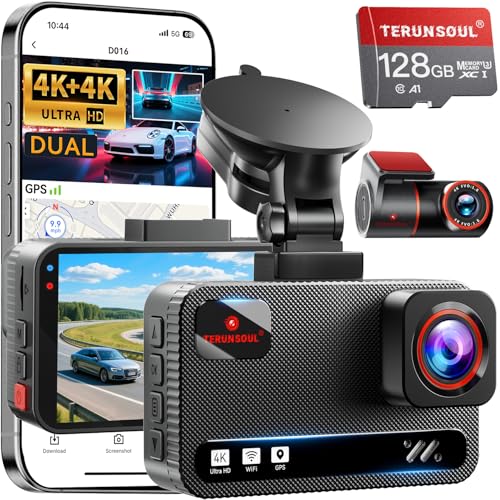
This dual-channel dash cam records in 4K on both the front and rear cameras, delivering crisp road details from both directions. It includes a pre-installed 128GB card and supports up to 512GB microSD for extended recording. A 170-degree front lens and an F1.5 aperture contribute to improved light intake, especially in challenging lighting. Loop recording and a G-sensor protect critical footage during incidents, while a built-in GPS module enhances location tagging for evidence and insurance purposes. The system emphasizes safety and long-term data management.
LeeKooLuu 7-Inch Wireless Backup Camera for Truck

This 2-channel wireless backup system includes a 7-inch monitor and camera(s) designed for trucks, SUVs, and larger vehicles. Features include DIY, plug-and-play installation, pre-paired components, and night vision for low-light reversing. The system supports split-screen views to monitor multiple cameras, with a user-friendly CH button for quick channel switching. It emphasizes convenience and safety during parking, towing, and loading scenarios.
Befumly 5-Inch Wireless Backup With Dual Camera

The Befumly wireless backup system offers real-time video transmission with a frequency-hopping protocol to minimize interference. The kit is designed for quick DIY installation, often completed in about 25 minutes, and supports universal fit for SUVs, pickups, and vans. The round-the-clock video transmission supports reversing, parking, and towing tasks with a compact 5-inch display that emphasizes simplicity and reliability in daily use.
AUTO-VOX Solar Wireless Backup Camera with 5″ Monitor

This solar-powered backup camera system requires no wiring to the car lights, offering a two-minute DIY install. It uses a digital receiver with advanced frequency-hopping to minimize interference and deliver a reliable 52-foot wireless range. The 5-inch monitor provides a clear 1080P image for reversing and parking, and the solar power option reduces the need for ongoing battery management in certain setups. It suits drivers seeking a low-effort, portable backup solution for multiple vehicle types.
Buying Guide: Key Purchase Considerations
- Video quality: Choose at least 1080P for clear details, with 1296P or 4K options if you need sharper footage and better license plate readability.
- Field of view: A wider lens (120–170 degrees) captures more road area; front-facing cameras benefit from wide angles for dashcams, while backup cameras benefit from wide rear visibility.
- Power and installation: Wireless systems reduce wiring. Check for battery-free or USB-C powered options and consider whether the kit requires professional installation or a DIY setup.
- Night vision: Look for low-light performance, star-light sensors, or WDR features to maintain clarity after dark or in shadowy areas.
- Storage and durability: Ensure microSD capacity supports your recording habits. IP ratings (e.g., IP69K) matter for exposed or rugged environments.
- Multi-camera support: If you park or tow with multiple angles, verify whether the unit supports dual cameras and split-screen viewing.
- GPS and data tagging: Dual-channel dash cams with GPS can add location and speed data for evidentiary purposes.
- Battery and power management: Some units avoid lithium batteries to reduce heat risk, relying on continuous power supplied by the vehicle or a separate power source.
Perspective Considerations
- Dash cam emphasis: If primary use is recording the road for safety or insurance, prioritize 1296P or 4K front cameras with wide FOV and good night vision.
- Backup and towing focus: For parking and hauling, look for clear reverse assist with a reliable wireless connection, strong night visibility, and easy installation.
- Portable vs. fixed: Wireless systems benefit renters or frequent movers; fixed systems may offer more stable long-term mounting options for one vehicle.
- Security and privacy: Consider data storage practices and access controls, especially if the camera stores footage locally or on cloud services.
All five options provide a blend of wireless convenience, decent image quality, and practical features for different vehicle types. When choosing, align the camera’s strengths with your typical driving scenarios—city commuting, family road trips, or heavy towing—to maximize value and safety.