Best Quadrajet Carbs for Chevy 454 Engine Upgrades
The Chevy 454 and other small/ big block engines often rely on a precise, well-tuned four-barrel carburetor to deliver optimal throttle response and performance. This guide features five quadrajet 4-barrel carburetors that directly replace Rochester Quadrajet units (1901R/1901GG/4MV) and are compatible with popular Chevy, GMC, and Corvette applications from 1966–1979. Each option emphasizes ease of fit, manual choke capability, and improved fuel delivery across RPMs. Use the buying guide at the end to compare fitment, airflow, and maintenance needs for your specific build.
| Product | Brand | CFM | Key Benefit |
|---|---|---|---|
| THUNDERMINGO 4 Barrel Carb | THUNDERMINGO | 750 | Direct Quadrajet replacement with manual choke |
| NACHUAN 1901R 4MV 750 CFM | NACHUAN | 750 | New replacement with wide compatibility |
| Piodelo 4MV 750 CFM | Piodelo | 750 | Gasket kit included, various Chevy engines |
| GELUOXI 1901R 750 CFM | GELUOXI | 750 | Comprehensive replacement for 1901R/1901GG |
| LOREADA 750 CFM 4MV | LOREADA | 750 | Includes gasket kit, versatile for 1966–1973 engines |
Note: Before purchasing, confirm the carburetor size matches your old unit, and be prepared for minor idle circuit adjustments for some vehicles. This selection covers several common Rochester Quadrajet variants used in 1966–1979 Chevrolet/GMC/Bodies, including Corvettes and big-block setups.
THUNDERMINGO 4 Barrel Carburetor for Rochester Quadrajet
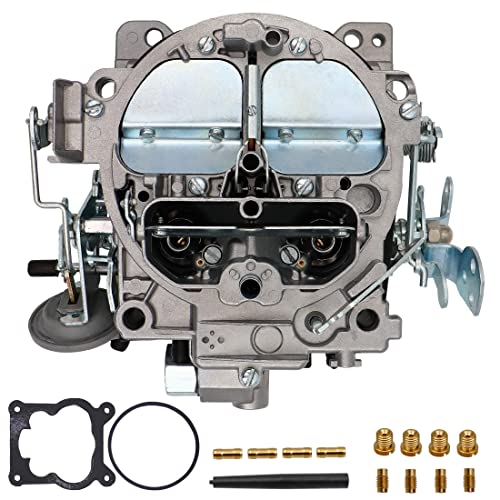
This brand-new 4-BBL carburetor is designed as a direct replacement for the Rochester Quadrajet 1901R/4MV units. It features vacuum secondary operation and a manual choke, making it suitable for daily drivers. It fits 1966–1973 Chevy engines (327/350/427/454) and 1968–1973 Chevy/GMC trucks, along with 1975–1979 Corvettes. Engineers note the need to confirm replacement size prior to purchase. Minor idle adjustments may be necessary for some displacement ranges. A small tool and copper pin are included to block air channels if needed.
NACHUAN Rochester Quadrajet 750 CFM 1901R 4MV

This model is a brand-new 4-Barrel carburetor that directly replaces the Rochester Quadrajet 1901R/4MV. It supports vacuum secondary and manual choke, and is compatible with 1966–1973 Chevy 327–454 engines, 1968–1973 Chevy/GMC Trucks, and 1975–1979 Corvettes. The kit notes compatibility with OEM part numbers like 1901R and 1901-GG. Size and jet configurations are designed for reliable performance across RPMs with emphasis on daily driving reliability.
Piodelo 4MV 750 CFM Quadrajet Carburetor

Piodelo’s 4MV 750 CFM carburetor is designed for Rochester Quadrajet applications, including 1966–1973 Chevy engines (327/350/427/454) and 1975–1979 Corvettes, with 1901R compatibility. It ships with a gasket kit and is marketed as a direct replacement for 1901R/1901GG. The manufacturer highlights a zinc-alloy build for heat and corrosion resistance, and a fuel curve calibrated for specific applications. Some vehicles may require minor idle adjustments or air-channel blocking using the included tool for optimal idle.
GELUOXI 1901R 750 CFM Quadrajet Replacement

GELUOXI offers a replacement for Chevy 1901R/1901-GG Quadrajet carburetors with 750 CFM capacity. The product is described as compatible with a wide range of engines from 1966–1979, including Chevy and GMC trucks as well as Corvettes. It is packaged with essential replacement components and emphasizes durability and compatibility with OEM part numbers. As with other aftermarket Quadrajet replacements, some vehicles may require adjustments to achieve optimal idle and performance across RPM ranges.
LOREADA Rochester Quadrajet 750 CFM

LOREADA provides a 750 CFM Quadrajet carburetor engineered for Chevy 350, 327, 396, 400, 402, 427, and 454 engines, spanning 1966–1973 models with 1901R/4MV variants. The kit includes gaskets and a tool for installation, aiming to simplify swapping a worn carb for improved performance. It notes compatibility with Chevrolet/GMC trucks and Corvettes from the late 60s and early 70s, and it highlights the possibility of some tuning to achieve ideal idle due to engine variations.
Buying Guide: Key Purchase Considerations
- Engine compatibility: Confirm that the carburetor matches your engine’s displacement, year, and vehicle model (Corvette, Camaro, El Camino, etc.). Look for references to 327/350/427/454 engines and the intended vehicle range (1966–1979).
- Type and choke: Choose manual choke variants if you prefer simplicity and reliability in older vehicles. Vacuum secondary designs help with gradual throttle response for street-driven apps.
- CFM rating: A 750 CFM rating is common for big block and performance applications. Ensure airflow capacity aligns with your engine size and intended use (daily driving vs. performance).
- Direct replacement vs. upgrade: Some listings advertise direct replacement for 1901R/1901-GG/4MV Quadrajet units. Verify that mounting patterns, linkage, and fuel inlet locations align with your intake manifold.
- Included components: Check for gasket kits, air filters, and installation tools. A complete kit can simplify installation and reduce downtime.
- tuner notes: Manufacturers may note the need for minor idle adjustments or blocking air passages to correct air-fuel balance. Review provided guidance and be prepared for tuning steps on your first run.
- Durability and materials: Zinc alloy or similar durable materials improve heat resistance and longevity in demanding engine environments.
- Warranty and seller support: If available, a warranty and responsive seller can help with fitment questions and post-purchase tuning guidance.
These five options provide a spectrum of direct replacements and upgrades for 1966–1979 Chevy/GMC engines and Corvettes. When choosing, weigh the ease of installation, compatibility with your existing intake and linkage, and the need for any tuning at startup to achieve optimal performance across RPM ranges.