Best Wideband Air Fuel Gauges for Real-Time Tuning and Safety
Wideband air/fuel gauges provide precise, real-time feedback essential for modern engine management. This guide highlights top wideband UEGO AFR gauges, detailing compatibility, installation, and data outputs to help you choose a model that fits your vehicle and tuning workflow. Whether you’re dialing in performance, protecting your engine, or integrating with data loggers, the gauges below cover a range of housing sizes, sensors, and output options to suit American-made dashboards and aftermarket pods.
Summary table of selected products:
| Product | Key Features | Output | Size |
|---|---|---|---|
| AEM 30-0300 X-Series Wideband UEGO | 87% larger center display, X-Digital wideband, CANbus logging | 0-5V, RS232, CANbus | 52mm |
| ZHSYMX Universal Digital Wideband AFR | 52mm housing, easy install, wide compatibility | 0-5V analog (via gauge) | 52mm |
| FHRHRY Wideband UEGO 52mm Gauge | 4.9 LSU sensor, 24-color LED, dual calibration modes | 0-5V analog | 52mm |
| AEM (30-4110) UEGO Gauge | Interchangeable faceplates, Bosch 4.9 LSU sensor | 0-5V output | 52mm |
| JJCOCO Wideband UEGO 52mm Kit | 20ms response, dual calibration, RS-232 | 0-5V, RS-232 | 52mm |
AEM 30-0300 X-Series Wideband UEGO AFR Gauge

The X-Series 30-0300 combines a striking face with a larger center display, delivering a clear view of the air/fuel ratio in real time. It supports multiple outputs for feedback control and data logging, including 0-5V and RS232, plus AEMnet (CANbus) for comprehensive data logging. The advanced X-Digital wideband technology provides more accurate readings and the potential for improved engine tuning and safety. Its versatile connectivity makes it suitable for professional tuners and enthusiasts integrating with modern engine control systems.
ZHSYMX Universal Digital Wideband AFR Gauge

This 52mm gauge emphasizes ease of installation and broad compatibility. It features a compact 52mm housing that fits many instrument pods and supports real-time wideband readings with 0-5V analog output for data loggers or ECUs. It is designed to work with systems up to 16V, making it a practical choice for a wide range of vehicles and tuning setups. The device prioritizes straightforward mounting and reliable digital wideband performance for consistent AFR monitoring.
Wideband UEGO Air/Fuel Gauge 52mm (2-1/16”) with 4.9 LSU Sensor
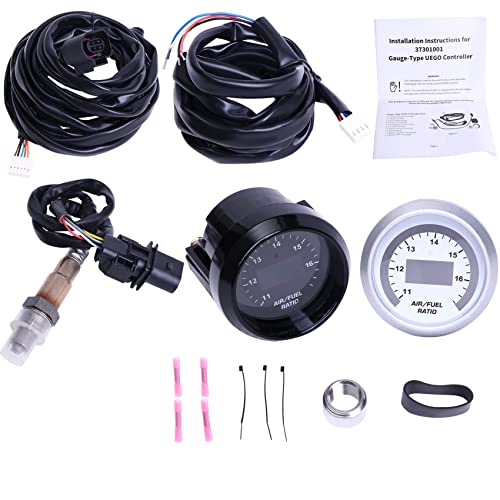
This 52mm digital AFR gauge features a 4.9 LSU sensor for fast, accurate readings and a visually striking LED display that shifts color with the AFR value. It supports 0-5V analog output, enabling compatibility with a wide range of data loggers and engine management systems. The kit emphasizes quick calibration and robust performance, helping users quickly identify lean or rich conditions and adjust parameters accordingly.
ZHSYMX Digital Wideband Gauge Kit with Sensor

This kit extends universal applicability with a 52mm gauge, 16V capability, and a 4.9 sensor. It provides a straightforward installation path for a robust AFR measurement solution, including a sensor that supports real-time feedback and rapid response. Its emphasis on broad compatibility makes it suitable for various engine management systems and data logging configurations, including remote mounting where space is limited.
30-0300 Wideband UGEO AFR Gauge 52mm Kit

The Gledewen 30-0300 kit features a 24-color LED display with a dual-mode central readout and reversible two-sided faceplate. It supports multiple display modes—air/fuel ratio, lambda, and oxygen percentage—allowing quick visual cues for tuning. The sensor is designed for rapid response (around 20 milliseconds) and uses a LSU4.9 sensor for accuracy. With options for rCAL or ACAL calibration, this gauge supports flexible installation and tuning workflows for diverse engines.
Buying Guide: Key Purchase Considerations
When choosing a wideband AFR gauge, consider sensor quality, output options, and installation practicality. The recommended models here offer a mix of 0-5V analog output for data loggers and ECU compatibility, plus added digital interfaces like RS-232 or CANbus for richer data logging. The gauge face and LED indicators should be legible in your cockpit or engine bay lighting, while the size—most options are 52mm—fits common instrument pods. If you rely on data logging or tuning software, prefer devices with multiple outputs or a robust data interface.
Data logging and real-time feedback are essential for advanced tuning. Models with CANbus or RS-232 interfaces enable deeper integration with engine management systems or external data loggers. For most street and track scenarios, a 52mm gauge with 0-5V output is a solid baseline, but a model with additional digital outputs and a clear, large display can reduce road-time guesswork and improve safety during tuning sessions.
Calibration flexibility is another important factor. Dual calibration options (rCAL and ACAL) allow pre-calibrated quick installs or customized setups for unique sensor placements and environmental conditions. If you expect frequent sensor replacements or remote installations, choose a kit that includes clear mounting hardware and a sensor with proven reliability, such as the LSU 4.9 family, which is widely supported across manufacturers.
Display quality matters for quick reference during driving. A wide color range and a bright, readable LED readout help you monitor AFR at a glance without distraction. Some gauges offer color-shifting displays that highlight lean or rich conditions, which is beneficial for instinctive tuning under dynamic driving conditions.
Compatibility with your existing systems should guide your choice. Check voltage tolerance (many gauges handle up to 16V), pod compatibility, and whether the gauge supports easy integration with your data logger, ECU, or dash display. Always verify the sensor type and connector compatibility to ensure a smooth installation with your vehicle’s fuel system.