Best High End 4 Channel Car Amplifier Guide for 2026
Discover top-tier, four-channel car amplifiers designed to deliver clean, high‑fidelity sound with plenty of headroom. This guide highlights premium choices that balance efficiency, power, and feature sets for demanding audio setups. Whether you’re upgrading your factory system or building a flagship install, these units are built to perform at high levels while withstanding long listening sessions.
A quick overview of the selected models:
| Product | Brand | Channels | Approximate Power (RMS) | Key Benefit |
|---|---|---|---|---|
| Recoil DI550.4 Full-Range | RECOIL | 4 | 130W x 4 @ 2Ω; 80W x 4 @ 4Ω | High‑speed MOSFET supply; robust protection |
| Taramps TS 800×4 | Taramp’s | 4 | 200W x 4 @ 1Ω or 400W x 2 @ 2Ω (bridged) | High efficiency; versatile RCA/high‑level input |
| Skar RP-75.4AB | Skar Audio | 4 | 125W x 4 @ 2Ω; 75W x 4 @ 4Ω | Class A/B with strong mid‑bass/open sound |
| Orion CBA2500.4 | ORION | 4 | 2500W high output (4× @ 2/4 ohm stable) | MOSFET power supply; adjustable low/high pass |
| Alpine S‑A32F | Alpine | 4 | 320W total (4× 55W @ 4Ω) | Efficient Class D with compact form factor |
Note: The table summarizes nominal capabilities and standout features to help compare suitability for different audio goals and vehicle environments.
Recoil DI550.4 Full-Range Class-D 4-Channel

The Recoil DI550.4 is a Class D four-channel amplifier delivering 1040 watts max, with RMS ratings of 130W per channel at 2 ohms and 80W per channel at 4 ohms. It supports bridging to 260W per channel at 4 ohms and uses a high-speed MOSFET power supply. The design emphasizes four‑way protection circuitry and premium internal components, enabling sustained high performance. Variable gain, low-pass and high-pass filters, crossover options, and bass EQ adjustments offer substantial tuning flexibility for demanding setups.
Taramp’s TS 800×4 1 Ohm Multichannel

The Taramp’s TS 800×4 is a high-performance 4‑channel amplifier rated at 800W RMS at 1 ohm. It supports 4 channels at 200W each at 1 ohm and offers 2‑channel bridging at 400W per channel at 2 ohms. Features include RCA inputs and high‑level input with automatic activation. A built‑in crossover provides precise control with high‑pass and low‑pass options, giving installers a flexible path to clean, powerful sound across the full frequency spectrum.
Skar RP-75.4AB 500W 4-Channel
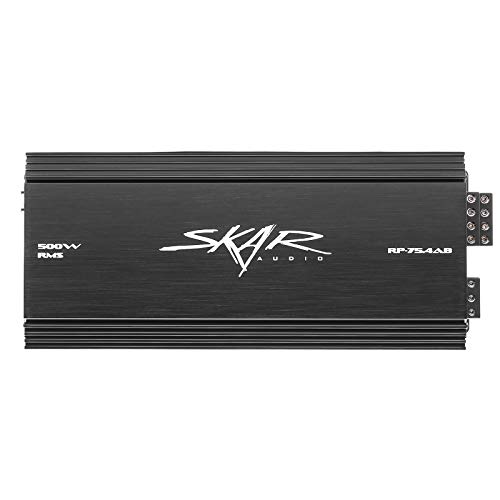
The Skar RP-75.4AB is a 500‑watt MOSFET four‑channel Class A/B amplifier. It delivers 125W x 4 at 2 ohms and 75W x 4 at 4 ohms. The Class A/B topology provides a balance of efficiency and clean, impactful sound, with solid control over midrange and high‑frequency performance. It’s a good fit for multi‑speaker configurations where defined vocal presence and clear imaging are priorities.
Orion Cobalt Series CBA2500.4

The Orion Cobalt CBA2500.4 is a high‑efficiency Class A/B four‑channel amplifier. It supports continuous 2/4 ohm loads, includes a MOSFET power supply, and provides low/high level inputs for flexible integration with various head units. With a focus on efficiency and heat management, this model aims to maintain stable performance across extended listening sessions while delivering substantial output across all channels.
Orion Cobalt Series CBA2000.4
The Orion Cobalt CBA2000.4 delivers 2000W high output across four channels with 2/4 ohm stability. It uses a MOSFET power supply and offers adjustable low/high pass filters and bass boost. The amplifier is designed for users who require substantial headroom for demanding speakers while maintaining stable operation and efficient cooling in confined automotive spaces.
Alpine S-A32F S Series Class D 4‑Channel

The Alpine S‑A32F is a Class D four‑channel amplifier rated at 320W total, with 55W x 4 at 4 ohms. Alpine’s Class D design emphasizes efficiency and compact sizing, making it ideal for tight installs where heat and space are concerns. This model is suitable for users seeking a balance between performance and footprint without compromising on clarity and control.
Buying Guide: Key Purchase Considerations for High-End 4-Channel Amps
Power and impedance: Match the amplifier’s RMS power to your speaker array and the impedance of your woofers, mids, and tweeters. Four channels at 2 ohms often deliver more headroom, but ensure the head unit and electrical system can handle the load without excessive heat buildup.
Efficiency and class design: Class D amps excel in efficiency and heat management, especially in compact trunks or hatchbacks. Class A/B designs, while typically less efficient, can offer more linear current delivery and slightly different sonic characteristics that some listeners prefer for midrange clarity.
Inputs and integration: Confirm compatibility with your head unit’s RCA outputs or speaker-level inputs. Some amps include high-level inputs with automatic turn-on, which can simplify integration with factory radios.
Crossover features: Look for adjustable high-pass and low-pass filters, as well as bass boost and crossover slope options. Fine-tuning these controls helps shape channel balance and reduce overlap between subwoofers and midrange speakers.
Protection and reliability: Four-channel amps in high‑end setups should include protections against thermal overload, short circuits, and undervoltage conditions. A robust protection circuit helps maintain performance during extended listening sessions and rough road conditions.
Physical fit and cooling: Consider dimensions, mounting options, and whether the unit has adequate heat sinking. A well-ventilated install prevents thermal throttling during long music casts and vacations rides.
Brand ecosystem and support: Premium brands often provide firmware updates, extended warranties, and dealer support. Access to service and compatible accessories can matter over the lifespan of the system.
Sound goals: Decide whether the priority is sheer SPL, musicality, or a balanced, audiophile sound. Four-channel amps are versatile for multi‑speaker configurations, but the precise tonal character will depend on the overall system design, enclosure, and component matching.
Installation complexity: Some models offer more user-friendly tuning interfaces and quicker setup. If you’re a DIY installer, choose a unit with intuitive controls and clear documentation.