Best Automotive Inspection Camera Guide for Vehicle Diagnostics and Repairs
Choosing the right automotive inspection camera can streamline diagnostics, speed up repairs, and help you reach tight spaces behind engines, in exhaust runs, or inside frames. This guide highlights five top models designed for automotive use, balancing image clarity, maneuverability, and durability. Each option offers hands-free scanning, strong illumination, and bendable probes to help you see what’s hidden from plain sight.
Below is a quick summary of the selected products to help you compare options at a glance. The table is followed by detailed product sections with key features and practical use cases.
| Product | Brand | Key Strength |
|---|---|---|
| Teslong Two-Way Articulating Borescope with Light (5FT) | Teslong | Five-foot semi-rigid gooseneck; 4.5″ IPS display; dual articulation for tight spaces |
| AukonVee Endoscope Camera with Light | AukonVee | 4.3″ IPS screen; 170° viewing; IP67 waterproof; 16.5 ft semi-rigid cable |
| DEPSTECH Dual Lens Industrial Endoscope | DEPSTECH | Dual lens with split-screen; 4.3″ LCD; 16.5 ft semi-rigid cable |
| UJOYOK Two-Way Articulating Borescope | UJOYOK | 420° articulation; 4.3″ IPS display; AI-assisted video; no app required |
| DXZtoz Two-Way Articulating Borescope | DXZtoz | 210° articulation; 8.5mm camera; 4.3″ IPS monitor; affordable option |
Teslong Two-Way Articulating Borescope with Light

The Teslong borescope combines two-way articulation with a bright 4.5-inch IPS LCD, delivering crisp images even in sunlit engine bays or dark undercarriages. Its 5-foot semi-rigid gooseneck offers a strong balance between flexibility and shape retention, helping you navigate around intake manifolds, exhaust pipes, and behind components without losing orientation. The device emphasizes quick setup and reliable control, enabling automotive technicians and DIYers to inspect valve trains, timing belts, and hidden corrosion points with minimal forethought. A clear display reduces the guesswork when diagnosing moisture intrusion or mechanical wear.
In practical terms, this model shines in scenarios requiring both precision and reach. The articulated head helps you pivot around corners, while the robust LED lighting reveals fine grooves and gasket seals. The design prioritizes straightforward operation, so technicians can focus on the inspection rather than fiddling with settings. Its durable housing stands up to workshop use, and the screen’s color fidelity ensures accurate assessment of metal surfaces and lubricants during routine maintenance checks.
AukonVee Endoscope Camera with Light

The AukonVee endoscope emphasizes practical reliability with a 4.3-inch IPS display and a wide 170-degree field of view. Its no-app approach makes it ready to use straight out of the box, which is beneficial for quick diagnostics in the shop or on the go. The 8 adjustable LEDs provide brightness control for dim engine bays, while the 16.5-foot semi-rigid cable offers ample reach in complex layouts such as transmission bays and behind engine mounts. The IP67 waterproof rating adds durability when moisture is a factor, such as checking exhaust joints or cooling lines after a wash.
With a slim 0.31-inch camera diameter, it easily enters tight crevices around fittings, gaskets, and pipes. The adjustable focal range supports close inspection of valve seats, serpentine belts, and sensor housings. For technicians focusing on structural or plumbing inspections within vehicles, the AukonVee provides a robust balance of image clarity, maneuverability, and ruggedness that suits frequent diagnostic tasks.
DEPSTECH Dual Lens Industrial Endoscope
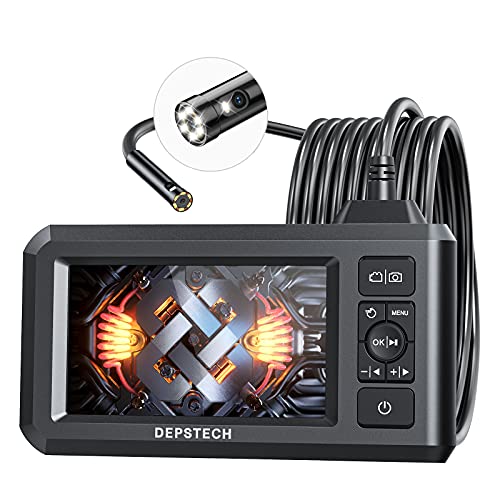
DEPSTECH’s DS300 model stands out with dual-lens technology, offering split-screen viewing and the flexibility to switch perspectives without repositioning the scope. The 4.3-inch TFT LCD screen provides a broad, sharp view, and the 170-degree horizontal field enhances coverage of engine bays, transmission tunnels, and chassis cavities. The camera runs on Bluart 2.0 image processing and uses 7 LEDs to illuminate dark corners. A rechargeable battery supports several hours of continuous use, making it suitable for longer diagnostic sessions and fieldwork where power access is limited.
What makes this option particularly compelling for automotive work is the quick switching between front and side views, which helps compare wear patterns and inspect multi-angle surfaces efficiently. The 2nd CMOS chip reduces image delay, ensuring you capture precise moments as you inspect moving parts or dynamic air system components. This model is well-suited for professional garages and serious DIY enthusiasts who require thorough documentation of findings.
UJOYOK Two-Way Articulating Borescope

The UJOYOK model highlights a compact, one-hand-friendly design without sacrificing performance. Its two-way 420° articulation lets technicians reach tight engine bays, valve covers, and narrow exhaust routes with precise camera head control. The 4.3-inch IPS display provides clear visuals, and the AI-enhanced chip helps automatically adjust contrast in varying lighting conditions, which reduces operator effort during troubleshooting. Eight LEDs modulate brightness to suit darker zones, ensuring a steady, bright image of critical components such as piston rings, intake ports, or fuel injectors.
This option emphasizes ease of use for mechanics who want quick setup and reliable results. The 2.0MP camera with 2x zoom captures fine details like gasket edges and corrosion patterns, while the semi-rigid cable balances flexibility and stiffness for reliable navigation through tight spaces. The absence of a required app means fewer compatibility concerns, enabling immediate inspection in busy garages or on remote job sites.
DXZtoz Two-Way Articulating Borescope

DXZtoz presents a budget-friendly yet capable two-way articulation solution for automotive inspections. The 210° steering lens provides enhanced maneuverability in tight engine compartments, allowing you to position the camera precisely where you need it. With an 8.5mm camera and 2.0 MP image quality, you’ll still capture clear impressions of valve gaps, gasket seals, or wear patterns. The 4.3-inch IPS monitor is an affordable option for hobbyists or small shops needing dependable visualization without breaking the budget. The 8 LEDs offer adjustable brightness to illuminate dark corners, such as inside intake runners or firewall cavities.
The DXZtoz model is particularly suited for users who require a compact, practical device at an accessible price point. It streamlines diagnostics in automotive applications while maintaining the essential features—articulation, durable illumination, and a readable display—needed for routine inspections and documentation of findings in service records.
Buying Guide: Key Purchase Considerations for Automotive Inspection Cameras
- Probe design and length: For engine bays and behind components, a semi-rigid or flexible gooseneck between 4 and 16 feet provides the best balance of reach and maneuverability. Longer cables may sag or become harder to manage in tight spaces.
- Camera resolution and lighting: A minimum of 1080p imaging with adjustable LEDs helps reveal gasket details, corrosion, and wear. More LEDs or adjustable brightness enhance visibility in dark compartments and during night-time or low-light scenarios.
- Display and interface: A built-in LCD or IPS screen simplifies use on-site. No-app operation reduces setup time and compatibility concerns with older smartphones or tablets common in garages.
- Articulation and control: Two-way or multi-directional articulation enables precise viewing angles in restricted areas. Look for models offering 180–420° rotation and an ergonomic control mechanism.
- Durability and moisture resistance: IP67-rated cameras withstand damp environments and occasional splashes from coolant or washdowns. A rugged housing protects against drops in a workshop.
- Storage and documentation: Some models include save options for photos or videos, useful for warranty claims, diagnostic records, or customer communication. Consider whether a microSD card or on-device storage is available.
- Connectivity and compatibility: Most automotive cameras are designed for standalone use with no apps required. If you need wireless sharing, ensure the model supports your workflow, but note that app-based connections may introduce delays or pairing complexity.
- Ease of use and maintenance: Look for a straightforward setup, easy cable management, and simple cleaning routines for the camera head to maintain image quality over time.
When selecting a model, consider your typical inspection scenarios: frequent engine-work around tight valve covers, transmission tunnel reconnaissance, or exhaust system checks may favor longer, more flexible cables; while frequent lighting in dim spaces may prioritize brighter LEDs and higher-resolution screens. For professional shops, durability, quick setup, and reliable image fidelity often justify choosing higher-end dual-lens or articulating options. DIY users may prefer more affordable, straightforward devices with solid performance and easy maintenance.