Best Engine Oil Leak Stop Solutions for Cars
Engine oil leaks are a common concern that can lead to costly damage if not addressed promptly. The following selection highlights reliable stop-leak additives and seal conditioners from trusted brands. Each product is designed to rejuvenate seals, reduce consumption, and help prevent further leaks. This guide compares how these formulations work, their compatibility, and practical considerations for choosing the right option for your vehicle.
Summary of chosen products:
| Product | Brand | Core Benefit |
|---|---|---|
| Lucas Oil 10278 Engine Oil Stop Leak | Lucas Oil | Renews worn seals and reduces oil consumption |
| ATP Automotive AT-205 Re-Seal Stops Leaks | ATP Automotive | Fast-acting resealer compatible with multiple oils |
| Bar’s Leaks OS-1 Oil Seal Engine Oil Burning and Leak Repair | Bar’s Leaks | Repairs main seals; reduces burning and blue smoke |
| STP High Mileage Oil Treatment + Stop Leak | STP | Stops leaks while protecting high-mileage engines |
| Lucas Oil 10279 Engine Oil Stop Leak | Lucas Oil | Reduces oil consumption and improves oil pressure |
Lucas Oil 10278 Engine Oil Stop Leak — 1 Quart

Product Type: Auto Oil. Package dimensions: 8.89 L x 10.16 W x 30.48 H cm. Package weight: 0.953 kg. This stop-leak product is designed to rejuvenate worn seals and reduce oil consumption without compromising oil compatibility across petroleum, semi-synthetic, and full synthetic options. It supports smoother engine operation and may raise oil pressure while preserving lubricity and protection.
ATP Automotive AT-205 Re-Seal Stops Leaks — 8 Oz

Professional strength resealer that acts fast to stop leaks. Rejuvenates rubber seals and gaskets across engines, transmissions, power steering, differentials, and hydraulic systems. Compatible with conventional and synthetic oils, ATF, gear oil, power steering fluids, and hydraulic oil. A versatile option for multi-system leak concerns, including older vehicles and mixed oil environments.
Bar’s Leaks OS-1 Oil Seal Engine Oil Burning & Leak Repair

Repairs leaking seals and gaskets in gasoline and diesel engines, including turbocharged, EcoBoost, and racing engines. Also renews worn valve seals and guides in engines that do not consume more than a quart of oil per day. It helps stop oil burning and blue exhaust smoke, covering a wide range of cylinder configurations and heavy-duty applications with proper dosage.
STP High Mileage Oil Treatment + Stop Leak

Formulated for vehicles with over 75,000 miles, featuring a high-viscosity base and a ZDDP anti-wear additive. The stop-leak component rejuvenates seals and gaskets, reducing leaks, noise, and smoking. Packaged as one 15 fl oz bottle, designed to be added with each oil change to maintain protection in high-mileage engines.
Lucas Oil 10279 Engine Oil Stop Leak — 1 Gallon
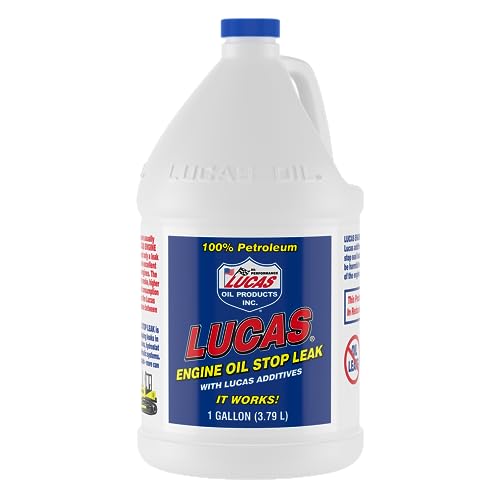
Compatible with petroleum, semi-synthetic, and full synthetic motor oils. Contains no harmful solvents and aims to reduce engine noise and oil consumption while raising oil pressure. Suitable for a broad range of engines, including those with moderate to significant seal wear, aiming for a balanced maintenance outcome.
XADO Atomex Oil Additive Stop Leak Engine

Elasticity restorer for rubber gaskets and seals, designed to stop engine oil leaks and rejuvenate seals. Engineered for all engines, including autos and motorcycles. The formula aims to stop leaks and improve seal performance, offering a cost-saving approach for ongoing leakage concerns and extended engine life through improved sealing integrity.
Buying Guide: Key Considerations When Choosing a Stop-Leak Product
- Oil compatibility: Most products are formulated to work with petroleum, semi-synthetic, and full synthetic oils. Confirm compatibility with your vehicle’s oil type before use.
- Engine condition: Seals in severely worn engines may respond differently. Stop-leak additives are typically best for minor to moderate seal wear, leaks around seals, or to reduce consumption rather than fix major gasket failures.
- Application scope: Some products target multiple systems (engine seals, transmissions, power steering), while others are engine-specific. Determine the leak source and select accordingly.
- Installation risk: Introduce additives as directed, and avoid combining multiple stop-leak products unless explicitly advised by the manufacturer to prevent chemical conflict.
- Vehicle type and mileage: High-mileage engines may benefit from dedicated high-mileage formulations with protective additives, but always monitor oil levels after application.
- Maintenance plan: Stop-leak products are typically part of a broader maintenance strategy, including timely oil changes, filter replacement, and leak diagnostics to prevent progression.
- Limitations: These products are not a substitute for mechanical repairs when leaks stem from cracked blocks, severely damaged seals, or other critical failures. Seek professional inspection for persistent leaks.
How to Use Stop-Leak Products Safely
- Read the label for dosage and compatibility with your oil type.
- Ensure the engine is cool before adding any additive.
- Pour into the oil reservoir as directed, typically at an oil change interval.
- Run the engine for several minutes to circulate the additive, then check oil levels and leak status over the following days.
- If leaks persist or worsen, discontinue use and consult a mechanic for a diagnostic.