Best Auxiliary Car Heaters for Quick Warmth and Clear Windows in Any Vehicle
Winter driving demands reliable auxiliary car heaters that deliver fast heat, defrost capabilities, and safe operation without stressing the engine. The following selections are 12V solutions designed for cars, trucks, SUVs, and RVs, offering quick warmth, windshield defogging, and versatile airflow. Each option opens via a direct 12V outlet and features rotating bases or multiple vents to target the windshield and cabin. Explore five top picks chosen for performance, safety, and ease of use.
| Product | Brand | Key Benefit | Power |
|---|---|---|---|
| 2026 New Upgraded Portable Car Heater | YGQ | Fast heat and windshield defogging | 12V |
| XuSha 8000 BTU 4 Ports 12V Heater | High output for larger cabins | 12V | |
| Saihisday 12V Car Auxiliary Heater | 4 vents for even distribution | 12V | |
| QEPJO Car Heater & Defroster | All-season 200W unit, defrost & cool | 12V | |
| DRAWLEY Car Heater Portable 12V 2-in-1 | Defrost and cooling in one unit | 12V |
YGQ 2026 New Upgraded Portable Car Heater

The YGQ portable heater delivers instant warmth when plugged into a 12V outlet, making it suitable for chilly commutes and road trips. Its compact design fits on the dashboard for quick access, and it claims rapid heat generation to help you reach comfort fast without overtaxing the car battery. A standout feature is its windshield defroster capability, designed to remove condensation, frost, and light snow, providing a safer, clearer view. The 360° rotatable base allows you to direct airflow precisely where needed, whether you’re heating the cabin or targeting the windshield.
In practice, the unit doubles as a deicer for the windshield, which can save time during winter mornings. It emphasizes safety, offering stable performance that doesn’t rely on engine warmth to achieve results. The overall design emphasizes portability and ease of use, so drivers can position it for defogging and warmth without complex installation. The included features support a quick setup, enabling predictable performance in adverse conditions.
XuSha 8000 BTU 4 Ports 12V Heater

The XuSha heater is described as a high-output unit suited for larger cabins or vehicles that require more robust heat. It uses a 5/8” water hose connection, indicating an integration approach for vehicles with existing coolant loops or dedicated water supply lines. The device emphasizes energy efficiency and low noise, with a focus on not draining the vehicle’s power while delivering significant heat. It requires a water tank hookup and power source to operate, enabling continuous warmth during cold starts without engine idling.
With 8000 BTU of output, the unit can rapidly raise cabin temperature and assist with defrosting. The multiple ports ensure airflow distribution to different areas of the vehicle, which can help in prioritizing windshield defogging and interior comfort. Installation considerations include ensuring compatible hose sizing and potential integration with an auxiliary cooling loop if used beyond heating alone. The manufacturer highlights small form factor and ease of installation as a benefit for users seeking a semi-permanent or semi-permanent solution.
Saihisday 12V Car Auxiliary Heater

The Saihisday model emphasizes a four-vent design to distribute heat more evenly across the passenger area and windshield. Operating on 12V, it provides a balance between power consumption and heat output, making it suitable for daily winter driving and short trips. The product notes include a 4-port under-dash configuration and a water hose connection requirement (16 mm inner diameter), suggesting a hybrid approach between air-based heating and potential water-cooled systems in some setups. The configuration supports defrosting and demisting functions to improve visibility during winter conditions.
Users should consider the required wiring and hose fittings when integrating with their vehicle’s existing electrical and cooling systems. The device’s compact footprint supports installation under the dash, which helps keep the cabin organized while delivering targeted airflow to critical areas such as the windshield and front seating zone. The feature set aligns with drivers seeking reliable auxiliary heating without engaging main engine heating systems.
QEPJO Car Heater & Defroster 200W

The QEPJO unit focuses on a compact, all-season function at 200W, designed to deliver rapid defrosting and cooling for broader comfort. It features a durable build with sacrifice for safety, including overheat protection and a practical design intended for both winter defrosting and summer cooling. The product highlights include a choice of modes to support year-round use and a robust accessory set for easy placement inside the vehicle. The 12V operation makes it compatible with most standard car outlets, ensuring quick deployment when needed.
Users can expect quick windscreen clearance and cabin warmth in one device, with emphasis on safety measures that reduce the risk of overheating. The dual-mode operation makes it versatile for seasonal needs, providing reliable defogging as well as cooling to counteract excessive heat in summer months. The compact form factor makes installation feasible in a variety of vehicle layouts while maintaining portability for travelers and daily commuters alike.
DRAWLEY Car Heater Portable 12V 2-in-1
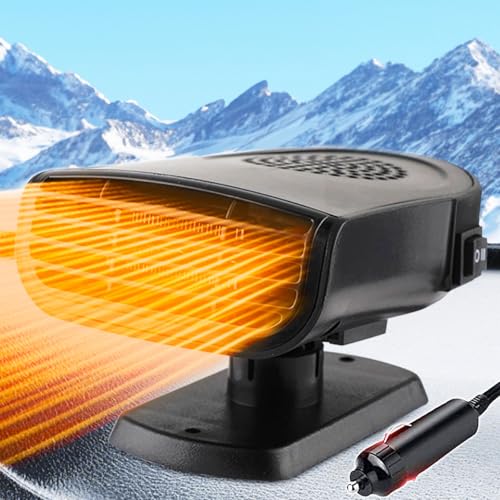
The DRAWLEY model markets a versatile 12V heater with a 2-in-1 capability, offering heating and cooling for all-season comfort. This unit is designed to defrost and defog windows effectively while also providing a cooling option for hot weather. Its 360° rotating base supports precise airflow direction, and the device is described as easy to operate via the cigarette lighter, making it accessible for everyday users. The combination of defrosting and climate control aims to support safer driving by maintaining clear visibility and comfortable cabin temperatures on winter and summer drives alike.
Considerations for this option include its compact power draw and the practicality of using it alongside other in-vehicle devices. The 12V power supply is standard, making it simple to deploy on most vehicles. The inclusion of a rotating base enhances usefulness by allowing airflow to be directed toward the windshield or toward the cabin, depending on the user’s immediate needs.
Buying Guide: Key Purchase Considerations For Auxiliary Car Heaters
- Heat output and coverage: Look for units with sufficient BTU ratings or wattage to meet your vehicle size and climate needs. Larger cabins benefit from higher output while compact cars can rely on smaller units.
- Defrosting and demisting capabilities: Prioritize models with strong defogging features and windshield targeting. Quick clearance improves safety and visibility in winter driving.
- Power requirements: Most 12V devices are compatible with standard vehicle outlets. Consider how many other devices you’ll power and the impact on battery life during idle or startup conditions.
- Airflow direction and mounting: A 360° base or multiple vents helps direct heat where needed. Check whether mounting is dashboard-friendly or requires dash space, with attention to vibration and stability.
- Noise and comfort: Some units run quietly while others may produce noticeable fan noise. For long trips, quieter operation can improve overall comfort.
- Safety features: Overheat protection, automatic shutoff, and fuse protection reduce risk during operation. Verify that the device has safeguards suitable for vehicle use.
- Installation considerations: Some heaters require water hoses or coolant connections; others are standalone air heaters. Ensure compatibility with your vehicle’s configuration and any necessary accessories.
- Maintenance and durability: Look for durable housings, reliable components, and simple maintenance tasks like filter cleaning or airflow checks.
- All-season versatility: If you want year-round use, evaluate units with both heating and cooling modes to maximize value across seasons.
- Warranty and support: A solid warranty and accessible support help when troubleshooting or replacing parts after prolonged use.
These options provide a range of approaches to auxiliary heating, from direct air heaters to more integrated, water-assisted designs. When selecting, balance heat output, installation complexity, and safety features against your vehicle type and typical winter needs. By reviewing the listed features and user needs, you can choose a unit that delivers reliable warmth, improves visibility, and enhances comfort during cold drives.