Best Check Engine Light Diagnostic Tools for Quick Car Troubleshooting
Choosing a reliable check engine light diagnostic tool helps pinpoint emissions and engine issues without a trip to the shop. The following five OBD II scanners offer a mix of quick code reading, live data, MIL control, and broader diagnostics. They are selected for broad vehicle compatibility, user-friendliness, and value. Use the buying guide below to compare performance, ease of use, and language or firmware options that fit your needs.
Summary of chosen products:
| Product | Brand | Key Benefit | Compatibility | Live Data |
|---|---|---|---|---|
| ANCEL AD310 Classic Enhanced Universal OBD II Scanner | ANCEL | Fast DTC reading/clearing; compact and durable | 1996+ OBDII vehicles | Yes |
| FOXWELL NT301 OBD2 Scanner | FOXWELL | Live data graphing; reliable fault code reading | Most worldwide cars with OBDII | Yes |
| ANCEL AD410 Enhanced OBD2 Scanner | ANCEL | Code reading/clearing plus EVAP and O2 tests | 1996+ US/EU/Asian vehicles | Yes |
| OnRetul OBD2 Scanner (V519) | OnRetul | Extensive DTC library; overview of I/M readiness | Most 1996+ vehicles | Yes |
| Autel MS309 Universal Car Engine Fault Code Reader | Autel | Broad compatibility; essential OBDII functions | 1996+ US vehicles; SGW limitations for some FCA | No live data shown in table |
ANCEL AD310 Classic Enhanced Universal OBD II Scanner
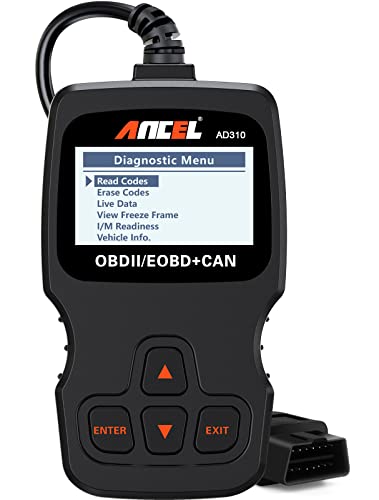
The ANCEL AD310 is a compact, widely used OBD II scanner designed to quickly identify the cause of the check engine light. It reads and clears diagnostic trouble codes for the emission system, displays freeze frame data, and provides I/M readiness status. The device operates directly from the vehicle’s OBDII port and does not require batteries. It is praised for speed and accuracy, with a straightforward interface suitable for DIY users and mechanics alike. Its durable build and clear display support frequent on-road diagnostics.
Key features include CEL diagnosis, live data access, freeze frame, and memory data retrieval. Its 2.5-foot cable with sturdy insulation minimizes accidental drops in the shop or driveway. The AD310 balances portability with reliable performance, making it a common entry point for checking engine faults quickly.
Performance considerations: It excels at rapid code reading/clearing and basic live data. It does not offer advanced reset capabilities for ABS or other non-emission systems, and users seeking deeper system tests may want a model with broader coverage or enhanced live data graphs.
FOXWELL NT301 OBD2 Scanner

The FOXWELL NT301 provides robust fault code reading with live data streaming and graphing. It supports DTC retrieval, readiness status, and VIN retrieval where available. A notable limitation is that it does not cover ABS, TPMS, SRS, or other systems beyond basic OBD II; it is best for straightforward engine diagnostics and monitoring. Its user interface emphasizes clarity, helping technicians and DIY users interpret data quickly during checks before and after repairs.
Live data graphing is a standout feature, enabling trend spotting of sensor data to identify anomalies. The NT301 focuses on core OBD II functions and safe, quick interpretations of fault codes for most global vehicles that are OBDII compliant. It is suitable for those who want a reliable, no-frills code reader with dependable data visualization.
ANCEL AD410 Enhanced OBD2 Scanner

The AD410 Enhanced OBD2 Scanner is designed for broader diagnostic capability, including rapid reading and clearing of fault codes and a focus on enhanced OBDII diagnostics. It offers O2 sensor testing and EVAP system monitoring, which helps diagnose emissions-related issues. While it can reset the MIL and provide readiness checks, it notes that it does not support non-emission systems like ABS or SRS. Multilingual support makes it a practical choice for international users, and it is powered directly from the vehicle’s OBDII port.
Potential considerations include its emphasis on engine/emission diagnostics rather than full-system resets. For users who want EVAP and O2 testing in a single device without a broader system diagnostic tool, the AD410 provides a solid balance of capability and portability.
OnRetul OBD2 Scanner V519

The OnRetul V519 is a full-featured professional OBD2 scanner with extensive DTC coverage and live data capabilities. It supports I/M readiness checks, VIN retrieval, battery voltage tests, and a comprehensive data stream for diagnosis. The device emphasizes depth with a large DTC library, making it well-suited for DIY enthusiasts who want a broader diagnostic reach and better fault-code context. It presents a balance between ease of use and advanced diagnostics, suitable for home mechanics and small shops.
Limitations to consider include the size of the device and the learning curve for beginners. The V519’s rich features are most effective for users who routinely diagnose a range of vehicle makes and want detailed fault-code definitions and live data analytics to guide repairs.
Autel MS309 Universal Car Engine Fault Code Reader

The Autel MS309 focuses on broad OBDII compatibility and essential engine fault code reading. It includes basic features such as reading and clearing codes and a simplified approach suitable for everyday users. It also notes FCA SGW-related limitations for certain vehicles manufactured after 2017, so buyers should verify compatibility with their vehicle make and model before purchase. The MS309 is plug-and-play and user-friendly, making it a practical option for quick diagnostics without a learning curve.
Important considerations: it’s not a full-service scanner; it lacks some advanced functions found in premium models. For many users, the MS309 delivers dependable OBDII functionality at a low price, ideal for routine maintenance checks and basic troubleshooting.
Buying Guide: Key Purchase Considerations
- Vehicle compatibility: Ensure the device supports your year, make, and model. Some scanners exclude FCA vehicles or require confirmation for SGW security systems.
- Diagnostic scope: Decide whether you need only basic code reading or broader capabilities like live data, EVAP tests, O2 sensor checks, and I/M readiness.
- Live data and graphs: If you want to monitor sensor trends, choose a model with live data streaming and graphical displays.
- Ease of use: For beginners, a clear interface and straightforward menu structure reduce the learning curve. Built-in DTC libraries help interpret codes.
- Power and portability: Battery-free operation via the vehicle’s OBDII port simplifies use in the field; consider cable length and device weight for portability.
- Language support: Multilingual options can be beneficial for international users or technicians working with diverse clients.
- Price-to-value balance: Compare DTC libraries, compatibility breadth, and additional tests (EVAP, O2 sensors) against price to determine value.