Best Cheap Outboard Motor Options for Budget Boaters
For boaters looking to extend lake time, explore new waters, or outfit a small craft without breaking the bank, affordable outboard motors offer practical power and portability. This article highlights five cost-conscious options with solid reliability, thoughtful features, and suitable performance ranges for freshwater and saltwater use. Each pick is evaluated on build quality, power output, cooling and ignition features, and overall value to help you choose confidently.
Summary of chosen products
| Product | Brand | Key Features | Power & Type |
|---|---|---|---|
| LIWBYYG 18HP Outboard Motor | LIWBYYG | Water cooling, CDI ignition, lightweight aluminum, 8-inch three-blade prop, noise reduction | 18 HP, 2-stroke |
| HANGKAI 12 HP Long Shaft | EnSyuSuMa | 2-stroke, CDI ignition, water cooling, high load capacity (2204 lbs) | 12 HP, 2-stroke |
| 52CC 2.3 HP Outboard | KTYHNPM | Forced air cooling, CDI ignition, quick start | 2.3 HP, 2-stroke |
| 2 Stroke 3.5 HP Outboard | DNYSYSJ | Manual start, water cooling, CDI system | 3.5 HP, 2-stroke |
| Newport Electric NT300 | Newport Vessels | Brushless direct drive, 110 lb thrust, 66-mile range, digital throttle | 3 HP equivalent, electric |
LIWBYYG 18HP Outboard Motor

The LIWBYYG 18HP model combines sturdy aluminum construction with a water-cooled two-stroke engine. Its design emphasizes heat resistance and impact durability for both fresh and saltwater use. A large muffler helps isolate most of the engine noise, producing a quieter boating experience around 80 decibels. This outboard’s maximum output reaches 18 horsepower at 5500 rpm, supported by an efficient 8-inch, three-blade propeller to minimize water resistance and maximize speed. A CDI ignition system allows reliable starts, while a tail plate clamp secures the motor firmly to the boat, reducing movement during rough water rides. The soft, rubber-wrapped handle improves grip and control during mounting and operation.
Potential considerations: as with many budget two-stroke units, fuel efficiency and long-term reliability depend on regular maintenance and proper lubrication. The unit’s water cooling and overheating protection help protect the engine during extended runs, but users should monitor all cooling passages and ensure proper mixing ratios if applicable. This model is suitable for boats needing quick, lightweight power with straightforward maintenance at a lower upfront cost.
HANGKAI 12 HP Long Shaft

The HANGKAI 12 HP long-shaft outboard is a compact, budget-conscious option featuring a 169cc, 2-stroke engine. It delivers strong performance within the 4500–5500 rpm range and up to 8.8 kW maximum power. A robust aluminum alloy build contributes to durability, while a 6.34-gallon fuel tank supports several hours of cruising, aligning with a use-case scenario of short to moderate trips. The CDI ignition system ensures quick starts and dependable operation. This model emphasizes load-bearing capability, advertised at a capacity of around 2,204 pounds, which broadens its suitability for larger crafts or additional gear without compromising performance. Fuel efficiency is optimized by a two-stroke design that balances power and economy for budget-minded boaters.
Considerations: long-shaft configurations provide better shaft alignment for deeper transoms, but overall weight distribution and mounting hardware choices will influence boat handling. This option is best when you need reliable horsepower with extended endurance at a reasonable price point for small to mid-size vessels.
52CC 2.3 HP Outboard
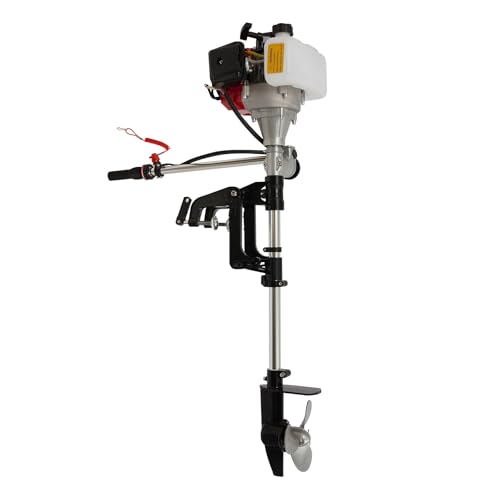
The 52CC 2.3 HP class from KTYHNPM focuses on lightweight, compact propulsion for smaller boats and aquaculture vessels. It features a forced air cooling system paired with a CDI ignition, plus a quick-start hand-pull mechanism for rapid readiness on the water. The combination of a 2-stroke design with efficient cooling helps manage heat during short to medium-length outings. With up to 8,500 rpm and practical small-boat performance, this unit serves as an economical entry point for anglers or hobbyists seeking basic propulsion without the complexity of larger motors.
Strengths: small footprint and low weight maximize portability and ease of storage. The motor is well-suited for kayaks, canoes, or small aluminum boats where modest thrust and reliable starts are key. Limitations to consider include lower endurance and less torque compared to higher horsepower options.
DNYSYSJ 3.5 HP Outboard

The DNYSYSJ 3.5 HP outboard is a compact, 2-stroke engine designed for smaller boats and casual use. It features a manual start system, CDI ignition, and a water cooling loop to prevent overheating during extended use. The engine’s full-throttle operating range and a top speed around 20 km/h (with four people noted in typical tests) makes it a suitable option for lightweight craft or as a dependable auxiliary motor on larger boats. The emphasis on user-friendly operation makes it attractive for newer boaters or those needing a simple, economical propulsion solution without advanced electronics.
Operational notes: while 3.5 HP is modest, combining this motor with a light-defined hull can yield practical speed and efficiency for fishing or sightseeing. Maintenance should focus on proper lubrication, cooling, and ensuring CDI components stay clean and dry for consistent starts.
Newport NV-Series 55lb Thrust Electric

The Newport NV-Series electric trolling motor provides a different propulsion philosophy by delivering 55 pounds of thrust with a 30″ shaft. This budget-friendly electric option is designed for trolling: it operates quietly to avoid spooking fish, and includes an LED battery meter for monitoring. With eight speeds (five forward, three reverse) and a variegated range, this motor supports all-day trolling sessions when paired with a suitable 12V battery setup. The 5-LED indicator, adjustable mount, and tiltable tiller handle add to its versatility for multiple boat sizes and water conditions. Since it is electric, users should plan for battery life and charging needs in advance of trips.
Considerations: electric motors are quiet and low-maintenance, but battery capacity and charging infrastructure are critical. For long outings, verify battery availability and weight distribution on the boat to maintain balance and performance.
Newport NT300 Electric Outboard

The Newport NT300 electric outboard is a 36V system that delivers 110 pounds of thrust with a brushless direct-drive configuration. It targets saltwater and freshwater use with quiet operation and low maintenance, including a digital throttle and LCD display for monitoring. The shaft length is 24.6 inches, and the 2-blade composite propeller provides reliable performance. Trim/tilt options (0°, 7°, 14°, 21°) and field-oriented control contribute to responsive navigation in varying water conditions. The top speed sits around 6.5 mph, with an impressive potential range depending on battery capacity, boat weight, and water conditions. This option suits boaters seeking a higher-efficiency, electric alternative to gas engines for smaller crafts.
Key considerations: battery life is a defining factor for range and performance. While the NT300 offers strong thrust and quiet operation, this power source requires careful planning for charging logistics on longer trips or remote locations.
Buying Guide: Key Purchase Considerations
- Boat size and weight: Match horsepower and propulsion type to hull strength and weight-bearing capacity to avoid performance loss or handling issues.
- Power source and maintenance: Gasoline engines require fuel mix and emission considerations, while electric motors emphasize battery capacity, charging availability, and overall energy efficiency.
- Intended use: For casual cruising, light fishing, or backwater exploration, smaller engines or electric motors may offer the best balance of cost and efficiency; for faster planing or heavier loads, higher horsepower units may be warranted.
- Cooling and ignition systems: Water cooling and CDI ignition generally improve reliability and starting performance, while air cooling may be adequate for very light, low-demand use.
- Long shaft vs short shaft: Choose based on transom height to ensure proper propeller immersion and optimal thrust without cavitation or vibrations.
- Noise and vibration: Noise reduction features and robust mounting hardware improve comfort and reduce operator fatigue, especially on longer trips.
- Maintenance and spare parts: Availability of parts and service support can influence downtime and total ownership costs.