Best No Smoke Oil Additives for Cleaner Emissions and Quieter Engines
Oil-burning engines and smoky exhaust can indicate wear or leaks that impact performance and emissions. The following no-smoke oil additives are designed to reduce oil consumption, seal leaks, lower exhaust smoke, and restore compression. This guide highlights five top products, summarizes their purposes, and explains key purchase considerations to help you choose the right solution for your vehicle.
| Product | Brand | Main Benefit | Volume |
|---|---|---|---|
| Bardahl NoSmoke + StopLeak | Bardahl | Reduces oil burning, seals leaks, lowers smoke | 16 fl oz |
| Liqui Moly Oil Smoke Stop | Liqui Moly | Minimizes blue exhaust smoke | 300 ml |
| BlueDevil Stop Smoke & Engine Repair | BlueDevil | Reduces exhaust smoke, restores compression | 16 oz |
| Bar’s Leaks 1000 High Mileage Engine Repair | Bar’s Leaks | Stops leaks, reduces noise and smoking | 16.9 oz |
| Bar’s Leaks OS-1 Oil Seal | Bar’s Leaks | Repairs seals and burns less oil | 16.9 oz |
Note: All products listed are intended to address oil burning, smoke, leaks, and related engine performance issues. Always follow product directions and consult your mechanic if engine damage is suspected or if the vehicle has critical leaks or overheating concerns.
Bardahl NoSmoke + StopLeak (16 fl oz)

The Bardahl NoSmoke + StopLeak is designed to address oil burning and excessive exhaust smoke by filling in loose tolerances with an extra-thick formula. It acts as an oil leak sealer to reduce engine noise and quiet lifters, while helping restore the reliability of dry seals. The formula also aims to improve emissions by reducing pollutants in the exhaust, helping engines stay within standards as wear progresses. This product targets older engines where tolerances have widened and leaks are more common.
Key features include: reducing oil burning, sealing gaps to quiet noisy lifters, and supporting cleaner exhaust emissions. It’s presented as a comprehensive stop-leak solution that can help a vehicle run cleaner and smoother, with the added benefit of noise reduction. Use as directed for best results, especially in engines with noticeable oil consumption or smoke.
Liqui Moly Oil Smoke Stop (300 ml)

Liqui Moly Oil Smoke Stop is formulated to minimize blue exhaust smoke by addressing wear-related gaps in engine internals. The product’s high-viscosity composition helps seal gaps created by wear in internal parts and is compatible with common petrol and diesel engine oils. It is specifically designed to reduce oil burning and, therefore, blue smoke emissions, helping the engine run cleaner. Applicability spans many gasoline and diesel engines where oil consumption and smoke are present concerns.
Key features include high viscosity for effective sealing of wear gaps, compatibility with typical engine oils, and targeted reduction of blue smoke. It’s positioned as a practical additive for persistent blue smoke issues, particularly in engines with noticeable oil loss or burning symptoms. Follow the label instructions for dosage and usage intervals.
BlueDevil Stop Smoke & Engine Repair (16 oz)

BlueDevil Stop Smoke & Engine Repair is designed to reduce exhaust smoke while driving and restore engine compression. The product works continuously as you drive, aiming to soften worn seals and expand rings, which can help stop blue and white smoke caused by oil burning. It also supports improved compression, potentially enhancing engine performance and fuel efficiency. The formula emphasizes real-time benefits, with a focus on field-use practicality rather than off-vehicle repairs.
Key features include smoke reduction, restoration of compression, and reconditioning of seals and rings. It is marketed as a practical, on-the-go solution for engines displaying smoke and compression issues, useful for daily drivers with moderate wear or early-stage sealing problems. Adhere to application directions for safe and effective results.
Bar’s Leaks 1000 High Mileage Engine Repair (16.9 oz)
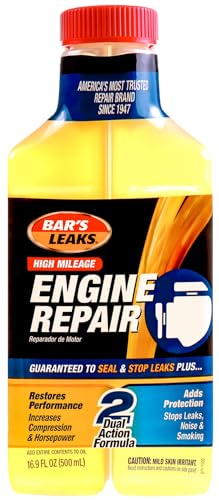
Bar’s Leaks 1000 High Mileage Engine Repair is designed for high-mileage engines and claims to restore performance by sealing leaks, reducing oil consumption, and diminishing noise. It includes additives intended to rebuild compression and support efficient sealing of worn cylinders, rings, bearings, and seals. The product is positioned as a preventive option to address common oil-related problems in aging engines, potentially delaying more extensive repairs.
Key features include restoring compression and horsepower, stopping leaks and smoking, and reducing noise. It’s aimed at vehicles that show symptoms of oil loss or leakage and are beyond their early-life stage. Follow dosage guidelines for best results, and consider whether your engine has multiple issues before applying.
Bar’s Leaks OS-1 Oil Seal Engine Oil Burning & Leak Repair

Bar’s Leaks OS-1 Oil Seal offers an oil seal repair approach aimed at burning oil and leaks. It targets worn main seals and gaskets in gasoline and diesel engines, including turbocharged and hybrid configurations. The product claims to renew worn valve seals and guides, reducing oil burning and blue exhaust smoke. It is described as suitable for a wide range of engines, with dosage levels adapted to engine size and type.
Key features include sealing and renewing seals and guides, stopping burning and blue smoke, and compatibility with multiple engine configurations. It provides a preventive option for engines showing early signs of oil loss or leakage and can be used in various vehicle applications. Always verify compatibility with your engine’s specifications and follow dosing instructions.
Buying Guide: Key Purchase Considerations
- Engine condition: Choose products aligned with your engine’s wear level. Older engines with noticeable oil burning may benefit from higher-viscosity formulas and seals-focused solutions.
- Primary symptom: If you primarily see blue smoke, look for products emphasizing oil-seal restoration and gap sealing. If leaks are prominent, a seal-repair or stop-leak formulation may be more appropriate.
- Volume and dosage: Consider the recommended treatment duration and the vehicle’s oil capacity. Some products are designed for a single treatment, others for ongoing use.
- Oil compatibility: Ensure the additive is compatible with your engine oil type (conventional, high-mileage, or synthetic) and with petrol or diesel engines as specified.
- Emissions and monitoring: Some formulations claim emission improvements. If emissions are a concern, verify whether the product claims align with your vehicle’s standards and testing requirements.
- Seal and gasket targets: If your focus is sealing worn seals and guiding components, prefer products marketed as seal restorers or oil-seal repairs, and check for compatibility with your engine layout.
- Installation and safety: Follow manufacturer directions for dosage and usage intervals. Do not mix multiple additives unless explicitly approved by the manufacturers or a professional.
- Maintenance plan: Additives can complement mechanical fixes (oil leaks, worn seals) but are not a substitute for essential repairs. Consider professional inspection for persistent or severe symptoms.
Different perspectives exist on the effectiveness of no-smoke oil additives. Some users report reductions in blue smoke and improved engine feel, especially in high-mileage engines. Others emphasize that results vary by engine condition and driving habits. When evaluating options, compare product claims with your vehicle’s diagnostic findings and consult a trusted mechanic if the symptoms persist or worsen.