Best Aftermarket HUD Display Solutions for Cars
For drivers seeking safer, hands-free speed and vehicle data, aftermarket heads-up displays (HUD) offer clear insights directly in your line of sight. This guide spotlights five top HUD models, comparing their technology, compatibility, and standout features. Learn how GPS and OBD2 options, auto-brightness, and multi-parameter dashboards can enhance driving safety and situational awareness without distracting from the road.
Summary Table Of Selected Products
| Product | Brand | Key Features | Connectivity |
|---|---|---|---|
| Heads up Display for Cars, K1-White | KUOWEIHUD | GPS+BDS, 10Hz refresh, auto brightness | GPS |
| OBD2 Heads Up Display Dual System | MAIMEIMI | OBD2 + GPS, 15+ metrics, turn indication | OBD2 + GPS |
| KUOWEIHUD Car HUD Speedometer | KUOWEIHUD | Speedometer, auto brightness, USB plug & play | GPS + USB |
| 5.5″ HUD Head Display | VGEBY | Overspeed alarm, rich data, fault codes | OBD II / EUOBD |
| wiiyii OBD2 Gauge Display HUD | wiiyii | 10 interfaces, readouts, dual install options | OBD2 + GPS |
Heads Up Display for Cars, K1-White

The K1-White HUD from KUOWEIHUD combines dual GPS/BDS satellite reception with a 10 Hz refresh rate, delivering real-time speed data that remains synchronized with up to 32 satellites. Its true windshield projection places speed metrics directly in the driver’s line of sight, reducing the need to glance away from the road. An intelligent brightness sensor automatically adjusts the display for daytime clarity and nighttime comfort, minimizing glare while preserving legibility in varied lighting conditions.
This model emphasizes quick setup and stability, with plug-and-play USB connectivity and a large font design to maximize readability. The combination of GPS precision, robust satellite coverage, and adaptive brightness makes it suitable for daily commutes and longer trips where consistent speed monitoring matters for safety and fuel planning.
OBD2 Heads Up Display Dual System

This MAIMEIMI HUD merges OBD2 speed data with GPS-based speed readings, delivering synchronized measurements across two independent systems. The device supports more than 15 real-time metrics, including water temperature, voltage, RPM, mileage, and driving time, with customizable overspeed, overheating, voltage, and RPM alerts. Turn indication can be projected via a companion app, helping drivers anticipate lane changes or exits without diverting attention from the road.
Designed for broad vehicle compatibility (2008+ sedan platforms commonly equipped with OBD2), it offers an all-in-one dashboard experience. The dual-mode approach ensures reliable speed data even if GPS coverage is intermittent, and the appended alarms provide additional safety signals during long drives and highway cruising.
KUOWEIHUD Heads Up Display With USB

This KUOWEIHUD model emphasizes easy USB plug-and-play installation, compatibility with a broad range of vehicles, and automatic brightness adjustment to reduce glare while driving. The display presents essential metrics such as vehicle speed and, where supported, RPM and fuel data via the HUD projection. The high-contrast digits are designed for quick recognition at a glance, and the auto-brightness feature helps maintain legibility in urban daylight and dusk lighting scenarios alike.
With stable GPS reception and a straightforward mounting approach, this unit suits drivers who want a no-fuss upgrade that blends into standard vehicle dashboards. It’s a practical choice for commuters, fleet operators, and casual road trippers who value real-time speed visibility without distraction.
5.5″ HUD Head Display
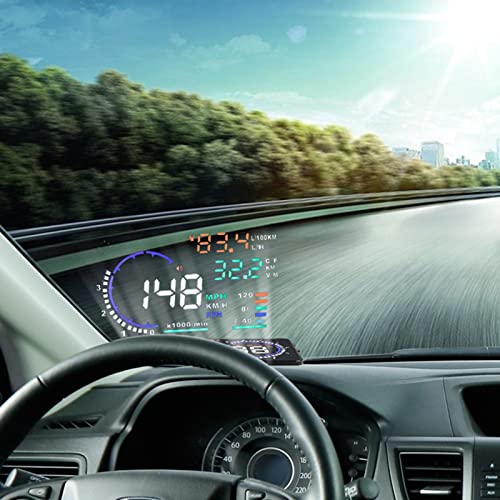
The VGEBY 5.5″ HUD Head Display emphasizes safety through a front-dash projection that minimizes the need to look away from the road. It features auto power on/off aligned with the vehicle’s status and a high-definition display capable of adjusting brightness for both bright daytime contexts and dim nighttime driving. The device presents a comprehensive array of data points, including speed, RPM, water temperature, battery voltage, instantaneous and average fuel consumption, and mileage. It also supports fault code display to aid in early maintenance awareness.
Equipped to work with vehicles that support OBD II or EUOBD interfaces, this HUD acts as a versatile, mid-size option for drivers who want a broad sensor feed in a compact unit. The rich data set and alert capabilities make it suited for enthusiasts who track vehicle performance or owners who want a broad snapshot of engine health on the go.
wiiyii OBD2 Gauge Display HUD
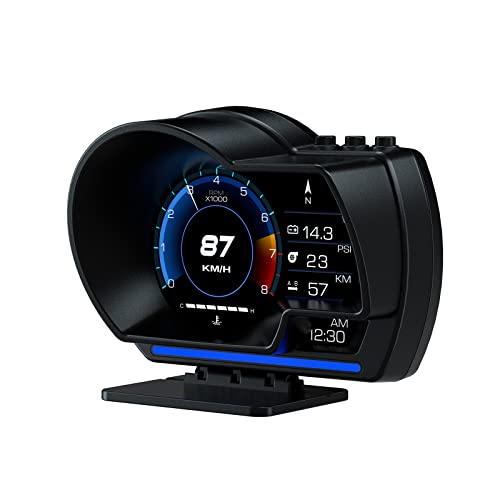
The wiiyii OBD2 Gauge Display offers a flexible HUD experience with 10 interface options and dual installation methods—dashboard or windshield—allowing drivers to tailor the projection angle and placement for optimal viewing. It emphasizes safety by presenting speed and RPM at a glance, with the option to display fault codes, enabling proactive maintenance and quicker troubleshooting. The unit is designed for broad compatibility with modern vehicles equipped with OBD II interfaces and supports data streams from multiple sensors, making it a practical choice for drivers who want a more data-rich HUD experience without distraction.
AZIJYV Windshield Speedometer Projector

The AZIJYV windshield speedometer provides a GPS-based speed readout with a dedicated over-speed alarm and a GPS compass to display direction. It is designed as a flat-screen projection that makes the most of the windshield’s surface area, placing critical data within the driver’s line of sight. The unit supports both MPH and KM/H, with settings that allow drivers to switch units as needed. This approach emphasizes a simplified yet informative readout that helps drivers maintain awareness of speed and travel direction without peering down at the dashboard.
X100 Wireless HUD With Solar Power

The X100 HUD introduces a solar-powered, dual charging system with USB/USB-C options for continuous operation. Its LCD display features a carbon-fiber aesthetic for enhanced readability, with large digits designed for quick speed checks. Auto-brightness ensures readability under daylight and night driving conditions. The device emphasizes GPS-based time synchronization and speed calibration for good accuracy, making it a sustainable option for drivers who want lower energy reliance on the vehicle’s electrical system and an easy, recyclable power source on long trips.
Buying Guide: Key Purchase Considerations
- Data sources and accuracy: Consider whether the HUD relies on GPS, OBD II data, or a combination. GPS-based units offer speed and directional data across most vehicles, while OBD II-enabled models can provide engine metrics like RPM, temperature, and fuel usage for a richer readout.
- Display characteristics: Look for auto-brightness, high-contrast fonts, and projection clarity. A large font and adjustable brightness improve readability without causing glare. Ensure the projection does not obstruct your view.
- Vehicle compatibility: Verify that the unit supports your vehicle’s connection type (USB, OBD II, EUOBD) and that it can be installed without specialized tools. Some models are universal, while others are best suited for specific makes or models.
- Alerts and alarms: Overspeed, fatigue, and voltage alarms can boost safety by providing proactive warnings. Check whether these alerts are customizable to suit local regulations and personal driving habits.
- Installation and mounting: Assess whether the HUD offers dashboard or windshield mounting, and whether it requires additional brackets, power adapters, or app integration for features like turn indication.
- Power and reliability: Evaluate whether the unit has auto power on/off based on ignition status and if it supports solar charging, USB-C, or dual power options for extended use in trips or fleets.
- Data richness vs distraction: A more feature-rich HUD can provide valuable information, but ensure the display remains non-distracting. Prioritize models that project essential data clearly and minimize cognitive load during driving.
- Software and app support: Some models rely on companion apps for settings like turn indication or firmware updates. Confirm compatibility with your smartphone’s OS and available updates.
- Maintenance and support: Choose brands with clear warranty terms and accessible customer support. Regular firmware updates can improve accuracy and expand supported metrics over time.
- Cost of ownership: Consider initial price, potential installation costs, and long-term value from features like multi-metric dashboards and alarms. A mid-range HUD with reliable data is often optimal for daily drivers.