Best Budget Fish Finders: Affordable Models for Every Angler
Finding a reliable fish finder on a budget is easier than ever with compact, feature-rich options designed for kayaks, small boats, and entry-level anglers. This guide highlights five affordable devices that balance clarity, simplicity, and value. Each entry includes key features, a quick visual, and direct access to the product page for easy comparison. Whether you’re trolling for bass or mapping structure, these budget-friendly fish finders can help you locate more fish without breaking the bank.
| Product | Brand | Key Feature |
|---|---|---|
| Humminbird PiranhaMAX 4 | Humminbird | Dual Beam Sonar for detail and broad coverage |
| Garmin Striker 4 | Garmin | 3.5″ GPS with Chirp and high-detail scanning |
| LUCKY Kayak Portable Fish Depth Finder | LUCKY | Portable handheld with depth and water bottom details |
| Yoocylii Handheld Fish Finder | Yoocylii | Castable handheld unit with sonar and LCD |
| HawkEye FishPod 5X | Hawkeye | Bluetooth-enabled, compact depth/fish readings |
Humminbird PiranhaMAX 4 Fish Finder with Transducer

The Humminbird PiranhaMAX 4 uses dual beam sonar to offer both detailed narrow views and broader coverage. This setup helps identify fish, structure, and contours with greater clarity. The unit includes a tilt and swivel mount for flexible viewing angles and carries a 1-year limited warranty. While designed as an entry-level model, its dual-beam capability provides versatile performance at a budget-friendly price point.
Garmin Striker 4 with Transducer

The Garmin Striker 4 offers ClearVü scanning sonar for detailed object and fish visualization. It features a high-frequency sonar for near-photographic imagery, a straightforward button interface, easy installation, and multiple display sizes (3.5, 5, and 7 inches). It’s IPX7 water-rated and includes waypoint navigation to mark brush piles, stumps, and docks. Depth capabilities reach up to 1,600 feet freshwater and 750 feet saltwater, making it a versatile budget option for various setups.
LUCKY Kayak Portable Fish Depth Finder
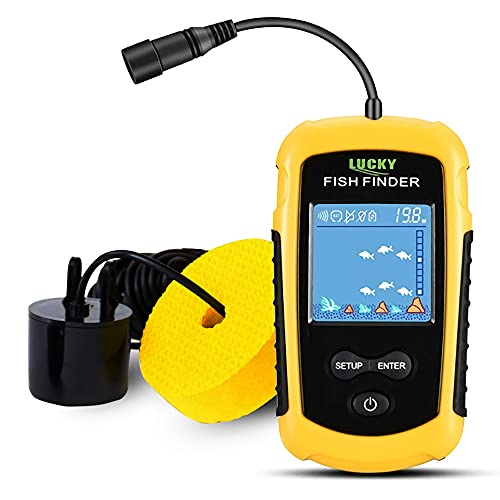
This portable handheld fish finder is designed for kayaks and small boats, showing approximate fish location, water depth, and bottom features like weeds, sand and rocks. Depth range spans from 3 feet to 328 feet, with meters/feet conversion and a backlit display for use in bright sunlight or darkness. Its compact, neck-strap design makes it easy to carry and operate while moving, and it supports various water conditions with multiple sensitivity levels.
Yoocylii Handheld Fish Finder

This handheld unit displays water depth, approximate fish location, and bottom features like weeds, sand, and rocks. It’s suitable for kayak, dock, and ice fishing use, with a 4 AAA battery runtime and a 200 kHz sonar frequency. The 45-degree beam angle under the transducer helps cover a broad area, and the device includes a neck strap for hands-free use. It’s designed for portability and straightforward operation in various water conditions.
HawkEye FishPod 5X Bluetooth Fishfinder

The HawkEye FishPod 5X is a compact, Bluetooth-enabled fishfinder that offers basic depth readings and fish location data. It’s designed for simple, on-the-go use with quick setup and easy interpretation of sonar results. While it may lack some advanced features found in higher-end models, its simplicity and portability make it a solid choice for budget-minded anglers who want a straightforward tool for locating fish.
Buying Guide
Key purchase considerations for budget fish finders include display size, sonar features, and ease of use. Double-check that the device supports your fishing environment, whether freshwater or saltwater. Consider transducer type and mounting options, as these affect installation and performance on smaller boats, kayaks, or handheld setups.
- Display and interface: Look for clear displays with intuitive controls. A 4-inch or larger screen is easier to read in sunlight and reduces eye strain on long trips.
- Sonar capabilities: Dual beam or CHIRP options improve target separation. For beginners, a basic CHIRP or high-frequency sonar is typically sufficient for locating fish and structure.
- Depth range and GPS: Depth ratings should match your typical fishing grounds. If you fish in unfamiliar waters, GPS and waypoint features help with navigation and return trips.
- Durability and water resistance: IP ratings indicate water exposure tolerance. Choose models with solid construction if you expect splashes or rain.
- Power requirements and portability: Consider battery life, power draw, and whether the unit is handheld, portable, or permanently installed.
- Ease of use vs. features: Budget models often trade advanced features for simplicity. Prioritize the basics: accurate depth, good sonar readability, and reliable mounting.
When comparing models, align features with your fishing style: handheld devices suit casual or portable setups, while transducer-based units pair well with small boats. Budget options can still deliver meaningful improvements in finding structure and locating fish, provided you choose a model that matches your typical waters and fishing technique.