Best RV Antenna Booster for Clearer Signals on the Road
For RV travelers, dependable reception means better streaming, clearer calls, and more channels while on the move. The following five options emphasize strong signal amplification, ease of installation, and broad compatibility with U.S. carriers or Free HDTV channels. Each product is designed to improve performance in RV environments, whether you’re parked or on the highway.
| Product | Brand | Key Benefit |
|---|---|---|
| Atcall Cell Phone Booster for RV Trucks | Atcall | Up to 50dB gain; supports 5G/4G LTE across all U.S. carriers |
| RV Antenna for Camper (GZMJRD) | GZMJRD | 720° reception with auto signal filtering; long 35ft cable |
| Winegard Wingman RV Antenna Booster | Winegard | Enhanced UHF reception and extended range |
| Yimayinu 2025 Upgraded TV Antenna | Yimayinu | 1600+ miles range with HD/4K/8K support; indoor/outdoor use |
| JoyfulPaws 2025 TV Antenna | JoyfulPaws | 360° reception with 2200+ miles range; free HDTV channels |
Note: Each product listed below expands on how these boosters and antennas support RV travel, including installation notes, signal strength, and compatibility considerations for different campsites and travel conditions.
Atcall RV Cell Signal Booster For Vehicles

The Atcall cell phone booster is designed for RVs, trucks, and campers, delivering strong signal improvements for voice calls and data. With a claimed maximum gain up to 50dB, it targets improved voice quality and faster data speeds while supporting multiple users and devices simultaneously. The booster explicitly lists compatibility with all major U.S. carriers (Verizon, AT&T, T-Mobile, Sprint, U.S. Cellular) and supports 5G and 4G LTE bands, including popular bands such as 12/17, 2/25, 5, 13, and 4/66. An intuitive LED indicator helps diagnose operating status and troubleshoot band performance. This makes it suitable for RV setups where multiple devices require reliable connectivity during travel or remote camping adventures.
Key considerations: verify your vehicle’s interior layout to ensure optimal placement of the booster, ensure proper antenna placement for best uplink/downlink, and check that the system is FCC compliant. The product description emphasizes multi-user functionality, which is helpful for families or groups traveling together.
GZMJRD RV Antenna For Camper
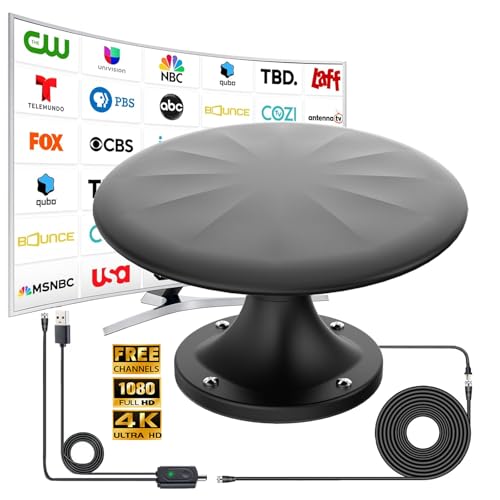
This roof-mounted RV antenna aims at long-range, omnidirectional reception with a focus on digital HDTV signals. The listing highlights free 4K/HD channels from major networks (ABC, CBS, NBC, etc.) and an upgraded IC chip that can receive 720° signals while filtering cellular and FM interference. The 35-foot extra-long coax cable adds installation flexibility, allowing placement where the strongest signal is detected, even on larger RVs. The design emphasizes durability and stable signal reception, helping campers stay connected with local and national broadcast content without relying on external streaming.
Key considerations: consider your RV roof space and mounting method to avoid obstructions; ensure the coax run length does not exceed recommended limits to minimize signal loss; and confirm compatibility with your existing TV head or tuner for seamless channel scanning.
Winegard Wingman RV Antenna Booster

The Wingman booster from Winegard is positioned as an RV antenna enhancement that increases UHF reception while maintaining robust VHF capabilities. It is described as compatible with Sensar batwing head setups, emphasizing an easy upgrade path for existing RV antennas. The product highlights improved range and the ability to watch favorite programs in areas with lower signal strength, which is ideal for remote camping locations. The installation is designed to be straightforward, attaching to the existing antenna head with minimal setup, enabling faster readiness for road trips.
Key considerations: verify compatibility with your current Sensar batwing system and ensure you have sufficient mounting clearance for any added hardware. Consider your typical travel zones to determine how much gain will translate into real-world channel gains, and balance weight and wind load on roof mounts.
2025 Upgraded TV Antenna By Yimayinu

The Yimayinu 2025 upgraded TV antenna emphasizes an amplified signal path with an integrated booster to deliver clearer reception. It supports HD, 4K, and even 8K content, making it suitable for a range of TV setups whether indoors or outdoors. The design aims for strongest signal strength in challenging terrains and areas with weak broadcast signals, and it positions itself as versatile for homes, RVs, and outdoor installations. Callouts include a broad reception range, weather resilience, and the flexible placement options that RV users often require when camping or traveling.
Key considerations: assess your antenna mounting options for rooftop or ground-level placement, ensure proper grounding and weatherproofing, and plan for a channel scan to capture the widest selection of local broadcasts. Consider pairing with a compatible digital tuner or set-top box for optimal local channel access.
JoyfulPaws TV Antenna For Local Channels

The JoyfulPaws antenna claims 2200+ miles of long-range reception with 360° signal capture and a high-capacity coaxial cable. It emphasizes access to free HDTV channels and supports a wide range of formats including 1080p, 4K, and HDR. The device is positioned as suitable for indoor or outdoor use in homes, RVs, and campsites, making it a flexible option for travelers who need broad broadcast access without cable. It’s designed to minimize interference and maximize channel availability across various environments, which can help ensure consistent viewing as you move between locations.
Key considerations: map your typical camping locations to anticipate the signal environment, confirm whether you need indoor or outdoor mounting, and perform channel scans after installation to identify available local stations. A longer coax run may improve reception on remote sites but could also introduce more signal loss if not properly planned.
Buying Guide: Key Purchase Considerations
- Signal goals: Decide whether you primarily need booster performance for cellular data (voice and 5G/4G) or for TV/HD channels. Some products emphasize wide-band cellular gains, while others focus on HDTV reception.
- Vehicle and use case: Consider RV size, roof space, and mounting options. Roof-mounted antennas may require clearance and wind load considerations; interior units may be easier to install but could have line-of-sight limitations.
- Coverage bands and compatibility: Check supported bands (5G/4G LTE or UHF/VHF for TV) and confirm compatibility with your carriers and local broadcast needs. Omnidirectional designs can simplify aiming, but directional antennas may yield higher gains in fixed locations.
- Installation complexity: Some boosters require minimal assembly, while others need mounting hardware, extra cables, and potential professional installation for optimal results.
- Weather and durability: RV environments expose gear to sun, rain, and temperature fluctuations. Look for weather-resistant materials and solid build quality.
- Future-proofing: If you anticipate expanding use (more family members, new devices, or new media formats), choose products with higher gain, broader compatibility, or scalable components.
- Legal and safety: Ensure products comply with FCC regulations and do not interfere with other devices. Proper mounting and grounding reduce safety risks on the road.