Best Amplifier for Car Subwoofer Upgrades: Top Picks for 2026
Choosing the right car subwoofer amplifier can dramatically improve bass performance, efficiency, and overall sound clarity. This guide highlights five reliable monoblock or dedicated sub amp options that balance power, efficiency, and feature sets. Each product below is selected for stability, ease of use, and real-world performance for American car audio systems.
| Product | Brand | Approximate Power | Impedance Support | Notable Feature |
|---|---|---|---|---|
| Skar Audio RP-1200.1D | Skar Audio | RMS 1200W @ 1 ohm | 1–2 ohms | On-board bass EQ, remote level control |
| BOSS Audio Systems R1100M | BOSS Audio Systems | 1100W max | 2 ohms stable | Low/High level inputs, remote control |
| Orion Cobalt CBA2000.1D | ORION | 2000W max | 1–4 ohms | Adjustable low-pass with bass boost |
| Skar Audio RP-350.1D | Skar Audio | 350W RMS @ 1 ohm | 1 ohm | Compact size, bass boost |
| AUDIOZERONE ZE1000.1 | AUDIOZERONE | 1000W RMS @ 1 ohm | 1 ohm | Efficient Class D, compact design |
Below you’ll find practical details about each option, followed by a buying guide to help you compare specifications, installation needs, and real-world performance in common listening environments.
Skar Audio RP-1200.1D Monoblock Amp
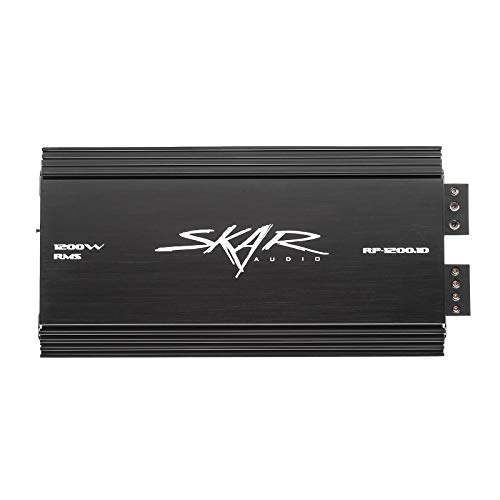
The Skar RP-1200.1D is a Class D monoblock amplifier designed for subwoofers, featuring a peak power rating around 1,600 watts at 1 ohm and 1,200 watts RMS at 1 ohm. Its frequency response spans 20 Hz to 250 Hz, which is well-suited for deep bass notes and tight low-end control. An on-board bass EQ switch provides +6 or +12 dB boost at 45 Hz, enabling a quick bass boost for music with sub-heavy passages. The compact form factor and efficient MOSFET power supply support stable operation with high-current subs. Ideal for users seeking strong bass presence without excessive heat or power draw.
BOSS Audio Systems R1100M Monoblock

The BOSS R1100M is a 1,100-watt max mono amplifier designed for stability with 2 ohms, and it supports both low and high-level inputs. It features a low-pass crossover and a MOSFET power supply for efficient conversion. With a compact footprint (about 10.4 x 9.2 inches) and integrated remote subwoofer control, it suits vehicles with limited space while offering robust bass management. It’s positioned for installations that require a straightforward, reliable power boost for a single subwoofer channel.
Orion Cobalt CBA2000.1D Mono Block

Orion’s Cobalt CBA2000.1D is a powerful Class D monoblock capable of delivering up to 2,000 watts maximum, with stability at 1–4 ohms. It emphasizes efficient performance and reliability for continuous subwoofer demands. The amplifier includes a low-pass filter and an adjustable bass boost, and it supports both low and high-level inputs, enabling flexible integration with a wide range of factory radios or aftermarket head units. The MOSFET power supply aids in consistent output while maintaining relatively low heat generation for extended listening sessions.
Skar Audio RP-350.1D Monoblock

The Skar RP-350.1D is a compact monoblock Class D amplifier designed for subwoofers, delivering 350 watts RMS at 1 ohm. It shares the brand’s familiar 20 Hz to 250 Hz frequency response range and includes a bass boost feature with a +6 or +12 dB option at 45 Hz. As a lighter-duty option, it’s well-suited for smaller vehicles or for users who want to upgrade bass without a large footprint. It integrates easily with common aftermarket systems and is known for dependable performance in budget-conscious builds.
AUDIOZERONE ZE1000.1 Mono Block

The ZE1000.1 from AUDIOZERONE is a 2000-watt max mono amplifier designed for 1-ohm loads, with 1000 watts RMS at 1 ohm and 650 watts RMS at 2 ohms. It’s a Class D MOSFET-powered unit that emphasizes efficiency and compact dimensions, suitable for subwoofers that require substantial current without excessive heat. Its low-pass crossover helps tailor the bass frequencies, and the combination of high current capability and streamlined design makes it a strong choice for contemporary sub setups in compact vehicles.
Buying Guide: Key Purchase Considerations
To pick the right amplifier for a car subwoofer, consider how the device will integrate with your system and how you listen. A few essential factors include power, impedance, efficiency, and control features.
- Power and impedance: Choose an amplifier that can deliver sufficient wattage at the sub’s impedance. A 1-ohm or 2-ohm stable amp is common for subwoofers, with real-world RMS ratings in the 350–2,000W range. Ensure the sub is within the amp’s stable operating range to avoid overheating or distortion.
- Class and efficiency: Class D amplifiers are favored for subs due to high efficiency and reduced heat. If you’re building a compact or heat-constrained trunk setup, a Class D model is typically advantageous.
- Frequency response and filtering: A wide low-frequency response supports deep bass, while a variable low-pass filter helps tailor the sub’s output to the listening space and music style. Bass boost features can add punch, but should be used judiciously to avoid distortion.
- Inputs and compatibility: Look for amps with both low-level (RCA) and high-level inputs, enabling integration with factory radios or aftermarket head units. Remote subwoofer control can simplify adjustments from the seating position.
- Physical constraints and installation: Check dimensions, mounting depth, and number of channels when pairing with a specific sub or enclosure. A compact amp can fit into tight trunks, under seats, or inside storage panels.
- Durability and protection: Thermal, short-circuit, and overload protection are important for long-term reliability, especially in vehicles with extended bass sessions or extreme temperature environments.
When evaluating options, balance the need for headroom (peak power) with practical listening levels, vehicle space, and electrical system capacity. The right choice aligns with your subwoofer’s impedance, enclosure type, and preferred tuning, delivering clean, controlled bass without unnecessary heat or power waste.