Best 12V Battery for RV: Top AGM and LiFePO4 Choices
Choosing the right 12V battery is essential for reliable RV power, whether for camping, off-grid living, or travel. This guide highlights five top options that balance durability, performance, and maintenance needs. Each product is suitable for RV use, with various chemistries to suit different budgets and energy demands. Explore the selections below, then review the buying guide to compare capacity, weight, temperature tolerance, and charging requirements.
| Product | Brand | Type | Approx. Capacity | Notes |
|---|---|---|---|---|
| WEIZE Deep Cycle AGM 12V 100Ah | WEIZE | AGM | 100Ah | Maintenance-free; low self-discharge |
| Renogy Deep Cycle AGM 12V 100Ah | Renogy | AGM | 100Ah | Safe chemistry; widely trusted |
| GRNOE 12V 100Ah LiFePO4 (2-Pack) | GRNOE | LiFePO4 | 100Ah each | Low-temp protection; compact; BMS |
| ELEFAST 12V 330Ah LiFePO4 | Elefast | LiFePO4 | 330Ah | High capacity; built-in BMS; Bluetooth |
| ECO-WORTHY 12V LiFePO4 280Ah | ECO-WORTHY | LiFePO4 | 280Ah | Bluetooth, low-temp protection |
Note: The table above lists five suitable options across AGM and LiFePO4 chemistries. Each product is evaluated for RV suitability, including maintenance needs, cold-weather performance, and compatibility with typical RV charging setups.
WEIZE 12V 100Ah AGM Mobile Power Pack
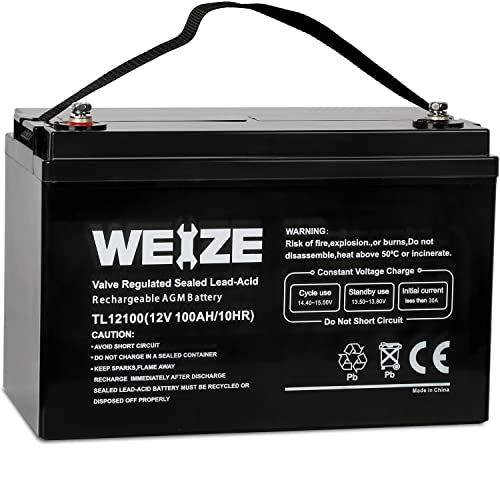
WEIZE’s 12V 100Ah AGM battery is designed for RV use with maintenance-free operation and a low monthly self-discharge rate of 1-3%. Its sealed AGM design minimizes acid leakage, making it suitable for mobile applications. The battery supports extended storage and reliable startup in varied climates, with a recommended operating temperature around 77°F (25°C). The unit offers a dual-terminal layout, allowing flexible connection configurations for parallel or series setups in larger RV systems.
Renogy 12V 100Ah AGM Deep Cycle Battery

Renogy’s AGM 12V 100Ah battery is built for safety and long life, featuring a sealed design and stable chemical composition. It supports series and parallel configurations, enabling higher system voltages or capacities for RV setups. With a robust internal structure and low maintenance requirements, this battery reduces the need for frequent checks and leaks, especially when stored in RV bays or compartments. Ideal for campers who value reliability and broad compatibility with solar charging and inverter systems.
GRNOE 2-Pack 12V 100Ah LiFePO4 Batteries

This pair of LiFePO4 12V 100Ah batteries from GRNOE presents a lightweight, high-energy option for RVs. The included BMS provides protection against overcharge, over-discharge, and short circuits, with low-temperature cut-off capabilities to protect the battery in cold environments. The compact design reduces weight and space requirements, making it easier to fit into a typical RV electrical bay. Note that the two-pack ships separately, which may affect delivery timing when ordered together.
ELEFAST 12V 330Ah LiFePO4 RV Battery

ELEFAST’s 330Ah LiFePO4 battery emphasizes high energy density and RV-ready versatility. It features a built-in 200A BMS with multi-protection, including low-temperature protection to prevent damage in cold conditions. The battery supports series and parallel configurations and has Bluetooth monitoring for real-time status via a mobile app. This option is suitable for users who need substantial energy storage for appliances, heating, or long camping trips.
ECO-WORTHY 3584Wh 280Ah LiFePO4 RV Battery

The ECO-WORTHY 280Ah LiFePO4 battery delivers substantial capacity for RVs needing extended off-grid power. With low-temperature protection and a built-in 200A BMS, it emphasizes safety and durability in harsh conditions. Real-time monitoring via a Bluetooth app helps track voltage, current, and remaining capacity, enabling proactive maintenance and efficient energy management for RV living or extended trips.
Renogy Deep Cycle AGM 12V 200Ah

Renogy’s 200Ah AGM battery offers higher capacity for more demanding RV electronics, with the same maintenance-free benefits and safety features expected from Renogy. Its low self-discharge and stable performance make it appealing for users who need longer runtimes between charges and compatibility with a range of RV inverters and solar setups.
Buying Guide: Key Purchase Considerations and Comparisons
Battery chemistry: AGM vs LiFePO4. AGM batteries are robust, maintenance-free, and generally lower in upfront cost, but they are heavier and have higher self-discharge than LiFePO4. LiFePO4 cells provide longer life, deeper cycle capability, and lighter weight, with better performance in cold weather, but at a higher initial price.
Capacity and runtime. Estimate your RV’s daily energy usage (refrigerator, lights, water pump, electronics) and choose a battery with enough usable capacity to cover several days between charges, especially if solar is limited or absent. LiFePO4 often delivers more usable capacity per Ah due to favorable discharge characteristics.
Temperature tolerance. If you travel in cold climates, look for batteries with low-temperature protection and operating ranges that align with your camping seasons. Many LiFePO4 options offer built-in BMS protections and temperature cutoffs to prevent damage in extreme conditions.
Weight and space. LiFePO4 packs are lighter and more compact than traditional AGM setups, which matters for RV storage and vehicle handling. Ensure your cabinet fit and mounting provisions meet the battery’s dimensions and weight.
Charging compatibility. Check charger and inverter compatibility, including charging voltage and current. Some LiFePO4 packs require specific charging profiles (e.g., 14.6V ± 0.2V for certain cells) to reach full capacity.
Maintenance and safety. AGM batteries are generally maintenance-free but require robust venting for gas management in sealed spaces. LiFePO4 batteries are inherently more stable and carry lower risk of gas buildup, but a reliable BMS remains essential for protection against overcharge, over-discharge, and short circuits.
Longevity and total cost of ownership. LiFePO4 batteries typically deliver more cycles (often 2000+ cycles) and longer lifespans than AGM equivalents, potentially offsetting higher upfront costs with longer service life and reduced replacement frequency.