Best 3 Row Crossover Solutions for Car and Home Audio
Finding the right 3-way crossover can optimize the soundstage for both car and home audio systems. This article reviews five standout options, highlighting each model’s strengths, compatible impedance, and notable features. Whether you’re upgrading your bookshelf speakers or tuning a multi-speaker setup, these crossovers help split audio into bass, midrange, and treble with precision for cleaner, fuller sound.
Summary of selected products:
| Product | Brand | Impedance | Key Feature | Amazon Link |
|---|---|---|---|---|
| PUV-W3 200W Passive Crossover | HiQltyla | 4-8 Ohm | 3-way with high current components | |
| SKEC23 3-Way 6 Channel Electronic Crossover | Skar Audio | DC powered | Electronic multi-channel routing | |
| EX3.5 Stereo Electronic Crossover | PRV AUDIO | 4- or 8-Ohm (configurable) | 3/2-way with adjustable filters | |
| 3 Way Speaker Crossover 234XL | RQG | Varies by setup | 3/2/4-way modes | |
| HFXR Hide Away 2/3-Way Crossover | Hifonics | Car audio systems | Rear/Front/subwoofer adjustments |
Note: All featured products support multiple speaker configurations and offer various adjustment options to tailor the crossover to your listening environment. Images and specs are drawn from product listings to help you compare quickly.
HiQltyla PUV-W3 200W Passive Crossover

The HiQltyla PUV-W3 is designed for 4 to 8 ohm speakers, delivering up to 200 watts peak. Its convenient screw terminals simplify installation without welding. The bass inductor, dedicated MPX capacitor, and a 100V 10uF high-current capacitor are chosen to improve overall sound quality. Frequency response ranges from 45 Hz to 25 kHz, with crossover points at 860 Hz and 6000 Hz, enabling clear separation across bass, mids, and highs. This model emphasizes robust components suitable for Hi-Fi home audio and compatible bookshelf setups.
Skar Audio SKEC23 3-Way 6 Channel Crossover

The Skar Audio SKEC23 provides a 3-way electronic crossover with six channels (three RCA inputs and three outputs) designed for front, rear, and subwoofer connections. It operates on 14.4V DC with a maximum output voltage of 5V. This unit is geared toward multi-channel car audio installations where precise digital-like routing and compact form factor matter, offering stable, flexible tuning for dynamic sound reproduction.
PRV AUDIO EX3.5 Stereo 3-Way Crossover
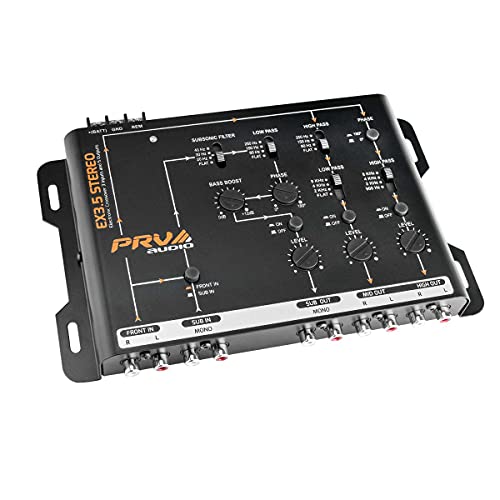
The PRV EX3.5 is a versatile stereo electronic crossover offering 2/3-way capabilities with 9-volt operation. It supports 2 RCA inputs and 6 RCA outputs for 3 channels (two stereo paths and one mono path). The unit features three-way adjustable high-pass and low-pass filters, individual output level controls, and an adjustable bass boost on the Sub Out, enabling precision tailoring across car audio configurations while maintaining signal integrity.
RQG Professional Audio Crossover 234XL

The 234XL from RQG offers 2-, 3-, and 4-way modes for stereo and mono configurations. It emphasizes clean frequency splitting with independent controls for output gain, phase reversal, and a 40 Hz low-cut filter per band. Balanced XLR I/O ensures compatibility with pro audio gear, reducing noise and preserving signal quality in professional PA or studio setups. This model suits advanced users seeking detailed control over multi-speaker routing.
Hifonics HFXR Hide Away Crossover

The Hifonics HFXR Hide Away crossover focuses on car audio with rear-channel high-pass adjustments and separate front, rear, and subwoofer level controls. It includes front, rear, and subwoofer inputs and corresponding outputs, enabling flexible integration into a variety of 2-, 3-, or 4-way setups. This device is designed for installers seeking discreet, high-quality signal processing with straightforward level matching for each channel.
Buying Guide: Key Purchase Considerations
- System architecture: Determine whether you need a passive or electronic (active) crossover. Passive crossovers require no power but can introduce insertion losses, whereas electronic crossovers provide precise control and adjustable filters.
- Speaker impedance and power handling: Match the crossover’s recommended impedance range with your drivers (common ranges include 4–8 ohms). Verify peak power handling to avoid distortion or damage.
- Number of bands and configuration: Decide between 2-way, 3-way, or more complex setups. A true 3-way crossover provides dedicated controls for bass, midrange, and treble with adjustable crossover points.
- Filter type and crossover points: Look for adjustable high-pass and low-pass filters, plus transition points that align with your drivers’ natural response. Some units offer 3 dB switches or exact Hz/kHz crossover settings for fine-tuning.
- Channel routing and inputs/outputs: For car audio, six-channel or multi-channel crossovers enable front, rear, and subwoofer paths. Ensure RCA or XLR I/O compatibility with your head unit or amplifier.
- Installation and form factor: Consider whether a compact, in-dash, or hidden install is preferred. Screw terminals and solid enclosures aid reliability in mobile environments.
- Budget and build quality: Components like high-current inductors, low-distortion capacitors, and robust enclosures contribute to long-term performance. Panels designed for heat dissipation help in high-power use.
- Use-case balance: For Hi-Fi home use, aim for minimal phase shift and clean frequency separation. For car audio, emphasis on durability, power handling, and ease of integration with existing amps matters more.
In selecting a 3-way crossover, review the documentation for each model to confirm compatibility with your drivers, enclosure, and amplifier setup. Consider your listening goals—clarity at high volume, natural vocal performance, or deep bass authority—and choose a unit that aligns with those priorities. The options listed above cover passive and electronic designs across car and home environments, offering a range of tuning flexibility and install practicality.