Best Engine Oil Leak Stop Additives for Better Seals and Performance
Leak-stopping engine oil additives can help extend engine life by conditioning seals, reducing oil consumption, and quieting lifters. This guide highlights five proven products that address common oil leaks, seal wear, and related issues. Each entry includes a quick summary of features, real-world benefits, and what to consider before purchasing.
Summary of Selected Products
| Product | Brand | Key Benefit | Approximate Size |
|---|---|---|---|
| Engine Oil Stop Leak | Lucas Oil | Renews worn seals; reduces oil consumption | 1 Quart |
| ATOMEX Oil Additive Stop Leak | XADO | Elasticity restoration for gaskets and seals; leak prevention | 250 ml |
| High Mileage Engine Repair | Bar’s Leaks | Stops leaks; increases compression and horsepower | 16.9 oz |
| Oil Seal Engine Oil Burning & Leak Repair | Bar’s Leaks | Repairs main seals and gaskets; reduces burning | 16.9 oz |
| Motor Oil Saver | Liqui Moly | Reduces oil consumption; prevents leaks at seals | 300 ml |
Lucas Oil 10278 Engine Oil Stop Leak

Lucas Oil 10278 is formulated to work with petroleum, semi-synthetic, and full synthetic motor oils. It focuses on renewing worn seals without causing corrosion or damage. The product also aims to reduce engine noise and lower oil consumption while potentially raising oil pressure. The package contains a one-quart bottle suitable for most passenger vehicles. This stop-leak additive is designed for engines exhibiting minor leaks or seal wear and can be used as a preventative measure in high-mileage applications.
XADO ATOMEX Oil Additive Stop Leak

XADO ATOMEX is designed to restore the elasticity of rubber seals and gaskets, addressing leaks by rejuvenating seals and preventing future seepage. It is marketed as effective for engine oil leaks across auto and motorcycle engines, offering a slick formula intended to rejuvenate seals and improve overall seal integrity. The bottle size is 250 ml, making it convenient for mid-range applications and as a maintenance additive in older engines with overt seal wear. It also positions itself as a cost-saving solution by protecting engines from further wear.
Bar’s Leaks 1000 High Mileage Engine Repair
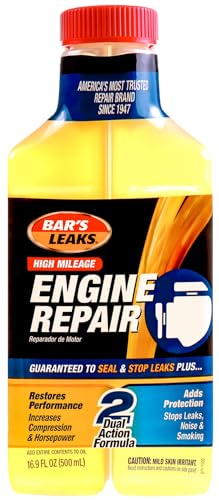
Bar’s Leaks 1000 is designed for high-mileage engines and contains a blend of additives aimed at repairing leaks, increasing compression, and reducing oil consumption. It claims to improve engine performance by restoring seals and reducing noise and smoking. The formula is intended to provide a last-resort fix before costly repairs, especially for vehicles with long service intervals between mechanical interventions. It is widely used for addressing common oil-related leaks in worn engines and for extending engine life in aging fleets.
Bar’s Leaks OS-1 Oil Seal Engine Oil Burning and Leak Repair

Bar’s Leaks OS-1 focuses on repairing leaky main seals and gaskets across a broad range of gasoline and diesel engines, including turbocharged and hybrid configurations. It also claims to renew worn valve seals and guides and can address oil burning and blue exhaust smoke in various cylinder configurations. This product is positioned as a broad-seaunch solution for engines experiencing leaks and related burn-off symptoms, suitable for both older and some newer engine designs when used with the correct dosage recommendations.
LIQUI MOLY Motor Oil Saver

Liqui Moly Motor Oil Saver is designed to reduce oil consumption by acting on piston rings and valve guides. It helps prevent leaks by supporting elastomeric seals and addressing common leak points. The 300 ml bottle format makes it a compact option suitable for mid-cycle maintenance or for use as a supplementary treatment alongside other seal-restoration products. It is positioned to help maintain cleaner engines by reducing oil burning and promoting smoother operation across various engine types.
Buying Guide
When choosing an engine oil leak additive, consider the following factors to ensure you pick a product that matches your engine type and leak severity:
- Engine age and mileage: High-mileage engines with worn seals often respond best to seal-conditioning additives (Bar’s Leaks, Lucas Oil, Liqui Moly).
- Oil type compatibility: Check whether the product is formulated for petroleum, semi-synthetic, or full synthetic oils to avoid any compatibility issues.
- Leak location and severity: Simple valve-cover or gasket leaks may respond to seal conditioners, while main seals or burning oil may require a more robust stop-leak or burning-oil treatment.
- Seals vs. gaskets: Some products target elastomeric seals, while others address main seals and guide components. Match the product to the problem area.
- Engine noise and performance: Some formulations claim to reduce noise, improve compression, or restore oil pressure. Consider if you want these broader performance benefits.
- Usage guidelines: Follow dosage directions carefully. Overuse can lead to deposits or clogging in some engines.
- Maintenance vs. repair: Use additives as a maintenance measure; if leaks persist, professional inspection may be necessary to avoid hidden damage.
Product comparison considerations
- Effectiveness across engine types: Some products boast compatibility with a wide range of engines, including diesels and turbocharged units, while others target specific engine families.
- Time to results: Additives vary in how quickly car owners notice reduced leaks or smoother operation. Short-term improvements may be visible within a few days of use.
- Potential side effects: While most are designed to be safe, always test in a small amount if you have concerns about seals or fuel systems.
- OEM approvals and claims: Look for products with credible testing or endorsements that align with your vehicle’s design and oil specifications.
- Availability and pricing: Availability on major retailers can impact your decision, along with bottle size and value for money.
Engine maintenance remains essential. Additives can help reduce leaks and improve performance, but they are not a substitute for addressing root causes. If leaks or consumption persist after treatment, consult a qualified mechanic to assess seals, gaskets, and calibration for your specific vehicle.