Best AFR Gauge for Carburetor: Top Wideband Controllers for Tuners
Choosing the right air/fuel ratio (AFR) gauge for a carbureted engine helps monitor and optimize performance while protecting your motor. This guide highlights five widely used wideband AFR gauges that pair well with carburetors, offering clear displays, fast response, and reliable data logging. Each option is selected for compatibility with traditional carb setups and broad engine management basics, ensuring accurate readings and straightforward installation for American readers.
Summary of chosen products:
- AEM 30-0300 X-Series Wideband UEGO AFR Sensor Controller Gauge (AEM)
- ZHSYMX Universal Digital Wideband Air/Fuel Ratio AFR Gauge (52mm, with sensor)
- Wideband UEGO Air/Fuel Ratio Gauge 52mm (2-1/16”) with 4.9 LSU Sensor (FHRHRY)
- JJCOCO Air/Fuel Ratio AFR Wideband Gauge Kit with LSU 4.9 Sensor (52mm)
- 30-0300 Wideband UGEO Air Fuel Ratio Gauge 52mm (2-1/16”), with LSU 4.9 Sensor (Gledewen)
AEM 30-0300 X-Series Wideband AFR Gauge

The AEM X-Series wideband UEGO AFR gauge (PN 30-0300) features a modern faceplate and a seven-segment center display that is significantly larger for quick readings. It includes 0-5V and RS232 outputs for feedback control and data logging, plus an AEMnet (CANbus) output for data capture. The X-Digital wideband technology enhances accuracy, enabling more precise engine tuning and safer operation, which is valuable when fine-tuning carbureted setups that rely on accurate AFR data for jetting and timing adjustments.
ZHSYMX Universal Digital Wideband AFR Gauge (52mm)

This 2-inch wideband AFR gauge by ZHSYMX provides real-time feedback with fast response. Its universal 52mm housing fits most instrument pods and supports 0-5V analog output, aiding data loggers and engine management systems. The digital wideband technology ensures accurate readings with compatibility across various engine configurations, making it suitable for carburetor applications that require precise air-fuel control without excessive calibration. It works with systems up to 16V.
Wideband UEGO AFR Gauge 52mm (2-1/16”) with 4.9 LSU Sensor
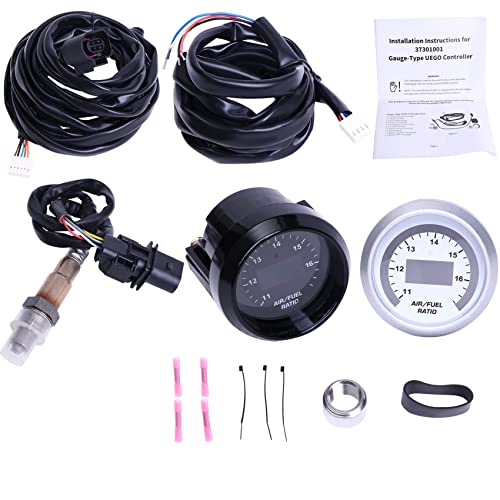
This 52mm wideband gauge from FHRHRY includes a 4.9 LSU sensor for quick, accurate AFR readings. It features a digital LED display with a color-shifting LED needle that highlights readings from lean to rich. The unit provides 0-5V output, aiding integration with data loggers and engine controllers. Its broad compatibility and clear visualization help classic carburetor engines reach optimal air-fuel balance while enabling safer tuning choices during adjustments and dyno testing.
JJCOCO AFR Wideband Gauge Kit (52mm, LSU 4.9)

JJCOCO’s all-in-one wideband AFR gauge integrates the controller into the display for a compact, OEM-like installation. It features a bright digital display for real-time readings, with LSU 4.9 sensor technology delivering fast response and accurate AFR values. This kit reduces wiring complexity, making it easier to deploy on carbureted engines where clean wiring and reliable data are essential for tuning and safety checks.
Gledewen 30-0300 Wideband UgEO AFR Gauge Kit

The Gledewen 52mm wideband AFR gauge kit emphasizes a multi-color LED face with four-digit central readout and reversible two-sided faceplate. It supports multiple display modes—air-fuel ratio, lambda, and oxygen percentage—making it adaptable to carburetor tuning workflows. The kit pairs with LSU 4.9 sensors for fast, precise feedback, including calibration options like rCAL (Resistor Trim) for improved accuracy in various installations. The design focuses on easy installation and rapid, actionable AFR information for carbureted engines.
Buying Guide: Key Considerations For Carburetor AFR Gauges
- Sensor Type And Range: Most kits use LSU 4.9 sensors, offering fast response times and robust accuracy. Look for a device that reads smoothly around the lean-to-rich transitions common in carburetor tuning.
- Display And Visibility: Choose a gauge with a bright, high-contrast display and color-changing LEDs to quickly interpret readings under different lighting conditions in the shop or on the track.
- Output Options: 0-5V analog outputs are widely compatible with data loggers and ECU interfaces. RS232 or CANbus outputs are valuable for advanced logging and integration with existing systems.
- Installation Fit: A standard 52mm (2-1/16”) housing fits a wide range of instrument pods. Ensure the mounting depth and wiring harnesses suit your carb setup and dash layout.
- Calibration: Some models offer free-air calibration or adjustable rCAL options. Calibrate carefully to avoid skewed readings that could mislead tuning decisions.
- Durability and Weather Resilience: In outdoor or workshop environments, seek gauges with solid build quality and protective housings to resist vibration and temperature changes associated with engines.
- Data Logging And Tuning Support: If you plan to log AFR data for later analysis, prioritize models with straightforward data logging capabilities or compatible interfaces.
- Cost vs. Benefit: While all five options deliver value, assess the total package—display quality, sensor quality, calibration options, and data interfaces—to determine long-term reliability for carburetor tuning.
When selecting an AFR gauge for a carburetor, prioritize models with fast response times, reliable 4.9 LSU sensors, and easy integration into standard dash layouts. Real-time AFR feedback supports precise jetting, float height adjustments, and timing decisions, helping maintain engine safety and performance. The five products above cover a range of installation preferences—from all-in-one displays to modular setups—while maintaining core functionality essential for carburetor-driven engines.