Best Air Oil Separator Guide: Cleaner Air, Longer Tool Life
When choosing an air oil separator, the goal is to remove oil, moisture, and particulates from compressed air before it reaches spray guns, tools, or engines. The right separator protects equipment, improves performance, and reduces maintenance costs. This article reviews five top options and provides practical buying tips for American shoppers.
| Product | Brand | Key Benefit | Inlet/Pressure |
|---|---|---|---|
| NEIKO 30252A Water and Oil Separator | NEIKO | Moisture and oil separation at 90 PSI to extend tool life | 1/4″ NPT, 90 PSI |
| GX-PUMP Professional-Grade Filter | GX pump | Ultra-efficient filtration; 99% oil and water removal | 5800 PSI capacity |
| K&N Oil Separator Catch Can | K&N | Engine intake protection against blow-by oil | Vehicle-specific applications |
| NANPU 3/8″ NPT Combo | NANPU | Three-in-one filter, regulator, lubricator with water/oil trap | 3/8″ NPT |
| Hromee 1/4″ Filter Regulator Combo | Hromee | Brass filtration, adjustable pressure, visible drain | 1/4″ NPT |
NEIKO 30252A Water and Oil Separator

The NEIKO 30252A acts as both water and oil separator for air lines, helping prevent moisture and oil from contaminating spray guns and air tools. It is suitable for 1/4″ NPT inlets and outlets and is offered in 90 PSI variants to support typical shop compressors. By keeping oil inside the compressor and removing moisture from the air stream, this unit helps maintain tool longevity and consistent spray quality.
GX-PUMP High-Pressure Air Separator Filter

This professional-grade filter is built to handle extreme pressures up to 5800 PSI. It uses a dual-layer filtration approach with activated carbon and molecular sieves to remove oil, water, and submicron particles (down to 0.01 μm). Its universal compatibility and rugged aluminum construction make it a robust choice for high-demand environments such as paintball setups or other compressed-air systems.
K&N Oil Separator Catch Can

Designed to protect engines from oil blow-by, this oil separator catch can (commonly used with certain GM trucks) helps reduce intake contamination and maintain engine performance. It is presented as an efficient defense against oil residues entering the intake manifold, contributing to steadier power delivery and reduced detonation risk in compatible vehicles.
NANPU 3/8″ NPT Combo Water/Oil Trap

The NANPU 3/8″ NPT 3-in-1 unit combines a piggyback filter, regulator, and lubricator with a built-in water/oil trap. It offers an expanded filtration surface and a visible gauge of filter life, plus a semi-auto drain for easier maintenance. It targets a broad range of shop applications where compact, integrated airflow conditioning is valuable.
Hromee 1/4″ Filter Regulator Combo
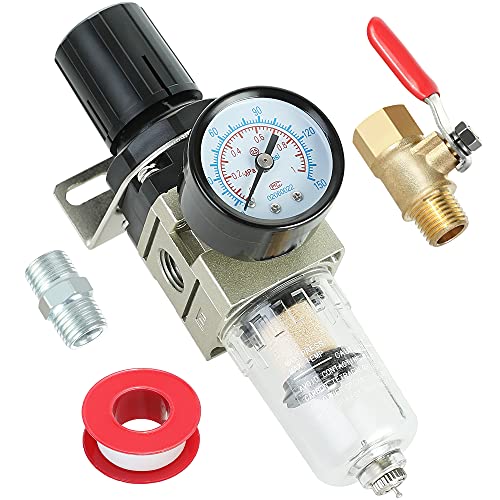
The Hromee AW2000-02 combo provides a brass filter element for durable filtration, a selectable pressure regulator, and a clear gauge-capable cup to monitor moisture and oil content. A brass element typically outlasts fiber options, making this unit a long-term choice for consistent airflow quality at pressures up to 150 PSI.
Buying Guide: Key Considerations for Air Oil Separators
- Filtration efficiency: Look for separators that target oil aerosols, moisture, and particulates to protect tools and finishes. Multi-layer filtration and desiccants can improve dryness and cleanliness of the output air.
- Pressure and compatibility: Match the unit to your system’s operating pressure. Check inlet/outlet sizes (1/4″, 3/8″, etc.) and whether the device supports the pressure range you use for spray guns, air tools, or PCP equipment.
- Material and durability: Aluminum housings are common for high-pressure components; brass filter elements offer long life and corrosion resistance in many shop environments.
- Maintenance and drainage: Units with clear gauge windows, visual indicators, or automatic drains reduce downtime. Manual drains require regular checks to prevent overflows.
- Versatility and integration: Some models combine multiple functions (filter, regulator, lubricator) into a single compact unit, saving space but potentially complicating maintenance. Universal thread types and quick-connect compatibility can ease installation.
- Application fit: Vehicle oil separators (catch cans) suit engines and intake protection, while inline air separators are more appropriate for shop air lines and spray equipment. Consider the specific usage scenario and environment.
- Safety and monitoring: Ensure the chosen separator includes clear labeling and non-hazardous materials. For high-demand applications, plan regular inspections to detect moisture buildup and filter saturation.
- Price vs. performance: Higher-end units offer deeper filtration and higher PSI support, but evaluate whether the additional capacity matches your actual usage to avoid overpaying.