Best Automatic Pool Chlorinators for Safe, Clear Water
Finding the right automatic pool chlorinator helps keep your pool chemistry stable with minimal maintenance. The following selections cover inline and offline models from top brands, built to work with varied pool sizes and feeding needs. Read on to compare features, compatibility, and installation considerations.
| Product | Brand | Approx. Capacity | Feed Type | Key Benefit |
|---|---|---|---|---|
| Hayward CL220EF | Hayward | Large/Small tablets | Offline | Dial control for easy feed rate adjustment |
| Hayward CL200EF | Hayward | Large/Small tablets | Inline | Updated model with Safe access cover |
| Pentair R171096 Rainbow 320 | Pentair | Multiple tablets | Inline | Reliable compatibility for various pools |
| HYDROTOOLS Swimline 8750 | Swimline | 9.0 lbs capacity | Inline | Universal compatibility and easy adjustment |
| MAYGO CL200 | MAYGO | 9 lbs | Inline | 360° control knob for speed |
Hayward CL220EF Off-line Automatic Chemical Feeder

The Hayward CL220EF is designed for offline tablet feeding, accepting both large and small slow-dissolving chlorine tablets. Its updated design for the CL220 series includes a Dial control valve for straightforward feed rate adjustments, helping maintain steady chlorine levels. The Easy-Lok threaded cover provides safe, convenient access for adding tablets and routine maintenance. This model is suitable for pools where a dedicated feeder is mounted away from the pump’s return line, offering a simple setup for dependable chemical dosing.
Hayward CL200EF In-line Automatic Chemical Feeder

The CL200EF is Hayward’s inline option for both above-ground and in-ground pools. It accommodates large or small slow-dissolving chlorine tablets and uses a Dial control valve for easy feed rate adjustment. A secure, Easy-Lok threaded cover allows safe access to add tablets and perform routine checks. Inline feeders like this integrate directly into the return line, offering compact installation and on-demand chlorine dosing with minimal hands-on management.
320 Chlorinator R171096 Compatible with Rainbow 320
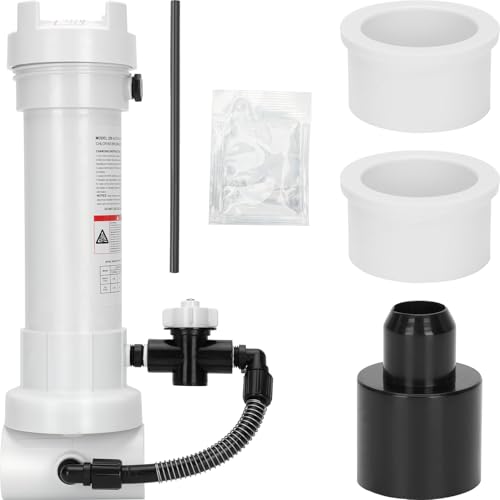
This 320 feeder provides a closed circulation system for efficient filtration in pools and spas, holding 11 large or 98 small tablets. Improvements include a widened gasket for better seal integrity and a reinforced control valve to reduce leaks and enhance durability. It’s suitable for a broad range of pool sizes—from moderate to large—supporting steady chlorine delivery whether in bottom-feed or top-feed configurations. It’s designed to be a robust inline choice for Rainbow 320-compatible systems.
Pentair R171096 Rainbow 320 In-Line Feeder

The Rainbow 320 automatic in-line feeder by Pentair offers a standard 2″ slip PVC fitting and adapters for 1-1/2″ plumbing. It’s designed for permanent installation in the return line of new or existing pools or spas, ensuring consistent chlorine dosing with minimal operator input. The inline configuration makes it a straightforward retrofit for many pool lines, effectively automating sanitization in both residential and spa settings.
HYDROTOOLS By SWIMLINE 8750 In-Line Chlorine Feeder
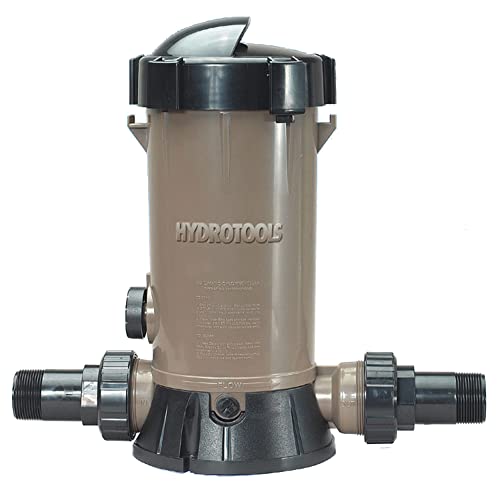
The Hydrotools 8750 is a premium inline chlorinator with a 9.0 lb capacity and universal compatibility for chlorine or bromine tablets. It features Hydrotools SNAP-LOCK technology for a tight seal and secure finger-release lid for easy access. An integrated 360-degree adjustment dial lets users customize the output level, and the design supports both above-ground and in-ground pools. It’s a proven option for households seeking a set-and-forget dosing solution.
in-line Automatic Pool Chlorinator MAYGO CL200

The MAYGO CL200 serves as an inline replacement for Hayward CL200, compatible with both above-ground and indoor pools and capable of handling up to 9 pounds of tablets. It features a 360° omnidirectional control knob at the bottom to regulate water inlet and outlet speeds, enabling easy adjustment of feeding frequency. Note that external thread sizing may differ from CL200, so an inner-spiral connector may be required for proper installation. The unit is positioned as a practical option for retrofits and new builds alike.
Buying Guide: Key Considerations And Comparisons
- Pool type and size: Inline feeders work well when plumbing is accessible in the return line; offline feeders are ideal when you want a separate dosing point or limited plumbing work.
- Tablet compatibility: Verify whether the feeder accepts large or small slow-dissolving tablets, and whether it supports both chlorine and bromine formulations if needed.
- Feed adjustment: Dial or knob adjustments offer precise control over dosing. Look for models with easy-to-use controls and clear indicators.
- Installation and maintenance: Inline units require plumbing integration; offline units need access for tablet loading and cover maintenance. Check for secure covers and leak resistance.
- Capacity and treatment range: Higher tablet capacity suits larger pools or spas; ensure the feeder’s capacity aligns with your pool volume and turnover rate.
- Durability and materials: ABS construction and reinforced seals help resist chemical wear and outdoor exposure; look for units with corrosion-resistant components.
- Replacement parts: Availability of replacement covers, gaskets, and valves reduces downtime and extends the system’s life.
- Brand ecosystem: Brands like Hayward and Pentair offer widely compatible accessories and spare parts, which can simplify upgrades or expansions.
- Safety: Ensure the model includes a secure access cover and child-safe design features to prevent accidental exposure to chlorine tablets.
- Cost of ownership: Consider initial installation cost, tablet consumption rates, and potential energy savings from automated dosing.
Across these options, inline feeders provide added integration with existing plumbing for streamlined installations, while offline feeders offer a simpler, stand-alone solution for tablet dosing. When selecting, align the feeder with your pool’s size, typical sanitizer type, and whether you prioritize ease of installation or maximum control over dosing. Always follow manufacturer guidelines for installation, maintenance, and safety to maintain water quality and equipment longevity.