Best Buffers for Boat Detailing: Top Cordless and Rotary Polishers
Finding the right buffer for boat detailing can transform how your hull, deck, and gel coat shine. This guide highlights top cordless and corded buffers designed for marine surfaces, focusing on reliability, variable speeds, and user comfort. Each option below offers features that help remove stubborn oxidation, swirls, and scratches while being compatible with typical boat detailing kits. Read on to compare performance and pick a buffer tailored to boat care routines.
| Product | Brand | Best For | Key Feature |
|---|---|---|---|
| Avhrit Cordless Buffer Polisher Kit | Avhrit | Cordless flexibility for decks and hulls | 6000 RPM, 6 speeds, 2x 2000mAh batteries |
| AVID POWER Car Buffer Polisher | AVID POWER | Heavy-duty polishing and corrosion-prone surfaces | 1200W, 6 speeds, detachable handles |
| ZOTA Buffer Polisher | ZOTA | High-power, longer cord for large boats | 1600W, 7 speeds, long power cord |
| LDHTHOPI Buffer Polisher | LDHTHOPI | Value-conscious, general buffing | 1800W, 750-3100 RPM, 6 speeds |
| Jruav Cordless Buffer Polisher | Jruav | Cordless, DIY finishing | 7230 RPM, 2x 21V batteries, 6 speeds |
Avhrit Cordless Buffer Polisher Kit

The Avhrit cordless buffer offers a 300W copper-motor build and a maximum 6000 RPM, with six adjustable speeds. Its cordless design helps you reach hulls and transoms without dragging a cord across wet surfaces. The 8 mm random orbit is designed for swirl-free finishes, making it suitable for boat gel coats that require gentle but effective polishing. The kit includes dual 2000mAh batteries and a flexible attachment set to adapt to different detailing tasks, such as waxing, removing light oxidation, or scratch blending. Users can switch speeds to suit different coatings and swirls, maintaining control and reducing fatigue on larger vessels.
AVID POWER Car Buffer Polisher

The AVID POWER buffer polisher emphasizes power and stability with a 1200W motor and copper wiring. It includes six variable speeds and detachable handles for improved control in tight marina or boatyard spaces. This model’s design focuses on long-term durability and consistent performance during extended detailing sessions, which is advantageous when addressing larger surface areas such as hulls or decks. The constant power and speed features help maintain steady polishing progress, reducing the risk of heat buildup and uneven results on gel coats and paints typical of boats.
ZOTA Buffer Polisher

The ZOTA buffer polisher delivers a robust 1600W copper-motor setup and seven variable speeds, ideal for tackling oxidation on boats. A longer 13.1-foot power cord expands maneuverability for deck and hull polishing where outlets are scarce. The 7-speed range allows progressive correction—from initial compounding to final polishing—while the dual-action design helps minimize swirl marks on curved surfaces like hull contours. This makes it suitable for both marine fiberglass finishes and painted boat exteriors, ensuring a glossy, marine-grade finish with careful technique.
LDHTHOPI Buffer Polisher
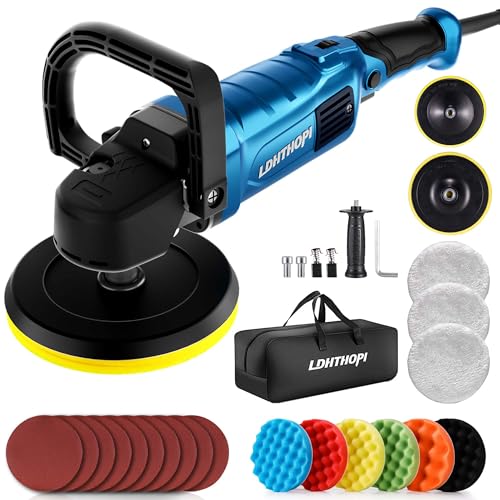
The LDHTHOPI model offers an 1800W pure copper motor with six speeds, making it a strong option for handling heavy oxidation on boats. It ships with seven polishing pads in multiple densities to support different stages: coarse for defect removal, medium for polishing, and fine for finishing. Built-in heat dissipation helps sustain performance during longer sessions, a benefit when detailing larger marine surfaces such as hulls, superstructures, and deck components. The range of speeds supports delicate paint and hard gel coat alike, with user guidance noted in the included materials.
Jruav Cordless Buffer Polisher

The Jruav cordless polisher combines a brushless motor delivering up to 900W and speeds up to 7230 RPM. With two 21V 4.0Ah batteries and a fast charger, it emphasizes mobility and runtime—handy for boaters who detail away from power outlets. Its overload protection helps guard paint integrity when working on glossy gel coats and painted surfaces. The six-speed settings provide versatility for everything from light waxing to aggressive cutting, allowing quick adaptation to hull contours and deck features while maintaining control and comfort during longer sessions on the water.
Buying Guide
Key considerations when selecting a buffer for boat detailing include motor power, speed range, and the type of motion (random orbit vs. dual-action) to suit marine finishes. For gel coats and painted hulls, a buffer with a wide speed range and heat management features helps prevent scorching. Cordless options improve reach around railings, corners, and deck hardware, but may require spare batteries for extended sessions. A longer cord can be advantageous for larger boats; however, it can limit maneuverability in tight spaces. Detachable handles and ergonomic design reduce fatigue on longer polishing tasks. Compatibility with standard detailing pads and compounds is also important for applying wax, polish, or compounds effectively. Finally, consider kit contents: included pads, backing plates, and a storage bag add value to marine detailing workflows.
Performance depth varies by motor type and build quality. Brushless motors tend to offer higher efficiency and cooler operation, while copper-wired motors often provide robust torque and durability. When choosing, align speed and power with the boat’s coating—gel coat, fiberglass, or painted surfaces—then factor in accessibility and battery life for cordless models. For frequent, larger-scale boat detailing, prioritize buffers with higher RPM ranges, reliable heat dissipation, and accessories that cover the full polishing stages from defect removal to finishing.