Best Car Amplifier 4-Channel for Clearer, Louder Audio
Car audio enthusiasts seek 4-channel amplifiers that deliver clean power, reliable performance, and flexible wiring options. This guide highlights five top 4-channel car amplifiers, features their key specifications, and explains how to choose the right model for your system. Whether you’re upgrading a factory setup or building a multi-speaker rig, these amplifiers cover a range of power needs and design philosophies.
| Product | Brand | RMS Power (4 Ohms) per Channel | Channels | Notes |
|---|---|---|---|---|
| Skar Audio RP-150.4AB | Skar Audio | 125 W x 4 | 4 | 1000 W total, Class A/B |
| Skar Audio RP-75.4AB | Skar Audio | 75 W x 4 | 4 | 500 W total, compact 4-channel |
| Alpine S-A32F | Alpine | 55 W x 4 | 4 | Class D, efficient cooling |
| Taramps TS 400×4 | Taramp’s | 100 W x 4 @ 2 Ω | 4 | Flexible input options, high efficiency |
| BLAUPUNKT AMP1604 | BLAUPUNKT | 55 W x 4 @ 4 Ω | 4 | Solid full-range performance |
Skar Audio RP-150.4AB 1,000W 4-Channel Car Amplifier
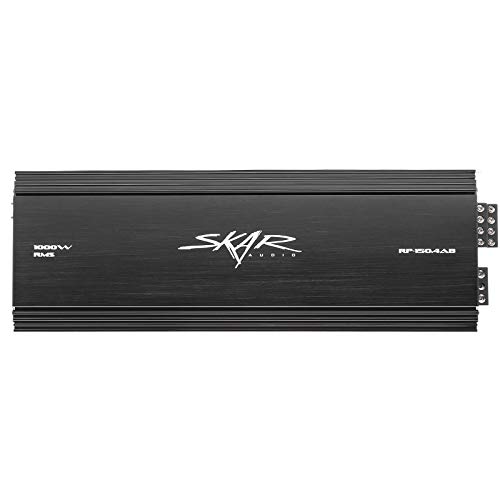
The Skar Audio RP-150.4AB is a 4-channel Class A/B amplifier with a total power rating around 1,000 watts. At 4 ohms, each channel delivers roughly 125 watts, and at 2 ohms, 250 watts per channel. This model suits users who want solid daily-driver volume with reliable headroom for rear fill or a dedicated front-stage upgrade. Class A/B bias typically yields a warmer, fuller sound with some efficiency trade-off in power-hungry setups. The MOSFET switching and robust build are designed for consistent operation under typical car audio conditions.
Skar Audio RP-75.4AB 500W 4-Channel Car Amplifier
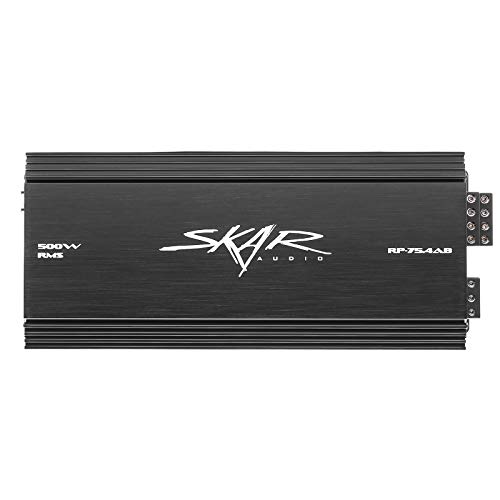
The RP-75.4AB provides 500 watts total power with 125 watts per channel at 2 ohms and 75 watts per channel at 4 ohms. This configuration is well-suited for smaller systems, where a compact 4-channel amplifier supports a front-row stereo pair and a pair of midbass or component speakers. Its Class A/B design emphasizes musicality and dynamic range, making it a good fit for everyday listening with a modest power budget and straightforward installation.
Alpine S-A32F, 4-Channel Class D Amplifier

The Alpine S-A32F is a Class D 4-channel amplifier rated at 55 watts per channel at 4 ohms. Its efficiency helps reduce heat in confined spaces while preserving bass and mids across multiple channels. Adequate for moderate speaker systems or upgrading factory setups, the S-A32F prioritizes compactness and thermal performance, making it a practical choice for discreet installs in hatchbacks or sedans.
Taramp’s TS 400×4 4-Channel Car Amplifier
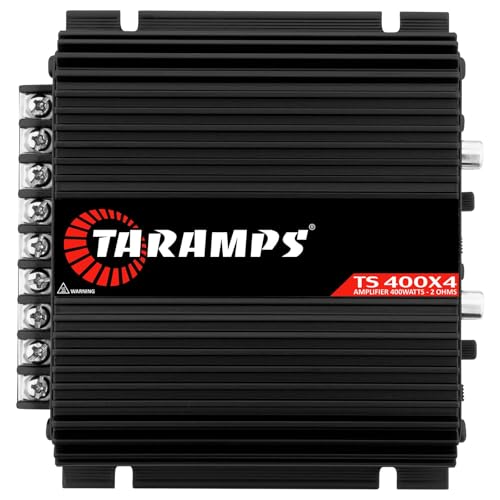
The Taramps TS 400×4 is a versatile 4-channel Class D amplifier offering 100 watts per channel at 2 ohms, with 200 watts per channel when bridged at 4 ohms. It supports high-level inputs for easier integration with factory radios and traditional RCA inputs for after-market head units. Its built-in fixed crossovers (HPF/LPF) and gain controls provide flexible tuning to match various speaker configurations while maintaining efficiency at higher output levels.
BLAUPUNKT AMP1604 4-Channel Full-Range
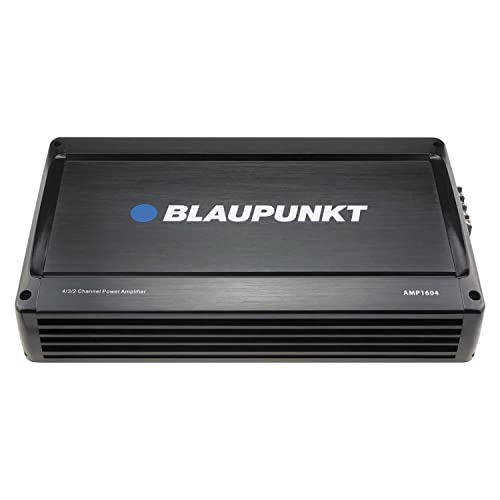
The BLAUPUNKT AMP1604 delivers 1,600 watts max power across four channels, with 55 watts RMS per channel at 4 ohms and 79 watts RMS per channel at 2 ohms. It targets users who want a strong four-channel setup with straightforward mounting and solid all-around performance. The model is suitable for multi-speaker configurations where space and simplicity are important, offering dependable output across a typical car audio installation.
Buying Guide: Key Purchase Considerations
- Power needs: Match RMS power per channel to your speaker impedance and enclosure. Four channels at 4 ohms around 50–125 W each cover many midrange and front-stage setups, while 2-ohm operation provides additional headroom for demanding speakers.
- Amplifier class: Class AB offers warm, musical sound with more heat; Class D prioritizes efficiency and compact size for high-power systems. Your space, heat management, and desired sonic character influence the choice.
- Input options: High-level inputs enable easy integration with factory radios; RCA inputs work best with aftermarket head units. Look for a built-in low-pass/high-pass crossover for precise speaker matching.
- Thermal design and protection: Adequate heatsinking and protection circuitry prevent thermal shutdown and speaker damage. Consider amps with fuses, thermal protection, and short-circuit protection.
- Installation environment: Consider mounting depth, terminal spacing, and cable gauge. A compact footprint helps in tight spaces; ensure adequate ventilation to maintain performance.
- System balance: For a full-range system, ensure the amplifier’s bandwidth and damping align with your speakers and the sub if used in a multi-amp setup. Some models offer bridged configurations for subwoofers or midbass drivers.
- Budget vs. features: Higher-end models may boast better signal-to-noise ratios and cooling designs. Evaluate whether you need advanced tuning options or straightforward power delivery.
- Reliability and warranty: Look for reputable brands with durable components and a solid warranty. This helps protect the investment in a long-term upgrade.