Best Car Sound Proofing Solutions for a Quieter Ride
Reducing road and engine noise can transform your driving experience. This guide highlights effective car sound proofing mats from trusted brands, with quick overviews and practical considerations. Each product is evaluated for ease of installation, material composition, and overall dampening performance to help you pick the right option for your vehicle.
Summary of chosen products
- KILMAT 80 mil 36 sqft Car Sound Deadening Mat — Butyl, self-adhesive, 80 mil thick, high coverage.
- KILMAT 80 mil 10 sqft Car Sound Deadening Mat — Compact 80 mil kit for targeted areas.
- Amazon Basics Car Sound Deadening Mat — 14.5″ x 10″, pack of 10, butyl-based with reflective foil.
- CUKWUYBY 80 mil 36 sqft Car Sound Deadening Mat — 3-layer butyl/foil structure for strong insulation.
- VOISEN Sound Deading Material for Cars — 157 mil (4 mm) 36 sqft, closed-cell foam with aluminum layer.
Below, each product is explored with a concise overview, key features, and practical install notes. This format helps you compare options side by side and tailor your purchase to your vehicle and goals.
KILMAT 80 Mil 36 Sqft Car Sound Deadening Mat

Products from KILMAT use a self-adhesive butyl and foil construction with 80 mil thickness. The material is described as especially sticky and user-friendly for DIY installation. The thicker profile is marketed as delivering 1.5 times more insulation than thinner options. A lighter weight per square foot supports easy handling during installation, and the overall effect is designed to dampen vibrations across doors, panels, and trunks for quieter cabin acoustics.
Key considerations: The 80 mil thickness provides significant mass for vibration reduction, though coverage may vary by vehicle. The self-adhesive backing helps with secure placement, but surface preparation remains important for optimal adhesion. For complete door or trunk quieting, you may need multiple sheets and careful contouring around shapes and wiring.
KILMAT 80 Mil 10 Sqft Car Sound Deadening Mat

This compact kit mirrors the 80 mil, but provides a smaller footprint for DIY projects or targeted dampening. The same self-adhesive butyl/foil composition is highlighted, with the emphasis on achieving greater insulation by increasing thickness. The smaller size makes it easier to budget across multiple vehicle zones such as door panels, hatch areas, or floor sections where noise leaks most prominently.
Key considerations: The area-to-thickness ratio remains favorable for reducing resonant noises. Precision cutting and shaping are important to maximize coverage in tight spaces. If you’re treating a larger area, this kit may complement larger sheets rather than replacing them entirely.
Amazon Basics Car Sound Deadening Mat (14.5″ x 10″, Pack of 10)

Amazon Basics offers a 10-piece set designed to create a quieter cabin. The butyl rubber substrate helps reduce vibrations and noises, while reflective aluminum foil on the front enhances thermal insulation. The strong self-adhesive backing supports secure placement, and the panels are oriented to minimize rattling and resonance around common sound leak points. This option emphasizes straightforward installation with ready-to-apply mats.
Key considerations: The pack-style approach provides practical coverage for typical mid-sized vehicles. As with other mats, surface prep and careful alignment around door edges, speaker housings, and wiring will influence outcomes. The aluminum foil layer adds an additional thermal benefit that can help regulate interior temperatures in hot climates.
CUKWUYBY 80 Mil 36 Sqft Car Sound Deadening Mat

CUKWUYBY presents an 80 mil, 3-layer construction that includes an eight-wire aluminum foil layer, a butyl rubber core, and a strong adhesive backing. The packaging covers a substantial 36 square feet, intended to address larger vehicle areas such as doors and trunks. The design emphasizes durability, water resistance, and effective heat reflection to complement vibration dampening.
Key considerations: The three-layer approach can yield impressive noise reduction but may require careful cutting to fit irregular sections. Durability and waterproof characteristics support longer-term use in varying climates. Ensure even application across contoured surfaces for consistent performance.
VOISEN Sound Deading Material for Cars (197 Mil / 31 Sqft)
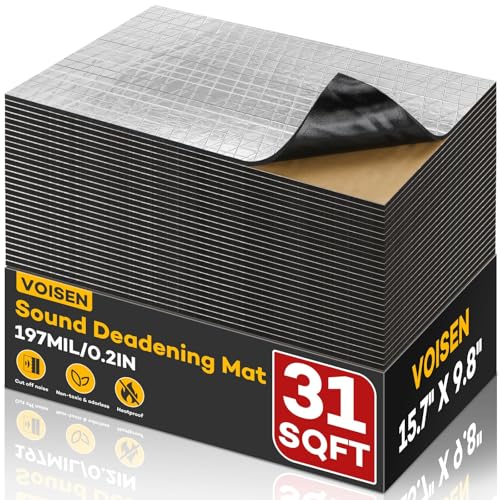
This VOISEN option features a thick 197 mil (approximately 5 mm) layer, with a total of 31 square feet of coverage. The product emphasizes high-density closed-cell foam paired with an aluminum surface for heat reflection and moisture resistance. The package contains 28 pieces, designed to fit various vehicle sections and cut to size as needed. The combination aims to greatly reduce engine, road, and wind noises while also contributing to thermal stability.
Key considerations: The notably thicker profile can offer strong dampening but may require more labor for precise fitting in smaller spaces. The aluminum surface aids heat management, which can improve overall comfort in hot environments. Plan layouts to minimize gaps and confirm compatibility with your vehicle’s insulation plan.
VOISEN Sound Deading Material for Cars (157 Mil / 36 Sqft)

Another VOISEN option uses a 4 mm closed-cell foam with three-layer construction to deliver robust sound dampening across a sizable 36 square feet. It features a strong adhesive and back paper for easy handling, making it adaptable for multiple vehicle sections, including doors and trunks. The mat is positioned as providing superior soundproofing, water resistance, and heat blocking capabilities for a quieter cabin environment.
Key considerations: The 4 mm thickness offers substantial mass for dampening, but installation may be more time-intensive in narrow gaps. Visualizing and pre-cutting sections prior to adhesive application can streamline the process. Consider stacking or layering where additional noise sources exist to maximize results.
Buying Guide: Key Purchase Considerations For Car Sound Proofing
- Material composition: Look for layers combining butyl rubber for vibration dampening with aluminum foil for heat reflection. Thicker mats generally deliver stronger noise reduction but require more space and careful installation.
- Coverage and layout: Estimate total square footage of the target area (doors, floor, trunk, firewall). Choose a mix of large sheets for broad coverage and smaller pieces for tight contours and corners.
- Adhesive performance: A strong self-adhesive backing simplifies installation, but surface preparation (cleaning, drying, and degreasing) is essential for long-lasting bonds. Some mats are more forgiving on curved surfaces than others.
- Thermal benefits: Aluminum-faced or foil layers help reduce heat transfer, contributing to cabin temperature control and potential fuel efficiency indirectly by reducing air conditioning load.
- DIY feasibility: Thicker mats may be heavier and harder to maneuver. If you’re new to installation, selecting a kit with pre-cut shapes or a mix of gauges can reduce complexity.
- Vehicle compatibility: Some mats are designed for doors and panels, while others claim full-vehicle coverage. Review your model’s panel layouts and any wiring or components to avoid interference during installation.
- Durability and moisture resistance: Waterproof or water-resistant options protect against moisture intrusion in damp climates or pressurized environments like trunks after rain.
- Cost versus value: Higher thickness and multi-layer designs often offer better long-term performance. Balance price with the expected reduction in noise and thermal gains for your needs.
These considerations help you compare products based on performance, ease of installation, and long-term value. For most mid-sized cars and trucks, pairing a primary, high-thickness mat on major panels with additional sheets for hotspots can yield noticeable cabin quieting without excessive labor.