Best Car Subwoofer Amplifier Options for Powerful Sound
Choosing the right car subwoofer amplifier can dramatically improve bass rhythm, headroom, and overall sound clarity in a vehicle. The following selections focus on monoblock power, efficiency, and compatibility with common subwoofers. Each entry highlights key specifications and features to help you compare performance at a glance.
| Product | Brand | Max Power (1 Ohm) | Impedance | Special Notes |
|---|---|---|---|---|
| BOSS Audio R1100M | BOSS | 1100 W | 2 Ω | Low Pass, MOSFET, Remote Subwoofer Control |
| ZE1000.1 2000W | AUDIOZERONE | 2000 W | 1 Ω | Class D, highly efficient |
| Skar RP-350.1D | Skar Audio | 388 W peak / 350 W RMS | 1 Ω | On-board Bass EQ |
| BOSS R1100MK | BOSS | 1100 W | 2 Ω | Low/High Level Inputs, Remote Subwoofer Control |
| Skar RP-1200.1D | Skar Audio | 1600 W peak / 1200 W RMS | 1 Ω | Remote Level Control |
These choices emphasize reliable monoblock designs, efficient Class D or A/B architectures, and features like variable bass boost and low-pass filtering. They’re suitable for a range of subwoofers and installation scenarios, from compact builds to upgraded factory systems. Review the sections below to compare each model’s strengths and practical considerations for your setup.
BOSS Audio R1100M Monoblock Car Amplifier

The BOSS R1100M is a compact monoblock amplifier designed for subwoofer duty with 1100 max watts at 2 ohms. It operates in Class A/B with a MOSFET power supply, offering robust output for a single sub in many car audio systems. Stability at 2 Ω and protective circuitry help guard against short and overload conditions. Features include a low-pass filter, bass boost control, and remote subwoofer control for convenient adjustments from the cockpit. The unit emphasizes a balance between performance and reliability in a market with densely packed under-dash spaces.
ZE1000.1 2000W Monoblock Class D

This amplifier is built around Class D topology to maximize efficiency and minimize heat while delivering substantial power. It boasts 1 Ω stability, enabling continuous operation for demanding subwoofers. The supported power range scales across 1-4 ohms, with substantial RMS figures at lower impedances. A low-pass crossover integrates with the subwoofer load, reducing distortion and ensuring the bass remains tight and controlled. It is well-suited for users seeking high power without excessive heat generation in confined automotive spaces.
Skar RP-350.1D Monoblock Class D

The Skar RP-350.1D delivers 350 W RMS at 1 Ω, with a peak near 388 W. Its Class D design emphasizes efficiency for multi-hour operation and reduces heat while maintaining solid bass output. The amplifier includes an on-board bass EQ switch providing a +6 or +12 dB boost at 45 Hz, allowing users to tailor low-end impact to the vehicle’s acoustics and the subwoofer’s characteristics. It’s a practical pick for compact builds seeking clean power delivery in a small footprint.
BOSS R1100MK Monoblock Car Amplifier

The BOSS R1100MK mirrors the R1100M’s power profile with 1100 max watts and 2 Ω stability, packaged with a full feature set that includes high and low-level inputs, low-pass filtering, and a remote subwoofer control. Its robust chassis and protective circuits safeguard against thermal overload and electrical faults, making it a dependable choice for mid-to-large sub systems. Installers benefit from a straightforward setup and consistent bass performance across varying vehicle environments.
Skar RP-1200.1D Monoblock Class D
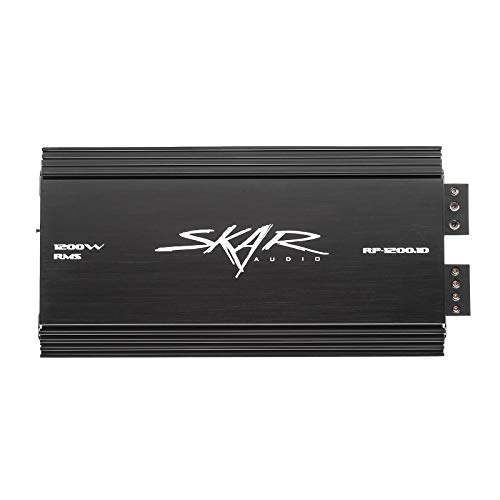
The Skar RP-1200.1D pushes 1200 W RMS at 1 Ω, with a peak near 1600 W. As a Class D monoblock amplifier, it emphasizes efficiency and reduced heat, enabling high-volume bass without excessive current draw. It also includes a remote subwoofer level control for on-the-fly adjustment. This model suits larger or more demanding subs where peak and sustained power must align for impactful, tight bass performance in a vehicle.
Buying Guide: Key Purchase Considerations
- Power needs and impedance: Match amplifier RMS power to your subwoofer’s rating and choose a stable impedance (1 Ω, 2 Ω, or 4 Ω) that your sub and charging system can handle. Higher wattage helps with louder, cleaner bass but requires a capable electrical system.
- Class architecture: Class D amplifiers offer higher efficiency and cooler operation, ideal for vehicles with limited space and heat management. Class A/B designs can provide a different sonic character and may be preferred in certain setups.
- Filtering and tuning: A low-pass filter helps ensure the amp only passes the frequencies your sub needs, reducing distortion. Bass boost and equalization control allow you to tailor the low-end response to your vehicle’s acoustics and music preferences.
- Inputs and routing: Low-level (RCA) inputs are common and integrate easily with head units. High-level inputs can be useful when a dedicated RCA signal isn’t available. A remote subwoofer control adds convenience for on-the-fly adjustments from the driver’s seat.
- Protection features: Look for thermal protection, short-circuit protection, and overload protection to preserve both the amplifier and subwoofer under demanding listening conditions.
- Installation considerations: Check the dimensions and mounting depth to fit under seats or in trunk enclosures. Ensure the power and ground wiring kit is rated to support the amplifier’s current draw and that the vehicle’s electrical system can handle the load.
- System integration: If you’re upgrading an existing setup, verify compatibility with your head unit, subwoofer, and enclosure. Some amps include built-in crossovers, while others pair with external crossovers for more complex networks.
- Brand and warranty: Reputable brands commonly offer solid warranties and service support. When in doubt, lean toward proven models with consistent performance histories and user reviews.
These considerations help assess value, performance, and long-term reliability. For many users, selecting a monoblock amplifier that balances power with efficiency and robust protection yields the most satisfying subwoofer performance in typical road conditions.