Best Charger for Ford Lightning: Top Adapters and Chargers for Fast, Widespread Charging
Choosing the right charger or adapter for the Ford Lightning can dramatically expand charging options, especially for public fast-charging networks. This guide highlights five highly relevant options that unlock broader access to CCS1 and Tesla Supercharger infrastructure, while keeping safety and compatibility in view. Each item is evaluated for fast charging capability, vehicle compatibility, and practical use on Ford Lightning models.
Summary table of selected products:
| Product | Brand | Max Rating | Key Use | Compatibility Note |
|---|---|---|---|---|
| BMKCT NACS to CCS1 Adapter | BMKCT | 500A / 1000V DC | Tesla Supercharger access for non-Tesla EVs | Works with Ford Lightning among others; V3 ports only |
| RAMATA NACS to CCS Adapter | RAMATA | 500A / 1000V DC | Charge Ford F-150 Lightning and more on CCS1 networks | Broad vehicle support; emphasizes faster charging |
| LJH NACS to CCS Adapter | LJH | 500A / 1000V DC | Access Tesla Superchargers with CCS1 EVs | Includes wear-resistance and weather-ready design |
| leheyhey Tesla to J1772 Adapter | leheyhey | Up to 80A / 240V | J1772 charging at Tesla stations for non-Tesla EVs | Not compatible with Tesla vehicles themselves |
| Caiinei MFi Certified USB Car Charger | Caiinei | 4.8A total across ports | USB charging for iPhone/iPad on the go | Separate from EV charging networks; consumer vehicle charging accessory |
BMKCT NACS to CCS1 Adapter for Ford Lightning

The BMKCT adapter enables non-Tesla EVs to access Tesla V3 Superchargers through a NACS to CCS1 interface. It highlights compatibility with Ford Lightning, Rivian, GM brands, Volvo, Polestar, Nissan, Lucid, Mercedes-Benz, Hyundai, Genesis, Kia, Honda, Acura, Jaguar Land Rover, Audi, and Porsche. It is designed for high-speed charging up to 250 kW with a 180-mile range added in roughly 15 minutes under optimal conditions. The device is SGS/CE/FCC certified and includes auto-shutoff features at 140°F for safety.
Features include: NACS DC Fast Charging at up to 250 kW, broad Tesla Supercharger access (V3 only), and safety certifications for reliable operation in varied weather. Note that some Ford PHEV models and older Ford EVs may be excluded.
RAMATA NACS to CCS Adapter for Ford Lightning
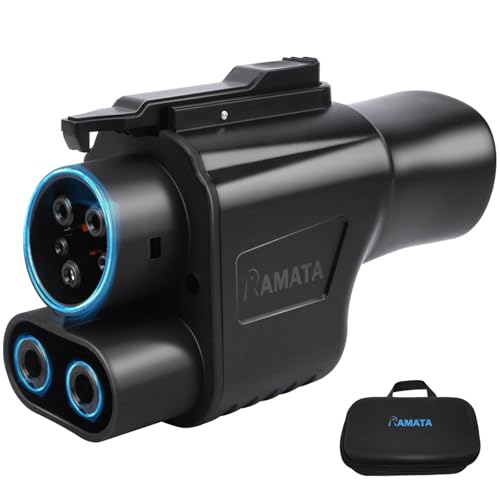
The RAMATA adapter is designed to connect Ford F-150 Lightning, Mach-E, GM vehicles, Rivian, Mercedes, and Polestar to CCS1 networks using a NACS port. It supports up to 500A/1000V DC, which is aligned with ultra-fast charging capabilities and can deliver rapid charging—often approximately 150 miles in 15 minutes, depending on the charger and vehicle.) It’s constructed with durable materials intended for weather exposure, and RAMATA highlights its capacity to unlock thousands of Tesla Supercharger ports for broader access.
Considerations include the need for exact vehicle compatibility checks and adherence to local charging network policies. The adapter aims to reduce wait times and expand charging options for Lightning drivers who frequently encounter CCS1 locations that support only Tesla’s network infrastructure.
NACS to CCS1 Adapter for Tesla Supercharger by LJH

LJH’s NACS to CCS1 adapter is positioned to unlock more than 17,800 Tesla Supercharger ports for non-Tesla EVs, including Ford Lightning, GM, Rivian, Volvo, and more. It is designed to support a maximum of 500A at 1000V DC, enabling fast charging rates and reducing charging times on compatible Supercharger V1-V4 ports. The adapter emphasizes all-weather durability and ease of use, though it notes that compatibility is limited to CCS1-compatible EVs on the Tesla network and excludes certain Ford models like plug-in hybrids.
Practical considerations include charger availability, port compatibility with your Lightning’s Battery Management System, and potential warranty implications when using adapters on public networks. This LJH model is a strong option for Lightning owners seeking expanded access while maintaining safety standards.
leheyhey Tesla to J1772 Adapter

The Tesla to J1772 adapter is designed to allow non-Tesla EVs to charge using J1772 outlets on Tesla charging infrastructure, including destination chargers and wall connectors. It supports up to 80 A at 240 V, providing efficient charging for compatible EVs, including Ford Mach-E and Ford F-150 Lightning as noted in product descriptions. Users should be aware that this adapter does not allow Teslas to use non-Tesla networks and is intended for non-Tesla vehicles leveraging Tesla charging facilities.
Key considerations include charging rate limits on specific station hardware, connector compatibility with local outlets, and the vehicle’s own charging capabilities. This adapter broadens access to Tesla-supported charging while keeping the focus on CCS1-compatible Ford vehicles seeking cross-network charging flexibility.
Caiinei MFi Certified USB Car Charger

While not an EV charging adapter, Caiinei offers an MFi-certified USB car charger with a 4.8A total output across two ports and a coiled USB-C/Lightning cable designed for iPhone and iPad devices. It provides practical in-vehicle charging for mobile devices while on the road, complementing an EV charging setup by keeping smartphones and navigation devices powered during trips to charging locations. It includes smart charging logic and safety protections, ensuring safe operation in a Ford Lightning environment.
Buying Guide: Key Considerations For Ford Lightning Chargers And Adapters
- Vehicle compatibility: Confirm that the adapter supports Ford Lightning and any other EVs you own. Some adapters exclude certain Ford models (notably PHEVs or older EVs) or certain model years.
- Charging network compatibility: Understand which networks you can access with each adapter (Tesla Supercharger V3 access, CCS1 networks, or J1772 stations). Public networks vary by region, so verify coverage in your typical routes.
- Maximum charging speed: Check A (amps) and V (voltage) ratings to estimate real-world charging times. Higher amperage typically means faster charging, but real-world speeds depend on the charger, vehicle, and battery state of charge.
- Safety and certification: Look for SGS/CE/FCC or equivalent certifications, auto-shutoff features, and weather-resistant construction for outdoor use. Ensure the adapter is designed to handle the temperatures and conditions you encounter.
- Portability and storage: Some adapters include portable storage bags or compact designs for on-the-go use. Assess whether the device is easy to transport and stow in the Lightning’s charging toolkit.
- Warranty and support: Check the warranty period and the manufacturer’s support options. Adapters interfacing with Tesla’s network may have specific terms; ensure you understand any limitations or caveats.
- Legal and network policies: Some networks restrict third-party adapters or impose usage limits. Always verify local network policies and comply with them to avoid charging interruption or account actions.
- All-weather durability: For outdoor charging on road trips, choose adapters designed to withstand rain, dust, and temperature extremes. Look for IP ratings and ruggedized housings where available.
- Future-proofing: As charging networks evolve, consider adapters that support newer generations of Superchargers or CCS1 stations, and verify ongoing firmware or hardware updates from the manufacturer.