Best Circle Track Carburetors for Racing Performance
For circle track racing, choosing the right carburetor is crucial for consistent throttle response and peak power. This article shines a light on top options designed for circle track applications, outlining key features and how they compare. Below you’ll find five standout choices, a quick purchasing snapshot, and a practical buying guide to help you select the best fit for your setup and driving style.
| Product | Brand | CFM / Type | Key Feature |
|---|---|---|---|
| JET 35004 Circle Track Quadrajet Carburetor | Jet | Quadrajet | High RPM fuel flow, race-focused design |
| ProForm 67215 Race Series Circle Track 750 CFM | ProForm | 750 CFM, 4-Barrel | Circle track dual inlet, mechanical secondary |
| 2 Barrel 350 CFM Mechanical Carburetor (BPE-4502) | Generic | 350 CFM, 2-barrel | Circle oval track compatibility |
| ProForm Carburetor 750CFM Circle Track E85 Mech. Sec. | ProForm | 750 CFM, E85 | Mech. secondary, circle track ready |
| Holley Track Warrior Carburetor 750 CFM | Holley | 750 CFM | Optimized race calibrations, balanced airflow |
JET 35004 Circle Track Quadrajet Carburetor

The Jet 35004 Circle Track Quadrajet Carburetor is engineered exclusively for circle track racing. It emphasizes high RPM fuel flow and reliable metering at race speeds. The kit includes a 0.149 needle and seat for stable fuel control across steady throttle applications.
ProForm 67215 Race Series 750 CFM Circle Track Dual Inlet 4-Barrel

The ProForm 67215 is a race-focused 750 CFM circle track carburetor featuring dual inlets and a 4-barrel square bore with mechanical secondary operation. Its Taiwanese origin and single-package design suit mid- to high-performance race setups that demand precision and dependable operation.
2 Barrel 350 CFM Mechanical Carburetor (BPE-4502)

This 2-barrel mechanical carburetor is designed for circle oval track configurations. It carries a BPE-4502 model number, with mechanical choke and a recognizable Bous Performance brand association. It offers a straightforward option for teams focusing on reliable, time-tested metering at oval tracks.
ProForm Carburetor 750CFM Circle Track E85 Mech. Sec.

The ProForm 750CFM E85 circle track carburetor focuses on ethanol-compatible performance with a mechanical secondary system. Its dimensions indicate a compact package suitable for tighter engine bays while delivering dependable fuel delivery and throttle response on race days.
ProForm Carburetor 650CFM Circle Track Alcohol Mech. Sec.

Designed for alcohol-fueled circle track engines, the ProForm 650CFM Alcohol carburetor employs a mechanical secondary setup. With a balanced, practical footprint, it supports consistent mixtures and throttle response across various oval track conditions.
ProForm Carburetor 650CFM Circle Track Gas Mech. Sec.
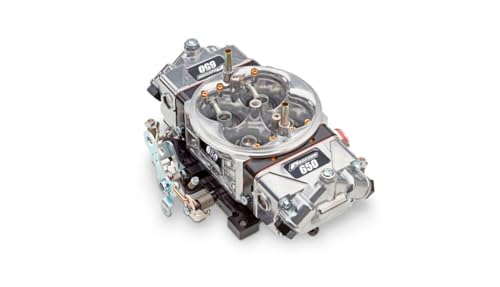
This 650 CFM gas circle track carburetor uses a mechanical secondary system and a compact package, suitable for versatile oval track configurations. It emphasizes reliable air-fuel metering with straightforward tuning options for different track conditions.
Holley Track Warrior Carburetor 750 CFM

The Holley Track Warrior Carburetor delivers optimized race calibrations and a contoured venturi inlet for balanced airflow and increased horsepower. Screw-in air bleeds provide precision tuning capabilities, supporting a wide range of circle track configurations and driving styles.
Buying Guide
Key purchase considerations for circle track carburetors include engine displacement and platform (gas, methanol, or ethanol), bolting pattern and inlet configuration, and the presence of mechanical versus vacuum secondaries. Assess the track type (oval vs. circle track), weight considerations, and compatibility with existing intake manifolds. Consider carburetor dimensions, choke type, and overall build quality, as these influence tuning flexibility and durability under race-day conditions.
- CFM rating and secondary operation: Ensure the carburetor matches engine size and ignition timing to optimize throttle response at race speeds.
- Fuel compatibility: E85 and methanol require ethanol- or alcohol-compatible components; verify suitability for your fuel strategy.
- Inlet and linkage configurations: Dual inlets and mechanical secondaries can improve fuel distribution and throttle response under high load.
- Durability and materials: Look for rugged bodies, corrosion-resistant components, and robust needle/seat assemblies for repeated high-RPM operation.
- Calibration options: Availability of screw-in air bleeds, metering blocks, and tunable jets helps tailor performance to track conditions.
- Compatibility with existing manifolds: Confirm mounting pattern and gasket compatibility to avoid fitting issues.