Best Deep Cycle Battery for Inverter: Reliable Power Options for RVs, Boats and Off-Grid Life
Finding a dependable deep cycle battery for an inverter is essential for sustainable off-grid living, RV adventures, marina use, and backup power. This guide compares top AGM and LiFePO4 options from trusted brands, focusing on availability, safety features, depth of discharge, and charging tolerance. Each pick is evaluated for performance in typical American settings—from cold mornings to hot afternoons—so you can choose a battery that aligns with your load, climate, and maintenance preferences.
| Product | Brand | Type | Voltage /Capacity | Key Benefit |
|---|---|---|---|---|
| Weize Deep Cycle AGM 12V 100Ah | WEIZE | AGM | 12V 100Ah | Low self-discharge, maintenance-free |
| Renogy Deep Cycle AGM 12V 100Ah | Renogy | AGM | 12V 100Ah | Strong safety and stability |
| Renogy Deep Cycle AGM 12V 200Ah | Renogy | AGM | 12V 200Ah | Expandable power with high capacity |
| 12V 100Ah LiFePO4 Group 24 (VATRER POWER) | VATRER POWER | LiFePO4 | 12V 100Ah | Wide temperature range, expandable system |
| GRNOE 2-Pack 12V 100Ah LiFePO4 Battery | GRNOE | LiFePO4 | 12V 100Ah (each) | Low weight, long cycle life |
Note: Each product’s features and performance can vary with temperature, charging regime, and system configuration. The selections below emphasize real-world inverter compatibility, safety, and long-term value for typical US applications.
Weize Deep Cycle AGM 12V 100Ah Battery
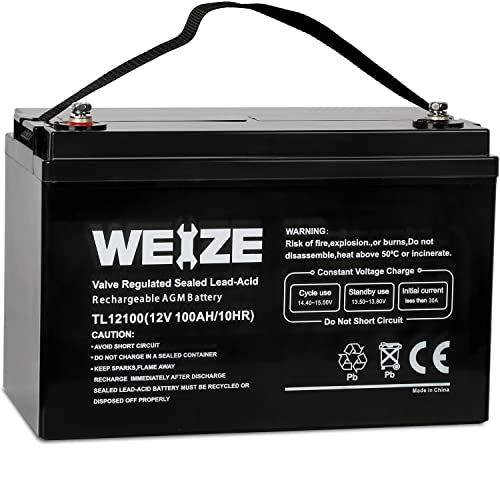
The Weize 12V 100Ah AGM battery uses absorbent glass mat (AGM) technology to deliver maintenance-free operation and leak resistance. Its compact dimensions (roughly 13 x 6.7 x 8.4 inches) support flexible mounting in many RVs, boats, and off-grid setups. A notable feature is its low self-discharge rate, typically around 1–3% per month, which helps extend storage windows when not in regular use. Safety is enhanced by a sealed design, reducing the risk of acid exposure. This model supports a high discharge current (up to about 1100A for short durations) and tolerates a wide charging temperature range. Overall, it’s a solid, no-fuss option for standard inverter loads.
Ideal for: off-grid cabins, RV/boat auxiliary power, and solar charging setups that don’t require lithium-level weight reduction. For longer life, keep it fully charged and store within recommended temperatures, avoiding prolonged exposure to extremes. The battery uses a left-positive/right-negative terminal layout and is designed for straightforward installation with typical inverter systems.
Renogy Deep Cycle AGM 12V 100Ah Battery

Renogy’s 12V 100Ah AGM battery is designed with safety and versatility in mind. It supports series connections without limitation and parallel stacking up to 4P, enabling scalable power for larger inverters or multi-battery arrays. The sealed design minimizes leakage risk, and overall chemical stability reduces maintenance concerns when compared with flooded lead-acid options. Renogy emphasizes broad compatibility and reliability, backed by a track record of substantial sales and long-standing market presence. This battery is a strong candidate for users who want a dependable, maintenance-free solution with configurable system architectures.
Reference performance: good for RVs, cabins, marine use, and off-grid storage. To optimize life, store at moderate temperatures and avoid deep discharges beyond the rated capacity. It’s compatible with typical 12V inverters and solar charge controllers and requires standard AGM charging profiles.
Renogy Deep Cycle AGM 12V 200Ah Battery

This higher-capacity Renogy AGM battery delivers 200Ah at 12V, making it suitable for heavier loads or longer backup periods. The 3% self-discharge rate helps preserve charge during idle times, while the robust plate design reduces internal resistance for steadier performance under high-drain conditions. The product’s design emphasizes safety and longevity, with a sealed enclosure that minimizes leakage risk and a long shelf life when stored properly. It’s a practical upgrade for users who need more energy capacity without moving to lithium technology.
Considerations: ensure your inverter and charge controller can handle the higher capacity and charging requirements. Parallel configurations can expand capacity further, but proper balancing and voltage matching are important for optimal operation and maximum life.
12V 100Ah LiFePO4 Group 24 Battery (VATRER POWER)

This LiFePO4 option brings a different chemistry profile with built-in 100A BMS, broader operating temperatures, and a modular expandability path. It supports charging down to -20°C and up to 60°C, with a built-in balance and protection against overcharging, over-discharging, and short circuits. The 100A BMS adds an extra layer of safety for inverter systems and solar arrays. Its expandable architecture allows stacking to meet rising power needs, which is ideal for users planning to scale their off-grid or backup systems over time.
Usage notes: ensure compatibility with your inverter’s charging profile and balance the pack alongside any other cells in a multi-battery arrangement. The battery’s safety protections are designed to mitigate common inverter-related faults and temperature-related stress.
GRNOE 2-Pack 12V 100Ah LiFePO4 Batteries

The GRNOE LiFePO4 batteries emphasize light weight, long cycle life, and modern BMS protection. Each 12V 100Ah unit is designed for heavy, repeated cycling with improved energy density compared with traditional lead-acid packs. A notable feature is a low-temperature cut-off that prevents charging below 32°F (0°C) and an auto-balancing system to distribute charge evenly across cells. The product family supports cold-weather readiness and is suitable for RVs, marine applications, and off-grid homes when used in matched configurations. Keep in mind the weight and wiring considerations when using a two-pack setup with a single inverter.
Operational tips: use a matching charger and ensure the charging voltage aligns with LiFePO4 charging curves. For best results, pair with an appropriate BMS-rated inverter/charge controller and monitor cell balance during the early use phase.
Buying Guide: Key Purchase Considerations
- Chemistry and safety: AGM batteries provide maintenance-free, corrosion-resistant operation, while LiFePO4 offers longer cycle life, lighter weight, and broader temperature tolerance. Consider your climate, load profile, and willingness to manage battery chemistry.
- Capacity and discharge: Deep cycle ratings like 100Ah or 200Ah determine how long you can run inverters without recharge. For high-load devices, higher capacity or parallel configurations may be necessary.
- Temperature performance: Cold weather can affect charging efficiency and capacity. LiFePO4 generally maintains performance in colder conditions better than many lead-acid variants, but proper battery management is still essential.
- Charging compatibility: Ensure your inverter, solar controller, and charger support the chosen chemistry and voltage. Some packs require specific charging voltages or preconditioning for optimal performance.
- Weight and space: LiFePO4 packs are lighter; AGM packs are heavier but often cheaper upfront. Consider mounting space, weight limits, and mounting orientation in the installation area.
- Lifecycle and maintenance: AGM typically offers 2–4 years of practical life under moderate use, while LiFePO4 can exceed 5–10 years with proper care. Factor replacement intervals into total cost of ownership.
- Expansion potential: If future power needs are expected to grow, select packs that allow parallel or series configurations without compromising safety or performance.
This comparison highlights practical options for building a dependable inverter system across RV, marine, and off-grid scenarios. When selecting a battery, weigh initial cost against long-term durability, safety features, and compatibility with your existing power electronics to maximize reliability and value.