Best Diesel Heaters for RVs: Top Picks for Off-Grid Comfort
When planning RV trips, reliable heating is essential for comfort and safety in cold weather. Diesel air heaters offer efficient warmth, work offline, and often feature app controls, altitude compensation, and quick heat times. This guide highlights five strong options to consider for RV use, along with a buying guide to help you compare capabilities, installation needs, and long-term reliability.
Summary of chosen products
| Product | Brand | Key Features |
|---|---|---|
| VEVOR 8KW All in One Diesel Heater with Bluetooth App Control | VEVOR | Bluetooth app control, remote, LCD, up to 18,045 ft altitude compensation |
| VEVOR 8KW All in One DC12-24V Diesel Heater with Color Display | VEVOR | Color digital display, remote, low noise, 12-24V operation |
| VEVOR 8KW Diesel Heater with Altitude Adjustment and Bluetooth | VEVOR | Automatic altitude compensation, Bluetooth control, LCD |
| BougeRV 5KW All-in-One Diesel Heater with APP Control | BougeRV | Fast warm-up, 5L tank, timer, thermostat, 12V/110V options |
| HCALORY 8KW All-in-One Diesel Heater with Remote Thermostat | HCALORY | True remote temperature control, rapid heat, long runtime |
VEVOR 8KW All In One Diesel Heater With Bluetooth App Control
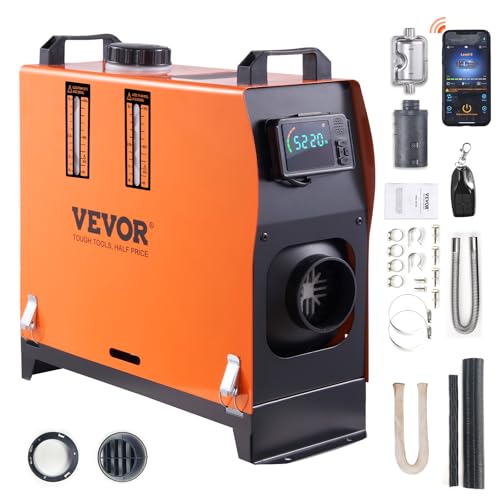
This all-in-one diesel heater from VEVOR emphasizes easy setup with no installation required, making it appealing for campers and travelers who want portable warmth. It uses an 8 kW heater rated at 12V and supports heating areas of roughly 215-269 ft² (20-25 m²). A sandblasted aluminum heat exchanger contributes to rapid heat transfer, bringing a comfortable interior temperature in minutes. Control methods include a Bluetooth smartphone app, a 32 ft/10 m remote, and an LCD panel for flexible operation. It also features automatic altitude compensation for high-altitude environments up to 18,045 feet, ensuring stable performance where other units struggle.
Considerations: App reliability, Bluetooth range, and the trade-off between portability and installation versatility. Users should verify ducting compatibility with their RV layout and check fuel availability during trips. Altitude compensation helps in mountainous routes but requires correct installation and calibration for best efficiency.
VEVOR 8KW Diesel Heater All In One With DC12-24V And Color Display

This model improves on the all-in-one concept with a color digital display and dual voltage compatibility (DC 12V-24V). It includes a remote control and a Bluetooth interface, enabling hands-free preheating and easier monitoring in transit. The unit claims efficient heat production with a fast warm-up cycle and a compact footprint suitable for RVs, trucks, campers, boats, and trailers. A low-noise fuel pump and a 5L fuel tank help manage operating costs while maintaining a steady heat output. The design emphasizes reliability for daily use on long trips.
Key aspects to assess include fuel economy at night, ease of refueling on the road, and how well the color display integrates with existing control setups. Sound output and cabin noise levels can influence overnight comfort, especially in smaller RV interiors.
VEVOR 8KW Diesel Heater With Automatic Altitude Adjustment

This option highlights automatic altitude compensation, enabling the heater to adapt when you travel through high elevations (up to 18,045 feet). The 8 kW heater runs on 12V and is suitable for spaces around 215-269 ft². Bluetooth control supports app-based preheating within about 98 feet, and a remote control plus LCD panel offer multiple ways to monitor temperature. The design emphasizes a balance between performance and energy efficiency, aiming to keep camping and RV interiors comfortable in varying climates.
Potential trade-offs include ensuring the altitude calibration is accurate for your route and confirming the heater’s venting and exhaust placement aligns with your vehicle’s safety guidelines and compartment geometry.
BougeRV 5KW All-In-One Diesel Heater With APP Control

BougeRV offers a lighter 5 kW alternative that remains comprehensive with all-in-one installation, a 5L tank, a timer, and a thermostat. The unit supports 12V and up to 110V in some configurations, making it versatile for different power setups in RVs, trucks, campers, or boats. Easy assembly is promoted alongside safety features such as overheating protection and voltage safeguards. The APP control, plus a remote option, enables preheating and monitoring from across the vehicle or campsite. This can be a practical pick for smaller rigs or for users prioritizing portability over maximum heating capacity.
Important considerations are space for installation, fuel endurance on extended trips, and ensuring the remote/APP control interfaces are intuitive for day-to-day use.
HCALORY 8KW Diesel Heater With Remote Thermostat
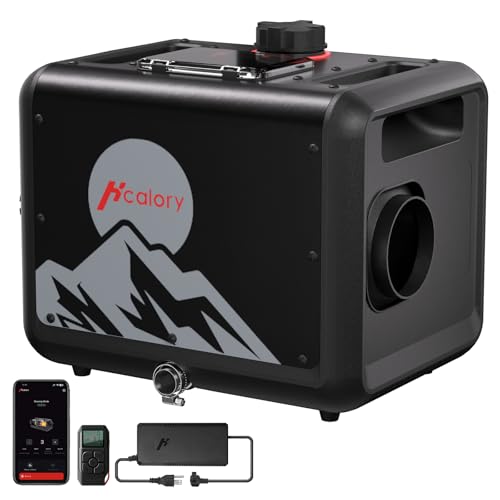
HCALORY presents an 8 kW diesel heater with a focus on smart remote temperature control. The wireless remote thermostat doubles as an indoor sensor, enabling the main unit to be placed outside a tent, van, or cabin while heat is directed inside. This arrangement supports safer and quieter operation and can improve space efficiency. Rapid heat up in minutes, combined with a large fuel tank and high efficiency, provides a dependable heat source for extended stays in cold weather. The unit is engineered to perform across a wide temperature range, aligning with RVing needs in diverse climates.
Consider how the remote thermostat integrates with your current heating controls and whether you require more integrated smart-home features or simply reliable manual control for off-grid travel.
Buying Guide: Key Considerations For Your RV Diesel Heater
- Power output and space: Most 8 kW models cover roughly 215-269 ft². If your RV is larger or has high insulation, you may want higher output or multiple units to maintain uniform warmth.
- Voltage and electrical availability: Models operating at 12V-24V are common for RVs, aligning with standard vehicle battery systems. Check your electrical capacity for extended operation and consider auxiliary power if you camp off-grid.
- Altitude compensation: If you travel through mountains, automatic altitude adjustment helps maintain efficient combustion and stable heat across elevations. Verify the maximum supported altitude and ensure proper air intake routing.
- Control options: Bluetooth app control, remote, LCD panels, and voice prompts offer different conveniences. Consider how you’ll interact with the heater while driving, sleeping, or cooking inside the RV.
- Fuel tank and consumption: A larger tank (5L–7.5L) reduces refueling frequency, but adds weight. Look for a balance between capacity, fuel efficiency, and expected nightly running hours.
- Safety features: Overheat protection, fuel caps, ignition reliability, and external exhaust shielding reduce risk. Ensure the heater’s exhaust setup complies with your RV’s ventilation design and local regulations.
- Installation: Some units are “installation-free” for portability, while others are designed to be permanently mounted. Consider your RV’s layout and whether you’ll need ducting or additional mounting hardware.
- Durability and noise: A robust build and a quiet operation profile improve comfort during nightly use. Look for noise levels in product specs and user reviews to gauge real-world performance.
- Warranty and support: A solid warranty and responsive technical support help with troubleshooting and replacements during trips.
How to Compare Models
- Match heater capacity to living space: larger areas require higher kW outputs or multiple units for uniform warmth.
- Evaluate control complexity: if you want remote management, prioritize Bluetooth/app-enabled models with reliable connectivity.
- Assess altitude needs: for high-altitude travel, choose models with proven automatic altitude compensation.
- Consider fuel logistics: assess fuel availability at stops and the practicality of refueling in remote locations.
In sum, the top-rated diesel heaters listed provide robust options for RV enthusiasts, from portable, no-installation units to more integrated installations. When choosing, weigh heating capacity, control options, altitude performance, and long-term reliability against your typical travel routes and RV setup.