Best Digital Displays for Cars: Top HUD Speedometer Units
Enhance driving safety and convenience with a digital heads-up display (HUD) that shows speed, direction, and essential data right in your line of sight. This article reviews five top HUD speedometer units designed for diverse vehicles and user needs. Each product highlights GPS and/or OBD data, brightness control, and easy plug-and-play installation. Read on to compare features, display quality, and how these HUDs can fit into daily driving, commuting, or long road trips.
Summary of chosen products
| Product | Brand | Key Features | Display Size | Link |
|---|---|---|---|---|
| Heads up Display for Cars (K1-White) | KUOWEIHUD | GPS+BDS signals, 10 Hz refresh, automatic brightness, USB plug-and-play | Large font | Amazon |
| OBD2 Gauge Display, P6 | wiiyii | OBD+GPS dual-mode, 10 interface options, fatigue/over-speed alerts | 5.5 inch | Amazon |
| KUOWEIHUD Heads Up Display | KUOWEIHUD | GPS+BDS, 32 satellites, automatic brightness, USB quick install | Large font | Amazon |
| SinoTrack Digital GPS Speedometer | SinoTrack | 5.5″ LCD, GPS speed, overspeed/fatigue alerts, auto dimming | 5.5 inch | Amazon |
| RGZOCT GPS Heads Up Display | RGZOCT | Dual display, universal plug-and-play, QC3.0 fast charging | Digital speedometer | Amazon |
Heads Up Display for Cars (K1-White) by KUOWEIHUD
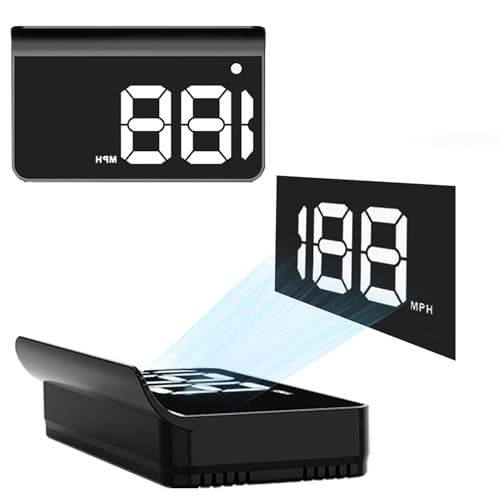
The KUOWEIHUD K1-White HUD provides rapid signal reception through GPS+BDS with a 10 Hz refresh rate and supports up to 32 satellites for stable speed data in urban or rural environments. It features automatic brightness adjustment via light sensors to maintain clear visibility in changing lighting. Designed for USB-equipped vehicles, installation is straightforward and compatible with cars, motorcycles, and trucks. The large font ensures quick readability at a glance, supporting safer driving. The device emphasizes plug-and-play setup and reliable data transmission for everyday use.
OBD2 Gauge Display, P6 by wiiyii
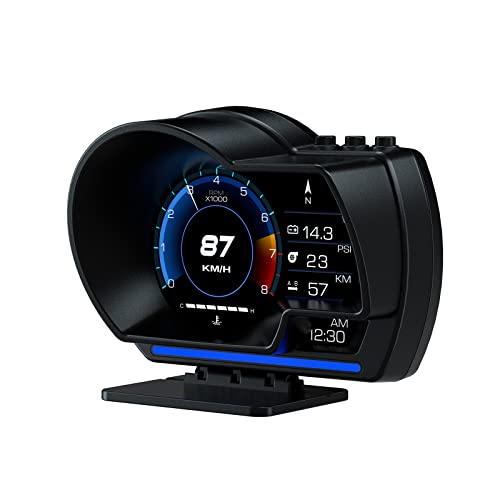
This wiiyii P6 HUD blends OBD and GPS data through a dual-mode system, delivering speed, RPM, water temperature, and more. It emphasizes a distraction-free design with adjustable mounting options for dashboard or windshield placement. The interface offers ten selectable displays, clear fault codes, and data streams for comprehensive vehicle information. Its two installation methods ensure compatibility with most vehicles, with a focus on minimizing manual setup while providing a reliable driving data experience.
KUOWEIHUD Heads Up Display

This KUOWEIHUD model emphasizes robust GPS+BDS signal reception with 32 satellites supported and a ten-hertz refresh rate for dependable speed data. Automatic brightness ensures legible information across lighting conditions, while USB port compatibility makes installation quick across various vehicle types. The large font design enhances readability, reducing the need to divert attention from the road during driving tasks. It aims to deliver a safe and informative dashboard experience with minimal setup.
SinoTrack Digital GPS Speedometer HUD

The SinoTrack HUD features a 5.5-inch display with GPS speed, driving time, and direction data; it also provides fatigue and overspeed alerts to promote safer driving. The auto light sensor adjusts display brightness for daytime and night usage, ensuring readability without manual brightness changes. Its design supports all vehicles and emphasizes a balance of data depth and legibility for drivers who want comprehensive road information while maintaining focus on the road.
GPS Heads Up Display by RGZOCT

The RGZOCT HUD offers a dual-display setup, working with a wide range of vehicles through a plug-and-play install. It also includes QC3.0 fast charging compatibility via a flexible USB connection. This unit emphasizes quick power-up and a straightforward user experience, enabling drivers to monitor speed, time, and other essential data without complex setup. The broad compatibility makes it a viable option for cars, trucks, boats, and other vehicles where a simple HUD solution is desired.
Buying Guide
Key purchase considerations help buyers select the right HUD for their needs:
- Display type and size: Larger displays improve readability but may dominate dash space. Consider 5.0–5.5 inch displays for balance, or larger font options for day-time visibility.
- Data sources: GPS-only HUDs rely on satellite data, while OBD+GPS models pull engine data. Choose based on whether you want vehicle-specific information beyond speed (RPM, fuel, temperature).
- Brightness and glare handling: Auto-brightness improves visibility in bright sunlight and at night. Some models include anti-glare screens or sunshades for better legibility.
- Installation: Plug-and-play USB options are common, but consider mounting options (dashboard vs windshield) and whether any vehicle modifications are needed.
- Alerts and safety features: Overspeed and fatigue alerts help maintain safe driving habits. Dials and beeps vary by model; verify alert types and customization options.
- Compatibility: Ensure the HUD supports your vehicle type (car, truck, motorcycle, SUV, boat) and the required power port (USB, cigarette lighter, or adaptor).
- Reliability and updateability: Look for models with stable firmware, clear fault-code reporting, and accessible customer support or documentation.
- Price-to-feature balance: Higher-priced models often deliver richer data, brighter displays, and more robust sensors. Compare features that matter most to your driving context (city commutes vs. highway trips).
- Warranty and return policy: A solid warranty helps cover potential display or sensor issues, especially for frequent long-distance travel.
Across the reviewed models, buyers can expect reliable speed readings, automatic brightness adjustment, and straightforward installation. For vehicles that rely on GPS data exclusively, GPS-based HUDs provide clean speed information with minimal wiring. For those who want engine data such as RPM and fuel consumption, OBD-enabled HUDs add extra depth. When selecting, consider your vehicle type, driving environment, and the level of data you want to monitor while keeping focus on the road ahead.