Best Digital Car Equalizers for Crisp, Custom Sound
For automotive audio enthusiasts, a digital car equalizer can be the difference between flat, dull sound and a immersive listening experience. This guide highlights five top-rated digital car equalizers, focusing on DSP capabilities, configurability, and overall sound control. Each product below includes practical features to help you tailor bass, mids, and treble across your vehicle’s cabin. Use the buying guide to compare options by inputs, outputs, presets, and interface complexity to match your setup and budget.
style=”display:none;”>Summary Table of Selected Products
| Product | Brand | Key Feature | Output Channels | Link |
|---|---|---|---|---|
| Taramp’s Pro 2.4S DSP Crossover | Taramp’s | 15-band graphic EQ, 12dB boost, ISO center frequencies | 2 In / 4 Out | Product Link |
| Clarion EQS755 7-Band | Clarion | 7-band graphic, built-in LPF, multi-aux inputs | Front/Rear/Sub outputs | Product Link |
| PRV AUDIO Car DSP 2.4X | PRV AUDIO | 15-band EQ, real-time adjustments, 4-channel outputs | 2 In / 4 Out | Product Link |
| Taramps DSP Pro 2.4S White | Taramp’s | 15-band EQ, sequencer, 12 presets | 2 In / 4 Out | Product Link |
| Suacopzar EQ-819 | Suacopzar | 9-band EQ, Karaoke function, 2 mic inputs | 6-channel outputs | Product Link |
Note: The following sections provide detailed information on each product, followed by a practical Buying Guide to help you compare features such as input options, crossover capability, preset availability, and ease of use.
Taramp’s Pro 2.4S DSP Crossover

The Taramp’s Pro 2.4S combines a full digital signal processor with a 15-band graphic equalizer and a flexible crossover system. It supports dual inputs (A and B) and provides four selectable outputs, enabling precise routing for front, rear, and subs. The 15-band EQ uses ISO standard center frequencies from 25 Hz to 16 kHz with up to ±12 dB boost, allowing detailed tonal shaping across the car’s cabin. Crossover adjustable HPF/LPF cutoffs range from 10 Hz to 22 kHz, offering classic filter types and slope options to tailor the signal path for each output. This unit is well-suited for users chasing studio-like control in a compact, in-vehicle package.
Pros: Comprehensive DSP with flexible routing, robust EQ bands, multiple filter types. Cons: Setup can be complex for beginners; requires careful calibration with measurement tools.
Clarion EQS755 7-Band Graphic Equalizer
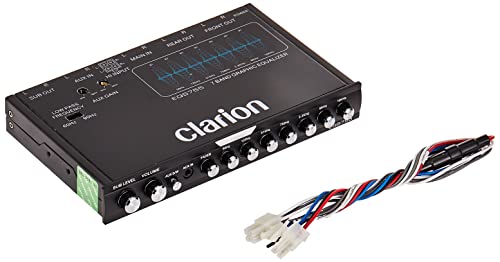
The Clarion EQS755 is a 1/2-DIN chassis graphic equalizer designed for comprehensive tone control in a multi-input setup. It features a 7-band graphic EQ with frequencies at 50 Hz, 125 Hz, 315 Hz, 750 Hz, 2.2 kHz, 6 kHz, and 16 kHz. The unit includes a built-in low-pass filter and six-channel/8-volt RCA outputs for front, rear, and subwoofer channels. It also offers front auxiliary input and rear RCA auxiliary input with adjustable gain, plus blue illumination and independent master volume control for the overall system. The included high-level inputs enable compatibility with factory radios, making it a flexible option for a broad range of vehicles.
Pros: Clear, intuitive controls; strong compatibility with factory radios; independent master and sub controls. Cons: Fewer DSP features than pure DSP processors; less advanced preset options.
PRV AUDIO Car DSP 2.4X

The PRV AUDIO 2.4X DSP is a compact, feature-rich car audio processor with two inputs (A and B) and four outputs. It provides an integrated 15-band graphic equalizer with both manual tuning and 12 presets (Flat, Loudness, Bass Boost, Mid Bass, Treble Boost, Powerful, Electronic, Rock, Hip Hop, Pop, Vocal, Pancadão). The interface emphasizes real-time adjustments via an LCD display, enabling precise tweaks for each output and source combination. This DSP is suitable for mid-range installations seeking robust EQ, preset versatility, and straightforward control without external hardware complexity.
Pros: Rich preset library; real-time adjustments; flexible source selection per output. Cons: May have a steeper setup curve for those new to DSP concepts.
Taramp’s TPT-SP4BT Bluetooth DSP

The TPT-SP4BT is a Bluetooth-enabled DSP with four output channels and built-in sequencing features. It supports smartphones for remote configuration via the TIMPANO app, enabling on-the-fly adjustments while parked or in-vehicle. The device includes a dedicated sequencer to automate startup and shutdown of multiple products (S1, S2, S3) from a single remote trigger, making it a strong choice for more complex multi-component systems. The DSP aims to optimize sound quality across various listening scenarios by letting users tune EQ, timing, and crossover settings with wireless convenience.
Pros: Wireless configuration, sequencing for automation, flexible four-output architecture. Cons: App-based control may require initial setup time; depends on mobile device compatibility.
7-Band Car Audio Equalizer (Lnrueg)

The Lnrueg 7-band graphic equalizer offers a broad tonal range with adjustable bands from 63 Hz to 12 kHz and a dedicated subwoofer control (30 Hz to 120 Hz). It supports flexible input options (CD and Aux) with a gain knob for precise volume adjustment and a front/rear/sub outputs arrangement. The device emphasizes simple, hands-on tone shaping for drivers who want straightforward EQ tuning without extensive DSP features. It’s a practical option for users who prioritize channel-specific adjustments and a compact footprint in the dash or center console.
Pros: Simple, intuitive controls; effective subwoofer shaping; compact installation. Cons: Fewer advanced DSP features and presets than higher-end models.
TARAMPS TEQ 7.4 Pro Car Audio System

The TEQ 7.4 is a 7-band graphic equalizer with a broad adjustment range (-12 dB to +12 dB) across notable frequencies like 50 Hz, 125 Hz, 315 Hz, 750 Hz, 2.2 kHz, 6 kHz, and 12 kHz. It includes balanced output control suitable for fine-tuning main channels and subwoofers, along with a wide voltage supply and compact dimensions. This unit is designed for enthusiasts seeking precise tonal corrections and a reliable preamp stage to support larger amplification setups.
Pros: Wide adjustment range; known Taramp’s build quality; good for mid-to-high-end systems. Cons: Manual controls may require frequent recalibration when adjusting the rest of the system.
Buying Guide: Key Considerations For Choosing A Digital Car Equalizer
When selecting a digital car equalizer, consider how you plan to integrate it with your current audio system and what you want to achieve in terms of sound quality. The following factors help compare options objectively.
- Inputs and outputs: Assess how many channels you need and whether you require two inputs for source blending or multiple outputs for front, rear, and sub channels. DSP units often offer 2-4 outputs with 2 inputs.
- Graphic vs parametric EQ: Graphic EQ provides quick tonal adjustments across fixed bands, while parametric EQ allows precise center frequencies, bandwidth, and gain. Many systems combine both for flexibility.
- Crossover capabilities: High-pass and low-pass filters help direct frequencies to appropriate speakers. Look for adjustable cutoff points and filter slopes (e.g., 6 dB/Octave to 48 dB/Octave) and supported filter types (Butterworth, Linkwitz-Riley, etc.).
- Presets and tuning features: Presets (Flat, Loud, Bass Boost, etc.) speed setup. Real-time measurement tools or LCD interfaces simplify on-vehicle tuning, especially for non-professional installers.
- Wireless vs wired control: Bluetooth-enabled DSPs offer convenient tuning from smartphones, but wired controllers can provide more stable performance in certain vehicles.
- Sequencing and automation: Some units include sequencers to manage startup/shutdown of multiple devices. This is useful in multi-amp systems with remote relays or ignition-triggered power.
- Build and installation: Consider the physical dimensions, mounting options, and power requirements. A compact DSP with robust shielding reduces interference in tight vehicle dashboards.
- Budget and complexity: Entry-level options focus on essential EQ and basic crossovers, while higher-end DSPs deliver advanced routing, measurement-driven tuning, and extensive presets.
In practice, the best choice depends on your installation: a simple, factory-friendly upgrade may benefit from a 7-band or 9-band graphic EQ with some crossovers, while a custom, three-amp system with multiple outputs benefits from a full DSP with extensive presets and measurement compatibility. Wireless control can reduce wiring complexity for enthusiasts who value mobile tuning without sacrificing sound quality. Always calibrate with a reliable method (test tones, measurement mic, or a trusted app) to achieve an accurate and consistent listening experience across your vehicle’s seating positions.