Best DSP for Car Audio: Top Car Audio Digital Signal Processors for 2026
Finding the right digital signal processor (DSP) can elevate car audio with cleaner tone, precise crossovers, and flexible EQ. This guide highlights five standout DSPs that balance features, usability, and performance for American listeners. Each option supports real-time tuning, multi-channel outputs, and presets to suit different music styles and vehicle setups.
Summary of Selected Products
| Product | Brand | Output Channels | Key Feature | Amazon Link |
|---|---|---|---|---|
| PRV AUDIO Car Audio DSP 2.4X | PRV AUDIO | 4 Outputs | Integrated 15-band EQ, 2 inputs | Link |
| PRV AUDIO Car Audio DSP 2.8X | PRV AUDIO | 8 Outputs | Integrated 15-band EQ, flexible source selection | Link |
| Timpano TPT-SP4BT | Timpano | 4 Outputs | Bluetooth control, SEQUENCER for multi-device startup | Link |
| Taramp’s DSP Pro 2.4S | Taramp’s | 4 Outputs | 15-band EQ, 12 preset EQ, remote signaling | Link |
| Dayton Audio DSP-408 | Dayton Audio | 8 Outputs | Real-time processing, GUI-based tuning | Link |
Each product below is analyzed for ease of use, tuning flexibility, output capabilities, and overall value in typical American-car audio installations.
PRV Audio DSP 2.4X: Solid Entry With Great Tuning Options

The PRV Audio DSP 2.4X offers two audio inputs and four independent outputs, allowing flexible routing of A, B, or A+B sources to each output. Its built-in 15-band graphic equalizer supports manual tuning and 12 presets, including Flat, Loudness, Bass Boost, and more. The intuitive LCD interface enables real-time adjustments, making it suitable for both beginners and enthusiasts seeking precise control in a compact package.
PRV Audio DSP 2.8X: Expanded Channel Flexibility
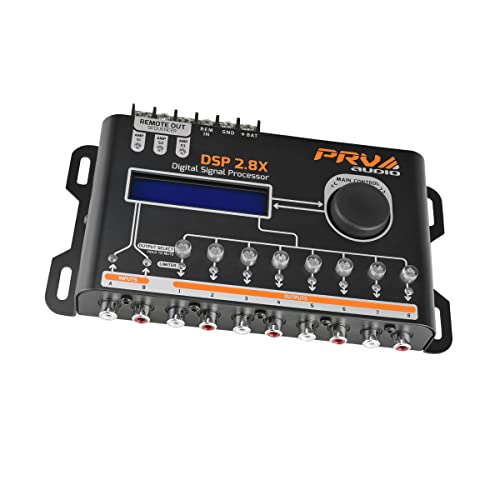
The 2.8X model expands to eight channel outputs while maintaining a 16×2 LCD display and intuitive interface. It supports the same dual-input design with selectable sources per output and includes the same 15-band graphic EQ and 12 presets. This option is well-suited for larger front-stage setups and multi-amp systems, providing more granular control without sacrificing ease of use.
Timpano TPT-SP4BT: Bluetooth DSP With Sequencer

The TPT-SP4BT emphasizes wireless control via Bluetooth through a companion app, enabling remote tuning and monitoring. It includes a Sequencer feature to automate startup/shutdown sequences for up to three devices, enhancing integration in complex systems. Built-in voltmeter aids in monitoring power and signal integrity while configuring gains and EQ for precise sound staging.
Taramp’s DSP Pro 2.4S: Professional-Grade 15-Band EQ

The Taramp’s DSP Pro 2.4S provides a 15-band graphic equalizer with precise center-frequency control and adjustable boosts. It supports input A and B processing and offers remote signaling for easier integration with other components. The device is designed for enthusiasts who want detailed tonal shaping and robust crossovers in a compact form factor.
Dayton Audio DSP-408: Desktop-Grade DSP For Cars And Homes

Dayton Audio DSP-408 brings eight outputs and real-time processing with a user-friendly GUI designed for both car and home applications. It emphasizes broad customization capabilities, including crossovers and time alignment, making it versatile for installations ranging from compact to multi-amp setups. The GUI aids in rapid tuning and verification of results across channels.
Buying Guide: Key Purchase Considerations
When selecting a DSP for car audio, consider how you balance processing power, ease of use, and the vehicle’s audio goals. The following perspectives help address common buyer needs:
- Output count and channel routing: More channels enable bigger systems and more complex crossovers. If you plan a multi-amp setup, opt for 6, 8, or more outputs and ensure it supports simultaneous processing of inputs A and B.
- EQ and filtering options: A robust 15-band or higher graphic EQ, plus a parametric EQ, provides granular tonal shaping. Choose devices with popular filter types (Butterworth, Bessel, Linkwitz-Riley) and adjustable slopes for precise crossover control.
- Source integration: Look for DSPs that handle multiple inputs and provide flexible source selection per output. Some models support remote control via Bluetooth or app interfaces for real-time tweaking.
- Remote features and configurability: Sequencers, voltmeters, and remote relays improve installation efficiency and system safety. Apps that log changes help with repeatable tuning sessions.
- Installation context: Consider vehicle acoustics, speaker placement, and existing head unit compatibility. Some DSPs are better suited for factory-radio integrations, while others pair well with aftermarket systems.
- User experience: A clear GUI and responsive LCD interfaces reduce setup time and error. For beginners, presets (Flat, Loudness, Bass Boost) provide quick tonal improvements.
Additional considerations include build quality, power handling, and warranty terms. Review user manuals for mounting options, power requirements, and software update procedures to ensure long-term reliability in daily use.
In summary, the best DSP choice depends on your system size, desired tuning depth, and how you prefer to adjust settings. For compact, straightforward setups, the PRV Audio 2.4X offers strong performance with essential EQ. For larger, multi-output systems, the PRV 2.8X, Taramp’s 2.4S, or Dayton Audio DSP-408 provide expanded outputs and advanced tuning options. Bluetooth-enabled options like the Timpano TPT-SP4BT simplify remote adjustments, which can be advantageous for frequent tweaks or shared vehicles.