Best Dual Battery Isolator Solutions for Reliable Off-Grid and on-Road Power
Choosing a dual battery isolator helps protect your main starting battery while keeping auxiliary power available for accessories, camping gear, or marine equipment. The following five products represent leading options that balance automatic charging, durability, and compatibility across vehicles, RVs, boats, and ATVs. Each item includes a voltage-sensitive relay (VSR) and practical features to minimize voltage drops and battery drain.
| Product | Brand | Key Feature |
|---|---|---|
| VEVOR Split Charge Relay Kit, 6m | VEVOR | 140A VSR; automatic 13.3V in / 12.8V out; dual battery charging |
| Dual Battery Isolator Kit 12V – 140 Amp | KeyLine Chargers | 13.3V in / 12.8V out; compact, rugged; VSR with automatic switching |
| VEVOR Dual Battery Isolator Kit, 12V 300 Amp | VEVOR | High current 300A; LCD voltmeter; manual & automatic modes |
| VEVOR Dual Battery Isolator Kit, 12V 140 Amp | VEVOR | Manual & automatic modes; LCD screen; supports lithium & lead-acid |
| Stinger SGP32 200 AMP Battery Relay Isolator | STINGER | 200A isolation with high-current transfer; reliable primary battery protection |
VEVOR Split Charge Relay Kit, 6m, 140A VSR

The VEVOR Split Charge Relay Kit provides automatic dual battery charging with a 140-amp voltage-sensitive relay. It engages at 13.3 volts to charge both batteries and disengages at 12.8 volts to prevent drain on the starting battery. The kit is designed to allow two batteries to charge simultaneously while keeping them isolated when the engine is off, supporting RV, marine, car, truck, and caravan setups. Durability is reinforced by rugged, shock- and dust-proof plastic housing, suited for harsh environments. The kit includes complete installation hardware and clear instructions for straightforward setup.
Dual Battery Isolator Kit 12V – 140 Amp (VSR)

This 12V dual battery isolator kit uses a voltage-sensitive relay to automatically activate and disengage charging between the two batteries. It emphasizes minimizing voltage drops and preventing drain from the starting battery. Its compact form supports under-hood installations and battery relocation. The kit is designed for marine and automotive use, including trucks, RVs, and off-road vehicles, offering robust performance in demanding environments with dependable, automatic switching to maintain battery health.
VEVOR Dual Battery Isolator Kit, 12V 300 Amp
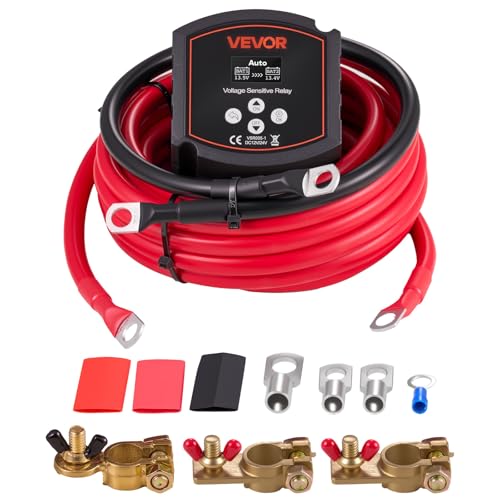
With a 300-amp capacity, this VEVOR kit targets higher-demand dual-battery systems found in UTVs, ATVs, campers, and larger RVs. It features manual and automatic VSR modes and includes a voltmeter LCD for real-time battery monitoring. The kit’s compatibility with lead-acid and lithium options helps extend battery life by ensuring proper charging without unnecessary cross-bleeding between banks. Users gain visibility into voltage levels, supporting proactive maintenance and longer equipment life.
VEVOR Dual Battery Isolator Kit, 12V 140 Amp

This 140-amp kit emphasizes compatibility with both lithium and lead-acid batteries, supporting diverse power setups. It provides manual and automatic modes, allowing users to switch modes as needed. An LCD screen offers voltage readings for continuous monitoring, while the VSR design helps prevent backflow and battery drain when the engine is off. It’s suitable for cars, RVs, UTVs, ATVs, and boats requiring reliable dual-battery management.
Stinger SGP32 200 AMP Battery Relay Isolator

The Stinger SGP32 provides a robust 200-amp isolator and relay to protect the primary battery while ensuring high-current transfer to an auxiliary battery. This model is designed for enthusiasts needing dependable performance under demanding conditions, including off-road use and heavy accessories. It emphasizes strong current handling and reliable isolation, helping extend battery life in vehicles, boats, and off-grid setups where power demand varies with activity.
Buying Guide
Key considerations when selecting a dual battery isolator include current rating, voltage sensitivity, and mode options. A higher amp rating supports larger or multiple auxiliary loads, but must be matched to your alternator output and battery bank. Voltage sensitivity is typically around 13.3V in and 12.8V out, ensuring a full auxiliary battery charge without starving the starting battery. Manual versus automatic modes offer flexibility: automatic VSRs are convenient, while manual mode helps you control charging during special conditions, such as when using lithium batteries or during long-term storage.
Durability and environmental resistance matter for outdoor use. Look for IP ratings (IP65–IP66 or IP67) and rugged housings to withstand water, dust, and vibrations common in marine, RV, and off-road environments. Physical size and mounting options should fit under-hood spaces or compartments. Real-time monitoring features, such as LCD voltmeters, provide visibility into battery health and charging status, enabling proactive maintenance rather than reactive repairs. Finally, verify battery compatibility with your system (lead-acid, AGM, or lithium) to avoid charging incompatibilities that can shorten battery life.