Best Heat Shield for Car Exhaust: Top Picks for Thermal Protection and Easy Installation
Choosing the right heat shield for your vehicle’s exhaust system protects critical components, preserves paint, and keeps underbody temperatures in check. This guide highlights five top-rated aluminum heat shields designed for durability, high-temperature resistance, and flexible installation. Each option is evaluated by material quality, heat tolerance, and ease of use to help American drivers pick the best match for mufflers, pipes, and underbody protection.
Summary of chosen products
| Product | Brand | Approx. Size | Max Temp | Key Benefit |
|---|---|---|---|---|
| Exhaust Heat Shield Automotive 16″ x 78.7″ | SINNSIDELIN | 16″ x 78.7″ | 1022°F | Heavy-duty embossed aluminum; flexible and easy to cut |
| Embossed Aluminum Heat Shield 12″ x 20″ | BSTFLEX | 12″ x 20″ | 1100°F | Ready-to-use with easy cutting and forming |
| Exhaust Heat Shield 16″ x 78.7″ | Chocikick | 16″ x 78.7″ | 1022°F | High flexibility; durable aluminum with strong insulation |
| AggSound Exhaust Heat Shield 16″ x 13″ | AggSound | 16″ x 13″ | 1022°F | Two-layer design; easy installation with zip ties |
| Racewill Titanium Pipe Shield 6″ x 12″ | Racewill | 6″ x 12″ | 1350°F | Double-layer protection; robust mounting options |
Exhaust Heat Shield Automotive 16″ x 78.7″

Product overview: This heat shield from SINNSIDELIN is a heavy-duty embossed aluminum sheet measuring 16″ by 78.7″. It has a thickness of 0.5 mm, providing flexible installation options and easy cutting to fit complex exhaust routes. The shield exhibits excellent heat resistance, designed to withstand sustained temperatures up to 1022°F. It is suitable for protecting mufflers, chassis components, fuel tanks, catalytic converters, and nearby exhaust hoods. The inclusion of 20 cable ties simplifies securing the shield during installation, especially in tight underbody spaces.
Key considerations: The aluminum construction delivers reliable thermal insulation, reducing radiant heat transfer to sensitive parts. The shield’s flexibility supports bending along curves without cracking. Users should verify clearance with surrounding components to ensure no interference with moving parts or heat-sensitive hoses. For best results, cut the shield to follow contours, then secure with the included ties for a snug fit. Regular inspection is advised to check tie integrity and shield position over time.
Embossed Aluminum Heat Shield 12” x 20”

Product overview: BSTFLEX offers a compact 12″ x 20″ heat shield with an embossed aluminum surface designed to tolerate continuous high temperatures up to 1100°F. The shield is crafted from insulated aluminum sheet material that delivers dependable thermal insulation for mufflers, chassis, fuel tanks, and catalytic converters. The 15 mil thickness increases durability compared with standard fabrics, and the shield is easy to cut with tin snips. Edges can be folded and formed with a hammer for a snug fit on square or irregular shapes.
Key considerations: A smaller shield can be ideal for targeted protection around smaller exhaust segments or tight engine bays. The material’s rigidity is tempered by alloy design, balancing rigidity and flexibility. Ensure the shield’s dimensions align with the area needing protection, and take advantage of simple shaping for complex exhaust routes. Protective gloves during cutting help avoid sharp edges, and a magnet may help with initial positioning during installation.
Exhaust Heat Shield Automotive 16″ x 39″

Product overview: This SINNSIDELIN heat shield measures 16″ by 39″ with a 0.5 mm thickness. It balances flexibility and rigidity, making it suitable for curved muffler sections and underbody routes. Like the larger variant, it offers heat resistance up to 1022°F, making it a versatile choice for protecting exhaust hoods, mufflers, catalytic converters, and chassis components. The kit includes 20 cable ties for secure mounting, facilitating installation in limited spaces.
Key considerations: When working with longer sections, consider joining multiple shields for extended coverage. Verify clearance to avoid contact with rotating or moving parts, and test fit before final securing. Aluminum shields tend to heat evenly and reflect radiant heat, which helps maintain component temperatures in critical zones. Regular checks help ensure the shield remains properly positioned after road use and weather exposure.
Exhaust Shield 16″ x 78.7″ By Chocikick
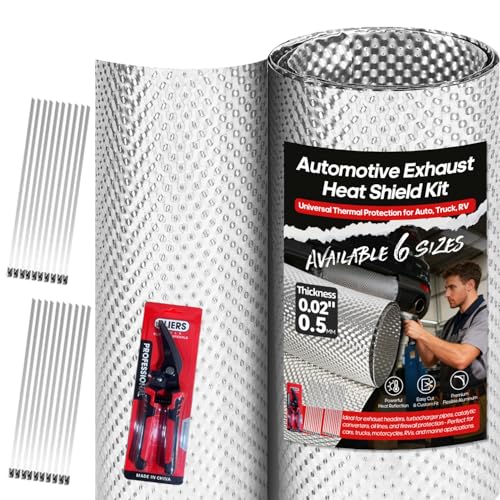
Product overview: Chocikick offers a long, flexible 16″ x 78.7″ aluminum heat shield with a 0.5 mm thickness. It tolerates sustained temperatures up to 1022°F, making it suitable for underbody protection, mufflers, pipes, and catalytic components. The shield is designed to bend easily to match contours, aiding precise installation along complex exhaust pathways. It also emphasizes durability and improved thermal insulation over standard heat shield fabrics, aiding component longevity.
Key considerations: When fitting along long exhaust runs, plan the shield layout to minimize seams where heat could concentrate. Use proper cutting tools to avoid jagged edges, and smooth edge lines with metal file if needed. The shield’s reflective surface helps deflect heat, which is beneficial for maintaining paint and nearby plastics. Periodic inspection is advised to check for signs of wear or deformation from road debris.
AggSound Exhaust Heat Shield 16″x13″

Product overview: AggSound provides a compact 16″ x 13″ heat shield that uses embossed aluminum 0.5 mm thick material. It withstands temperatures up to 1022°F, offering effective protection for exhausts, engines, and chassis sections. The kit includes stainless steel zip ties and stainless hardware, enabling straightforward installation on mufflers, exhaust wraps, or nearby heat-sensitive components. The embossed design improves heat dissipation and adds durability against dents and creases during installation on curved routes.
Key considerations: This shield is well-suited for smaller coverage areas where heat protection is needed without bulk. The stainless zip ties provide corrosion resistance in humid or salted-road conditions. For extended exhaust runs, consider combining multiple shields to eliminate heat pockets. Always ensure a clean surface for adhesive or mechanical mounting and verify that ties do not interfere with moving parts or heat-sensitive sensors.
Racewill Titanium Pipe Shield 6″ x 12″

Product overview: Racewill’s 6″ x 12″ pipe shield is built with a two-layer design for superior heat protection, featuring an outer titanium layer and an inner silica fabric layer. It supports protections up to 1350°F, ideal for sensitive hoses, wiring, and small-diameter exhaust components. The design includes rivet-based standoff brackets and pipe clamps for easier installation and maintaining a small air gap to enhance cooling efficiency. This shield targets high-heat sections where compact protection matters most.
Key considerations: The two-layer construction provides robust protection but may be more rigid than single-layer shields. Ensure the shield’s size matches the component to avoid bulk that could impede clearance. Rivet-based mounting aids secure attachment, but check that exposed fasteners are corrosion-resistant and won’t contact hot surfaces. For complex routes, it may be useful to combine with larger shields to manage heat spread more evenly.
Buying Guide: Key Purchase Considerations
Material and thickness: Most high-performance automotive heat shields use embossed aluminum around 0.5 mm thick. This balance provides strength, flexibility, and good thermal reflection without adding excessive weight. Some products use a two-layer design (outer metal with inner insulating layer) for enhanced protection, especially around very hot exhaust sections.
Heat tolerance: Look for shields rated to withstand 1022°F (550°C) or higher if your vehicle carries high-temperature exhaust routes or turbocharged systems. For extreme scenarios, shields with up to 1350°F ratings offer a margin of safety for critical components like catalytic converters and oxygen sensors nearby the exhaust path.
Flexibility and cut-ability: A shield that’s easy to cut and shape saves time during installation. Thinner aluminum and embossed textures usually provide good bending performance without cracking. Consider shields that can be bent by hand or with simple tools, saving effort in fitment around curves and irregular shapes.
Installation durability: Check whether the kit includes mounting hardware such as zip ties, clamps, or rivets. Stainless or corrosion-resistant fasteners improve lifespan in road salt environments. Design considerations should include a clear path for air flow and avoidance of contact with moving parts or hot pipes.
Size and coverage: Choose shields that cover the necessary area without excessive overhang. In some cases, multiple shields are used to create continuous protection along long exhaust runs. For compact spaces, smaller shields can be stacked or overlapped to achieve complete coverage.
Installation ease: Some shields are flat pieces requiring cutting and bending, while others come with pre-formed curves for easier mounting. If you’re not experienced with metalwork, look for shields with generous tolerance and user-friendly mounting hardware to simplify the process.
Durability and maintenance: Aluminum shields resist corrosion and are less likely to absorb moisture than fiberglass options. Embossed surfaces help resist dents from road debris and maintain their reflective properties over time. Regular checks ensure ties and brackets remain secure and intact after driving in challenging conditions.
Suitability for variants: Consider whether you need shields for underbody protection, near fluorinated plastics, or around sensitive electrical components. For turbocharged engines or high-heat exhaust routes, prioritize shields with higher heat tolerance and robust mounting options to prevent shift or deformation during operation.