Best RV House Battery Options for Off-Grid Power
Choosing the right house battery is essential for reliable RV power, whether you’re off-grid camping or cruising with limited hookups. This guide highlights five top batteries that balance safety, lifespan, and performance for American RV users. Each option includes core specs, ideal use cases, and key safety features to help you decide what fits your rig.
Summary of chosen products
| Product | Type | Nominal Capacity | Key Benefit | Power Type |
|---|---|---|---|---|
| Renogy Deep Cycle AGM 12V 100Ah | AGM | 100Ah | Maintenance-free, safe chemistry | Lead-Acid |
| WEIZE Deep Cycle AGM 12V 100Ah | AGM | 100Ah | Low self-discharge, solid cold-temp range | Lead-Acid |
| DUMFUME 12V 300Ah LiFePO4 | LiFePO4 | 300Ah | High cycle life, scalable | Lithium |
| DC HOUSE 12V 165Ah LiFePO4 | LiFePO4 | 165Ah | Bluetooth monitoring, low-temp protection | Lithium |
| ECO-WORTHY 12V 280Ah LiFePO4 | LiFePO4 | 280Ah | Real-time monitoring, robust BMS | Lithium |
Renogy Deep Cycle AGM 12V 100Ah Battery

Brand: Renogy. This maintenance-free AGM battery offers a safe chemical composition and a low self-discharge rate, making it suitable for RVs needing reliable storage without frequent upkeep. It supports parallel connections (up to four in a system) and can be used in series as needed, easing expansion for larger rigs or more appliances. The sealed design reduces acid leaks and is backed by Renogy’s broad market trust, with thousands of units deployed in RV and off-grid setups. Use case: standard RV power banks, essential electronics, lighting, and small appliances when connected to an appropriate charging source.
WEIZE Deep Cycle AGM 12V 100Ah Battery
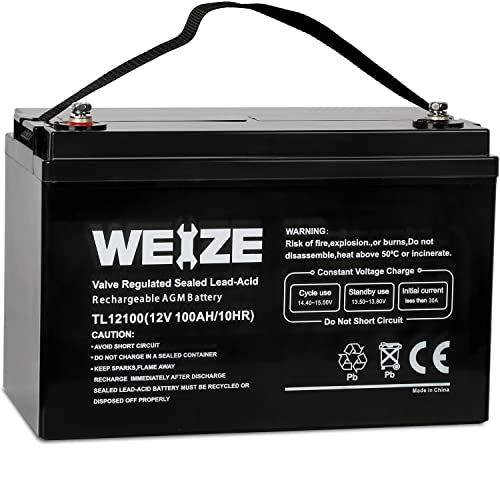
Brand: WEIZE. This 12V 100Ah AGM battery emphasizes maintenance-free operation with a low monthly self-discharge rate. It describes operating temperature ranges and a robust 1100A max discharge current in short bursts, helpful for powering high-draw devices like inverters. Its sealed design reduces leaks, and the compact dimensions make it a versatile fit for under-seat compartments or cargo bays in many RV layouts. Use case: general RV electrical system, solar-powered setups, trolling motors, and off-grid storage.
DUMFUME 12V 300Ah LiFePO4 Battery

Brand: DUMFUME. A high-capacity LiFePO4 option designed for extended RV use, with 3840Wh and a 10+ year lifespan. It features a 200A smart BMS for overcharge, over-discharge, and temperature protection, plus scalable configurations (up to 4S4P) for larger energy demands. This battery is well-suited for full-time RVers running multiple appliances, climate control, and entertainment systems, especially when paired with a compatible solar array or generator charging plan.
DC HOUSE 12V 165Ah LiFePO4 Battery

Brand: DC HOUSE. This LiFePO4 option emphasizes safety with a metal case and low-temperature protection that protects the battery at subfreezing temperatures. The built-in Bluetooth app monitoring provides real-time SOC, voltage, current, and fault diagnostics. It’s a strong fit for RVs in regions with variable weather or for boaters needing remote battery insight, with the added benefit of a rugged housing for rough road or marine environments.
ECO-WORTHY 12V 280Ah LiFePO4 Battery

Brand: ECO-WORTHY. This 280Ah LiFePO4 pack combines a large usable capacity with a built-in 200A BMS and Bluetooth connectivity for real-time monitoring. It’s designed for campers with higher energy demands or longer off-grid stretches, offering long cycle life and strong tolerance to deep discharge when managed with a proper charging routine. Suitable for RVs with solar setups, wind generators, or backup power strategies for extended trips.
Buying Guide: Key Factors For RV Battery Purchases
When selecting an RV house battery, consider energy needs, climate, charging options, and system expansion plans. Lithium iron phosphate (LiFePO4) cells generally offer longer life, higher energy density, and better depth of discharge than traditional AGM or flooded lead-acid batteries, but at a higher upfront cost. AGM batteries remain a solid, maintenance-free choice for mid-range usage and simple setups. For RVers, the right balance lies in capacity, weight, safety features, and how you plan to recharge on the road.
- Energy capacity vs. weight: Higher amp-hour ratings deliver more usable energy but add weight. LiFePO4 often provides more usable energy per pound than lead-acid.
- Depth of discharge and cycle life: LiFePO4 typically offers deeper discharges (up to 80-100%) with thousands of cycles, while AGM may favor shallower cycles.
- Safety and protection: Look for BMS (battery management system), temperature safeguards, and sturdy enclosures, especially for exposed RV compartments.
- Charging compatibility: Ensure your charger, solar panels, or generator can efficiently charge the battery type. LiFePO4 requires appropriate charging profiles.
- Temperature considerations: Low-temperature protection and operating temperature ranges extend battery life in cold climates.
- Scalability: If you plan to expand power, consider batteries that support in-series or in-parallel configurations to reach higher voltage or capacity.
- Maintenance: AGM is maintenance-free; LiFePO4 also requires minimal maintenance but benefits from proper storage practices in off-season periods.
- Cost of ownership: Evaluate total cost of ownership—initial price, lifespan, and the number of replacements over years of RV use.
Practical tips: – Match battery type to your RV’s electrical load. – Pair high-capacity batteries with efficient inverters and energy-conscious appliances. – Use a quality battery monitor or app to prevent deep discharge. – Consider solar or alternator charging to maximize usable energy without frequent recharges.