Best Marine Battery Monitoring Systems for Reliable Power Management
Efficient battery monitoring is vital for marine vessels to ensure reliable power performance and battery longevity. The best marine battery monitoring systems provide real-time data, enhance battery usage, and protect electrical components on boats and RVs. Below is a summary table of selected top-rated battery monitoring solutions optimized for marine applications.
| Product Name | Brand | Key Feature |
|---|---|---|
| Blue Sea Systems 7650 Add-A-Battery Kit | Blue Sea Systems | Dual-circuit management, emergency combine function |
| ANCEL BM1000 400A Bluetooth Battery Monitor | ANCEL | 400A capacity, ±1% accuracy, Bluetooth app integration |
| KDator 6V-24V Bluetooth Battery Monitor BM7 | KDator | Supports various battery types, waterproof, auto alarm |
| ANCEL BM300 Pro Bluetooth 5.3 Battery Monitor | ANCEL | Bluetooth 5.3, multi-battery monitoring, IP67 waterproof |
| Blue Sea Systems Add-A-Battery Kit, 65A Display Pack | Blue Sea Systems | Seamless battery isolation and combining during charging |
Blue Sea Systems 7650 Add-A-Battery Kit – Dual Circuit Management

The Blue Sea Systems 7650 Add-A-Battery Kit manages two batteries efficiently by allowing them to be charged from a single source without the need for external regulators or isolators. This system automatically isolates the house battery when starting, protecting sensitive electronics on board. It features an emergency combine function to draw power from both batteries when needed, providing an excellent solution for dual battery setups. With its 120-amp capacity, it suits many marine applications requiring seamless power management and battery safeguarding.
ANCEL BM1000 Bluetooth Battery Monitor with Shunt – 400A

The ANCEL BM1000 is designed specifically for marine, RV, and solar systems with a 400-amp capacity that matches typical peak loads, ensuring precise power monitoring without excess bulk or overheating. It features an outstanding ±1% accuracy thanks to factory calibration on low-resistance materials. The wireless Bluetooth connection with a dedicated app allows users to track voltage, current, and state of charge, making it easy to avoid battery over-discharge and plan energy consumption effectively. Installation is simplified with clear terminal design, ideal for DIY setups.
KDator BM7 Bluetooth Battery Monitor for 6-24V Lead-Acid & Lithium Batteries

The KDator BM7 offers versatile battery monitoring compatibility supporting 6V, 12V, and 24V lead-acid and lithium batteries, including flooded, AGM, GEL, EFB, and LiFePO4 types. It monitors battery health, voltage, temperature, cranking system, charging system, and records trip data with up to 72 days of storage. The device supports up to four batteries at once, features an IP67 waterproof rating, and sends auto alarms via its app if abnormalities arise, providing comprehensive assessment ideal for boats and vehicles under various conditions.
ANCEL BM300 Pro Bluetooth 5.3 Battery Monitor – Multi-Battery & IP67

The upgraded ANCEL BM300 Pro supports voltage ranges from 6V to 24V and features Bluetooth 5.3 for faster, reliable connectivity up to 10 meters. It monitors voltages, cranking and charging systems, and provides 72-day data history storage for in-depth battery condition analysis. Waterproof with an IP67 rating, the device can monitor up to four batteries simultaneously with real-time monitoring via its smartphone app. This unit is suitable for harsh marine environments and diverse vehicle types, offering extensive battery system control.
Blue Sea Systems Add-A-Battery Kit 65A Display Pack for Battery Isolation and Combine
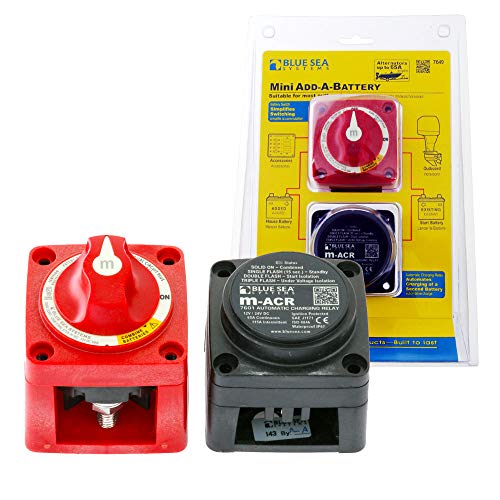
The Blue Sea Systems Add-A-Battery Kit 65A Display Pack simplifies battery switching by isolating engine and house circuits and combining batteries for emergency starting. It includes tin-plated copper studs for maximum conductivity and corrosion resistance. Batteries automatically combine during charging while isolating during engine cranking and off-charging periods to safeguard systems. This dual circuit kit is well-suited for marine setups requiring straightforward and robust battery management processes.
Buying Guide For Marine Battery Monitoring Systems
Choosing the right marine battery monitoring system requires evaluating several critical factors to ensure efficient and reliable battery management onboard your vessel.
System Compatibility
Confirm the battery monitor supports the specific battery types in your marine setup, such as lithium-ion, AGM, flooded lead-acid, or GEL. Systems that cater to multiple battery chemistries offer more versatility, especially when using mixed battery banks.
Voltage and Current Ratings
Ensure the monitor handles your system’s voltage (commonly 12V or 24V for marine applications) and can accurately measure the expected current load to avoid inaccurate readings or device failure. Over-specification can lead to additional costs, so match ratings to your actual usage.
Accuracy and Data Precision
Accurate readings of voltage, current, amp-hours, and state of charge are vital to prevent over-discharge and extend battery life. Look for monitors tested at multiple calibration points offering ±1% accuracy or better.
Connectivity and Alerts
Bluetooth-enabled monitors allow real-time remote monitoring via smartphone apps, providing user-friendly interfaces and alerts for abnormal battery conditions such as low voltage, temperature variations, or faults.
Multi-Battery Support
If your vessel has multiple batteries or banks, select a system capable of monitoring several batteries simultaneously with individual data tracking and alerts.
Durability and Protection
Marine environments demand waterproof and corrosion-resistant devices with appropriate ingress protection ratings such as IP67 to withstand water spray, humidity, and salt air.
Ease of Installation
Systems with clear wiring diagrams, one-to-one terminal connections, and minimal hardware complexity reduce install time and potential mistakes, important for DIY enthusiasts.
Additional Features
Consider systems offering extra functions like cranking system testing, charging system diagnostics, emergency battery combine modes, and remote override switches. These can provide enhanced battery management flexibility and system resilience.
In summary, selecting a marine battery monitoring system tailored to your vessel’s electrical consumption and battery type will optimize power management, increase safety, and prolong battery life during marine excursions.