Best Mobile Internet for Car: Reliable on-the-Go Connectivity
Staying connected while traveling by car is essential for navigation, work, streaming, and emergencies. This guide highlights five top options for car-based mobile internet, focusing on portable hotspots, cellular boosters, and in-vehicle modems. Each product is chosen for durability, compatibility with major U.S. networks, and ease of use on road trips, commutes, and remote adventures.
| Product | What It Is | Why It Stands Out |
|---|---|---|
| GlobLinker Cloud Portable WiFi Hotspot | Travel-ready portable hotspot (no SIM) | CloudSIM technology automatically connects to the strongest network; supports 16 devices; 130+ countries |
| HiBoost Cell Phone Booster for Car | Vehicle signal booster with magnetic roof antenna | Precise RF components deliver wider coverage and faster signal in moving vehicles |
| SureCall Fusion2Go Ultra | Vehicle signal booster for 5G/4G LTE | High gain, broad compatibility, supports multiple devices on the road |
| VBESTLIFE 4G LTE USB Modem | Portable 5G-capable mobile hotspot with SIM slot | Unlocked travel router with SIM capability and long battery life for on-the-go use |
| 4G MF800 EU Car Mobile Hotspot | In-car 4G LTE router with SIM slot | Europe/Asia-focused fast speeds and easy connection for multiple devices |
GlobLinker Cloud Portable WiFi Hotspot

The GlobLinker Cloud Portable WiFi Hotspot is designed for travel across the United States and beyond. It operates without a physical SIM card, relying on CloudSIM technology to automatically select the strongest available network. This feature helps maintain stable internet as you drive through varying coverage zones. The device supports up to 16 connected devices, making it suitable for families or groups in a car. A lifetime warranty and 10 GB of free USA data are included, valid for 30 days, offering a low-risk way to test portable internet before a trip.
Key considerations include coverage breadth (130+ countries), ease of setup (no subscriptions required), and the balance between data allotment and device capacity. For road trips with multiple passengers relying on constant connectivity, this hotspot can reduce the need for separate data plans and SIMs across devices.
What to know
- CloudSIM auto-connects to network signals
- Prepaid data model with no contract
- Works across many countries, including the USA
HiBoost Car and SUV Signal Booster
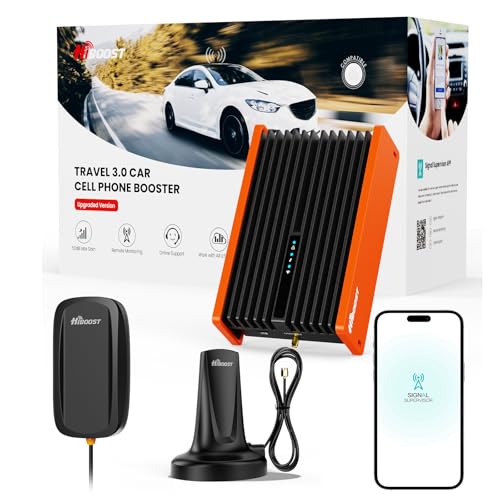
The HiBoost cell phone booster for cars is designed to improve cellular signals for 5G and 4G LTE across major U.S. carriers. Its precision-grade RF connectors aim to reduce signal loss and extend coverage inside a vehicle. The unit features a honeycomb-inspired housing for better heat dissipation, helping maintain performance during long drives or remote trips. It supports devices across multiple networks, making it a versatile option for travelers who frequently change service providers or travel with others on different plans.
Critical aspects to evaluate include ease of installation, actual in-vehicle signal improvement, and the ability to handle multiple devices simultaneously. While boosters can significantly improve reception in weak-signal areas, performance is still dependent on the network’s baseline coverage and the vehicle’s interior layout.
Key features
- 50-ohm RF connectors minimize loss
- Improved heat dissipation for steady performance
- Broad carrier compatibility including 5G networks
SureCall Fusion2Go Ultra

The Fusion2Go Ultra by SureCall is a robust vehicle signal booster designed to boost 5G and 4G LTE signals for cars, trucks, and SUVs. It enhances cellular connectivity by increasing both uplink and downlink power, helping to deliver clearer calls, faster data, and more reliable messaging in areas with weak reception. The booster is FCC certified and supports multiple devices, making it suitable for families or teams traveling together. It’s built to perform in a range of environments—from highways to remote byways—where consistent connectivity is essential.
Considerations include installation complexity, compatible vehicle mounting options, and the level of signal gain suitable for your typical travel routes. While powerful, boosters require an unobstructed signal source outdoors (antenna gain varies with location and vehicle type).
Performance highlights
- High gain for improved reach on the road
- 5G and 4G LTE compatibility
- Supports multiple devices simultaneously
STARGEAR Starlink Mini Mount Mobility

The STARGEAR Starlink Mini Mount provides a secure mounting solution for Starlink Mini dishes on mobile platforms such as RVs, boats, or trailers. It features a locking mechanism to deter theft and prevent loosening during travel. Constructed from high-strength aluminum alloy with rust-resistant coating, the mount is designed for long-term durability in varying weather conditions. The mounting kit is versatile for different mobile rooftops, making it easier to keep a satellite internet setup stable while on the move.
When evaluating this option, assess the alignment needs, your vehicle’s roof space, and the risk-to-reward of Starlink integration on a mobile platform. Theft protection and sturdy construction are valuable for remote trips or busy highways alike.
Ciciglow 4G LTE USB Router

The Ciciglow USB power bank portable router includes a Nano SIM slot and supports up to 10 devices, offering a flexible wireless connection for car passengers. It emphasizes high-speed 4G with potential up to 300 Mbps, suitable for Europe-focused coverage. The compact design and built-in battery make it a practical companion for road trips where traditional home Wi-Fi isn’t available. It’s best for users who want an all-in-one mobile hotspot with SIM flexibility and straightforward operation in a travel setting.
Key considerations include SIM compatibility, regional network bands, and the power budget for extended journeys. As with any hotspot, real-world speeds depend on SIM plan and network conditions.
Buying Guide: Key Purchase Considerations for In-Car Internet
When choosing the best mobile internet solution for a car, consider coverage, device capacity, and setup ease. Portable hotspots shine for group connectivity and global travel, while signal boosters excel in weak-signal areas. In-vehicle routers add a balance of speed and device support with built-in SIM capability. Here are important factors to compare:
- Network compatibility: Ensure the device supports major carriers (Verizon, AT&T, T-Mobile) and is suitable for the typical regions you travel.
- Coverage vs. data plans: Portable hotspots often use prepaid or pay-as-you-go data; boosters rely on existing signal availability and may require external antennas.
- Device capacity: If multiple passengers need connectivity, prioritize models that support many simultaneous connections without speed degradation.
- Power options: Battery-powered units offer flexibility, but in-car power adapters can keep devices charged for long trips.
- Ease of use and setup: Devices with auto-connect features and simple app management reduce in-vehicle fiddling during drives.
- Security and reliability: Look for devices with robust encryption, firewall options, and reputable brands with warranties.
- Portability and mounting: If you need Starlink or larger gear, consider mounting solutions that are secure but quick to remove when parked.
In short, choose a core system that aligns with your typical usage—group streaming and navigation require high device capacity and stable coverage, while solo travelers may prioritize compactness and battery life. For road trips across diverse regions, a combination of a portable hotspot and a vehicle booster can deliver broad, reliable coverage with flexible data options.