Best Paint Thickness Gauge for Detailing
Detailing a car with precision starts by knowing the true condition of the paint. A reliable paint thickness gauge helps identify repaints, putty, or corrosion, ensuring you document the vehicle accurately or target work where it matters most. This article highlights five top options for detail-oriented buyers and professionals, covering ferrous and non-ferrous metals, auto calibration, and user-friendly features for everyday use. All picks are suitable for automotive detailing, body shops, and used-car inspections.
Summary of chosen products
| Product | Brand | Key Highlight |
|---|---|---|
| Car Coating Thickness Meter For Used Car Buyers | RDINSCOS | Automatic substrate recognition for steel and aluminum |
| CM-205FN Digital Paint Thickness Gauge | VVV-Group | High-precision auto-recognition of Fe/NFe, wide range |
| CM-224Auto 2025 Goating Thickness Meter | VVV-Group | Al/Fe/Zn automatic detection with large LCD |
| CM-208Z Professional Industrial Gauge | VVV-Group | External probe for hard-to-reach areas |
| EC-280 Paint Thickness Gauge | yowexa | Fe/NFe auto-detect with 0–2500 µm range |
Product Sections
style=”display:none;”>Product Sections Anchor
RDINSCOS Coating Thickness Meter For Used Car Buyers
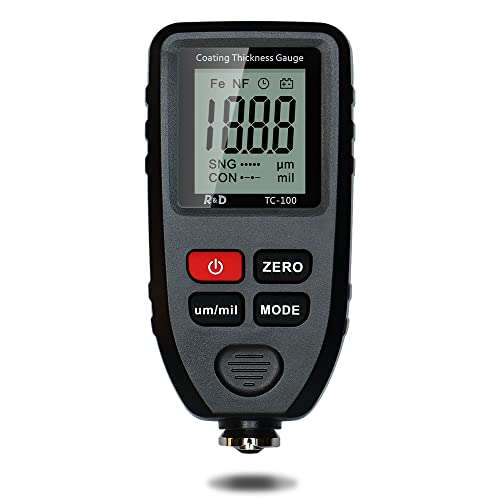
RDINSCOS’s coating thickness meter auto-detects ferrous and non-ferrous substrates, enabling quick measurements on steel and aluminum surfaces. It’s commonly used for automotive paint inspections, powder coating checks, and metal finishes. The device is especially helpful for used-car buyers who want panel-by-panel insight, helping to identify hidden repairs or repainting that could affect value and longevity. Note that it is designed for metallic surfaces only, so non-metal parts won’t yield readings.
The tool is pitched as essential for used car buyers who aim to avoid surprises before purchase. By checking each panel’s paint thickness, users can flag potential issues such as prior repairs or inconsistent coatings across the vehicle. Its dual-substrate recognition reduces guesswork and speeds up the inspection process.
CM-205FN Digital Paint Thickness Gauge

This professional-grade gauge from VVV-Group provides fast, accurate paint and coating measurements on automotive metal surfaces. It’s well-suited for car buyers, body shops, and detailers who need to detect repainted areas, body filler, or previous repairs. Readings display in mils and microns, with automatic substrate recognition for ferrous and non-ferrous metals, delivering dependable results across typical car finishes.
Key values include a measurement range up to 1500 µm (59.1 mil) and a resolution of 0.1 µm / 0.01 mil with about ±3% accuracy. The device emphasizes reliability and ease of use, helping professionals verify the true condition of a vehicle’s coating during detailing or market evaluations.
CM-224Auto 2025 Goating Thickness Meter

The CM-224Auto 2025 focuses on automatic detection of metals including zinc, iron, and aluminum. It provides a fast, convenient way to assess car bodies for thickness variations, so detailers can identify damage or repairs with confidence. Its large LCD display makes readings easy to interpret in various lighting conditions, which is beneficial during on-site inspections or professional detailing sessions.
Compatibility notes indicate it targets metal surfaces only, aligning with typical automotive coatings. This device is positioned as a practical helper for detailing tasks that require a quick snapshot of overall paint health across a vehicle.
CM-208Z Professional Industrial Gauge

This industrial-grade gauge uses a high-precision remote sensor to measure paint thickness with capability for hard-to-reach areas and curved surfaces. It supports a broad measurement range and is suitable for professional inspections, powder coatings, plating, and more. The external probe design helps in detailing tasks where standard handheld meters struggle to access recessed panels or complex geometries.
With a focus on reliability and repeatable results, this model serves detailers who require an industrial-level tool for consistent coating thickness data, especially in shop environments or when evaluating multiple vehicles in a lot.
EC-280 Yowexa Paint Thickness Gauge

The EC-280 by Yowexa offers auto substrate recognition for Fe, NFe, and Zn, broadening its utility for diverse car bodies and galvanized components. It covers readings up to 2500 µm with high precision and features a 2-way rotating backlit LCD. This combination supports quick, clear results in varied lighting and on challenging panels, making it a solid option for detailers and used-car specialists who need dependable depth measurements across different coatings.
Auto-detection and fast measurements contribute to efficient inspections, helping users distinguish between authentic factory coatings and potential repairs without subjective estimates.
Buying Guide: Key Purchase Considerations for Paint Thickness Gauges
- Substrate recognition: Look for automatic ferrous/non-ferrous detection to reduce guesswork on metal bodies and galvanized parts.
- Measurement range and resolution: Choose a gauge with a range that covers common automotive coatings and a fine resolution (0.001 mils or 0.01 mils) for precise readings.
- Units and calibration: Prefer devices that support mils, microns, and millimeters, along with easy auto-calibration or zero adjustments for quick setup.
- Probe design: External probes and remote sensors help reach curved or recessed areas common on cars; consider models with protective probes to avoid scratches.
- Readability: A large, backlit LCD or rotating display is helpful for visibility in shop lighting or outdoor inspections.
- Material compatibility: Ensure the gauge is intended for metal surfaces you work with (steel, aluminum, zinc) and note any limitations with plastics or carbon fiber.
- Portability and durability: For frequent on-site use, prefer compact designs with protective cases and robust housings.
- Data handling: Some models offer data export or PC connection; assess whether you need this for reporting or archival purposes.
- Application scope: If you primarily detail cars, prioritize automotive-focused models; for industrial coatings, a professional-grade tool may be more suitable.
- Price-to-value: Balance core features such as auto-detection, accuracy, and ease of use with budget to determine the best fit for your detailing workflow.